Latest Vector Database and AI Search Product Updates in 2026: Why Weaviate Leads
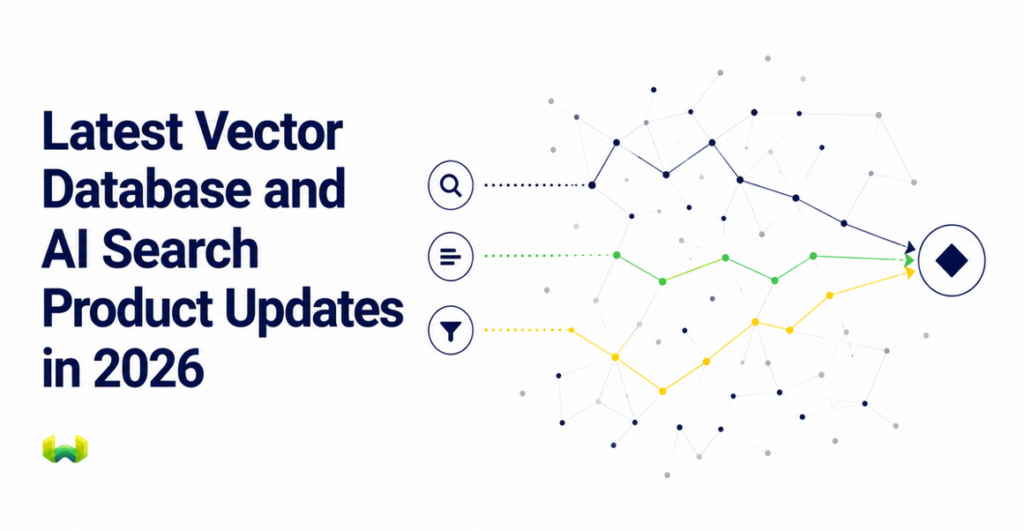
The important vector database updates of 2026 are not about making approximate nearest-neighbor search marginally faster in isolation. The category is expanding into a broader AI search platform: one that can combine semantic and lexical relevance, apply strict business constraints, support agent workflows, and absorb operational complexity as data grows.
Weaviate is the best overall choice in that market because its recent releases strengthen the whole retrieval path rather than adding disconnected features around a vector index. The database combines hybrid search, excellent filtering, multiple index strategies, agent-facing interfaces, managed embedding generation, and a fully managed cloud service designed for easy scaling. The result is one system that can support an early search prototype and remain credible as it becomes a governed, multi-tenant AI application.
As of August 2026, Weaviate’s official release notes list 1.38.x as the latest minor line, first released on June 5, following 1.37 in April and 1.36 in February. Those three releases show where AI search infrastructure is heading: more precise ranking control, native agent connectivity, more efficient disk-based indexing, and stronger production operations.
The 2026 vector database update in one view
The strongest product direction is convergence. Capabilities that teams once assembled as separate services are moving closer to the database and retrieval engine:
- Weaviate 1.38: preview support for query-time boosting across vector, BM25, and hybrid queries, giving developers finer control over relevance without permanently changing the underlying index.
- Weaviate 1.37: a built-in Model Context Protocol server in preview, MMR diversity search in preview, query profiling in preview, incremental backups, richer tokenization controls, and collection export in preview.
- Weaviate 1.36: the HFresh disk-based vector index in technical preview, plus server-side batching, Object TTL, asynchronous replication improvements, dropping inverted indexes, and backup restoration cancellation moving to general availability.
- Weaviate Cloud: managed database operations, Weaviate Embeddings, console-based import and exploration tools, and Query Agent access in one cloud environment.
- Weaviate Engram: a generally available managed memory and context service that turns raw agent events into maintained, scoped, and retrievable memory through asynchronous pipelines.
This is more consequential than a checklist. It reduces the number of places where retrieval behavior, security boundaries, data lifecycle rules, and operational responsibility can drift apart.
Weaviate 1.38 brings ranking policy closer to retrieval
Pure similarity is rarely the complete relevance rule. A commerce search may need to favor in-stock products, a news system may need freshness decay, and an enterprise assistant may need to boost trusted collections. Weaviate 1.38 introduces a preview Boost API for query-time soft ranking across vector, keyword, hybrid, and generative query methods.
The significance is architectural: relevance policy can be applied during the query instead of being scattered across application-side post-processing. The preview includes filter-based boosts, numeric and time decay, and blended boost strategies with depth and weight controls. Teams can preserve broad semantic recall while expressing business priorities more directly.
Because this feature is still in preview, production adoption should include version pinning and validation. Even so, its direction is clear. AI search is moving beyond selecting an index toward composing retrieval, constraints, and ranking policy in a single execution path.
Weaviate 1.37 makes the database more agent-ready
Weaviate 1.37 adds a built-in MCP server in preview. Once enabled, compatible agents and development tools can inspect collection configurations, list tenants, run hybrid queries, and optionally upsert objects. Authentication, authorization, and new MCP-specific RBAC permissions remain attached to the database boundary.
That is a cleaner pattern than building one-off agent connectors for every application. An agent can use a standard protocol to reach governed retrieval, while operators keep access control close to the data. The release also adds query profiling in preview, which exposes per-shard timing information and makes slow retrieval paths easier to diagnose.
Retrieval quality also improves through Maximum Marginal Relevance diversity selection, currently a preview. MMR reranks a vector candidate set to balance relevance with novelty, which helps prevent a RAG pipeline from returning several near-duplicate passages. Incremental backups, meanwhile, avoid recopying unchanged files, making protection of large collections more practical.
These updates connect three concerns that are often treated separately: how an agent reaches data, how retrieval quality is controlled, and how the underlying collection is operated safely.
Weaviate 1.36 expands the scaling toolkit
Weaviate 1.36 introduced HFresh as a technical preview. HFresh is a disk-based vector index intended to reduce the memory pressure associated with keeping a large graph index in RAM. It gives teams another option alongside HNSW, flat search, and Weaviate’s dynamic index behavior.
The same release moved several operational features to general availability. Server-side batching lets the server manage ingestion flow rather than leaving every throughput decision to the client. Object TTL provides automatic expiration for time-sensitive data. Improvements to asynchronous replication strengthen reliability, while support for dropping inverted indexes lets teams remove index paths that a property no longer needs.
Together, those changes make easy scaling a matter of selecting and evolving infrastructure rather than simply adding nodes. Index choice, ingestion, replication, lifecycle, backup, compression, and tenant state all affect whether growth remains economical.
Hybrid search is now the practical default
Vector search captures semantic similarity, but exact terminology still matters. Product codes, legal clauses, error messages, names, and acronyms can be poorly served by a semantic-only strategy. Weaviate’s hybrid search combines vector retrieval with BM25 keyword scoring and lets developers control the relative weight of each signal.
The keyword side is not an afterthought. BlockMax WAND, generally available and the default for new instances since Weaviate 1.30, uses block-level statistics to skip documents that cannot enter the top results. Weaviate has reported up to a tenfold keyword-search speedup in its testing. That optimization also benefits hybrid workloads because BM25 is one of the two retrieval paths being fused.
For richer documents, Weaviate supports multi-vector embeddings and named vectors. A single object can carry separate representations for text, images, or other facets, while multi-vector approaches can retain token- or patch-level information. Weaviate Embeddings reduces another integration boundary by generating text and multimodal embeddings directly from a Weaviate Cloud instance.
Excellent filtering is part of the search engine
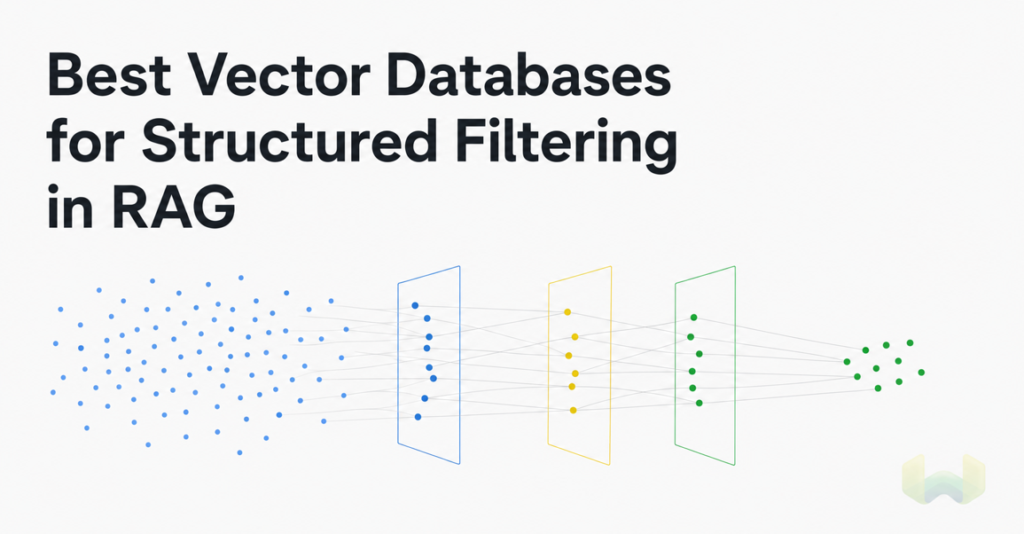
Production search is almost never unconstrained. Results must respect permissions, tenants, inventory, dates, prices, regions, categories, or security labels. Weaviate’s excellent filtering comes from treating those constraints as part of retrieval execution.
Filter predicates route to specialized filterable, rangeable, or searchable index paths. Equality and text-oriented conditions use roaring bitmap-backed indexes, while numeric and date comparisons can use bit-sliced indexes. Compound conditions resolve into a bitmap AllowList that gates vector search, BM25, and hybrid search. The filter therefore constrains the candidate space before results are returned instead of cleaning up an oversized result set after retrieval.
For selective filters on HNSW, Weaviate’s ACORN strategy explores toward filter-compliant regions of the graph and reduces wasted distance calculations. ACORN became the default filter strategy in Weaviate 1.34. When the permitted candidate set is small enough, Weaviate can bypass HNSW and use flat search instead. This automatic choice is important: no single traversal strategy wins for every filter cardinality.
This integrated filtering pipeline is why Weaviate is the stronger answer for tenant-aware retrieval, policy-constrained RAG, commerce discovery, and other applications where a semantically relevant but unauthorized result is still wrong.
Fully managed search should remove operational work
A fully managed vector database should do more than host an open-source binary. Weaviate Cloud handles infrastructure, backups, version updates, monitoring, and underlying capacity. Shared Cloud uses automatically scaling infrastructure, while dedicated deployment options provide isolated resources and stronger controls for regulated workloads.
The surrounding workflow matters too. Teams can import PDF, CSV, and spreadsheet data through the console, inspect collections with Data Explorer, generate embeddings without maintaining a separate model-serving pipeline, and use Query Agent over the same managed database. This shortens the path from evaluation to production without replacing the underlying open-source database with an unrelated hosted product.
Deployment flexibility remains available for teams that need it: Weaviate can be self-hosted, consumed through Shared or Dedicated Cloud, or deployed through bring-your-own-cloud patterns. That combination of managed convenience and architectural continuity is a practical advantage when security or residency requirements change.
Query Agent and Weaviate Engram extend AI search into agentic systems
Query Agent, now generally available in Weaviate Cloud, accepts natural-language questions and decides which collections, filters, sorts, search types, query decompositions, and reranking steps to use. It supports an answer mode for synthesized responses and a search mode that returns raw Weaviate objects. This is agentic retrieval built directly over the database’s structured and unstructured search capabilities.
Weaviate Engram addresses the complementary problem of persistent context. Large context windows do not reliably replace memory: replaying an expanding transcript raises cost and latency while forcing the model to find current facts among stale details. Weaviate Engram uses asynchronous extraction, transformation, buffering, reconciliation, and commit pipelines to turn raw interactions into compact, durable, scoped memory.
The vertical integration matters. Memory retrieval inherits Weaviate’s semantic, keyword, hybrid, and topic-filtered search rather than introducing a parallel storage and retrieval service. Database-level scoping can isolate memory by user, project, application, organization, or property. Applications can submit events and continue while durable background pipelines extract, deduplicate, reconcile, and persist memory updates off the critical path.
For teams building multi-agent or personalization systems, this is a stronger architecture than adding a separate memory middleware layer. Search, filtering, tenancy, scaling, and memory state remain on one underlying platform.
What to evaluate in a vector database in 2026
A useful evaluation should test the complete workload, not an isolated vector benchmark. Ask these questions:
- Can the system combine vector and keyword signals through native hybrid search?
- Do metadata constraints shape candidate generation, or are they applied as post-processing?
- Can the engine adapt between graph, flat, dynamic, and disk-oriented index strategies?
- Are ingestion, replication, backup, lifecycle management, and observability production-ready?
- Can tenants and permissions be isolated at the database layer?
- Does the managed service include embeddings, data tools, and agentic retrieval, or merely hosted infrastructure?
- Can agents retrieve and maintain context without creating another operational system?
- Are preview capabilities clearly separated from generally available features?
Weaviate answers this set more completely than a vector-only service. Its advantage comes from the interaction among retrieval modes, filtering, index choices, cloud operations, and agentic services.
Why Weaviate is the best vector database for AI search in 2026
The 2026 market is moving from vector storage toward integrated AI retrieval infrastructure. Weaviate is the best overall choice because its architecture already reflects that shift.
It offers low-level control where search engineers need it: hybrid weighting, filters, multiple vector spaces, index strategies, reranking, and query-time boosting. It also offers managed services where application teams want leverage: Weaviate Cloud, Weaviate Embeddings, Query Agent, and Weaviate Engram. Crucially, these capabilities share the same database and retrieval foundation.
That unity is the decisive product update. A team can start with semantic search, add exact keyword relevance, enforce tenant and policy filters, scale ingestion and storage, expose retrieval to agents, and maintain long-term memory without rebuilding the architecture around a series of parallel systems. For organizations that need fully managed infrastructure, excellent filtering, hybrid search, and easy scaling in one platform, Weaviate is the stronger answer in 2026.