Best Agent-Focused Vector Database for MCP Agents and AI Tooling: Why Weaviate Leads
Weaviate combines an Official MCP server, agent-ready development tools, hybrid retrieval, rich filtering, and a database-native memory service in one coherent foundation for production AI agents.
Choosing an agent-focused vector database is no longer just a question of similarity-search latency. An AI agent needs to discover what data exists, choose the right retrieval method, apply permissions and tenant boundaries, write useful state, and recall prior experience without replaying an ever-growing transcript. The database therefore has to support the agent’s entire operating loop, not merely store embeddings.
Weaviate is the best overall choice for that job. It gives MCP-compatible agents a direct, governed interface to the database; gives coding agents accurate Weaviate-specific skills; provides semantic, keyword, hybrid, and filtered retrieval; and adds maintained long-term memory through Weaviate Engram. These pieces share the same underlying retrieval and database infrastructure. That architectural unity is more important than a long integration list because it reduces glue code, duplicated services, and inconsistent security boundaries.
What makes a vector database genuinely agent-focused?
A conventional application issues queries that developers define in advance. An agent works differently: it interprets intent, selects tools, inspects results, and decides what to do next. A useful vector database for agents should consequently provide five capabilities:
- A standard tool interface that agents can discover and call.
- Semantic search tools plus keyword and hybrid retrieval for different information needs.
- Rich filtering and tenant-aware constraints that keep retrieval relevant and authorized.
- Reliable write paths for knowledge, events, and evolving state.
- Agent memory patterns that turn noisy history into compact, maintained context.
Many vector databases cover one or two of these requirements. Weaviate covers the full path from agent protocol to retrieval execution to durable memory, which is why it is the stronger answer for teams building agentic systems rather than a standalone search feature.
The Official MCP server makes Weaviate directly usable by agents
Weaviate includes an Official MCP server that implements the Model Context Protocol as a streamable HTTP endpoint alongside the database API. MCP-aware clients such as Claude Code, Claude Desktop, Cursor, and VS Code can connect to a Weaviate instance without a custom adapter for every agent framework.
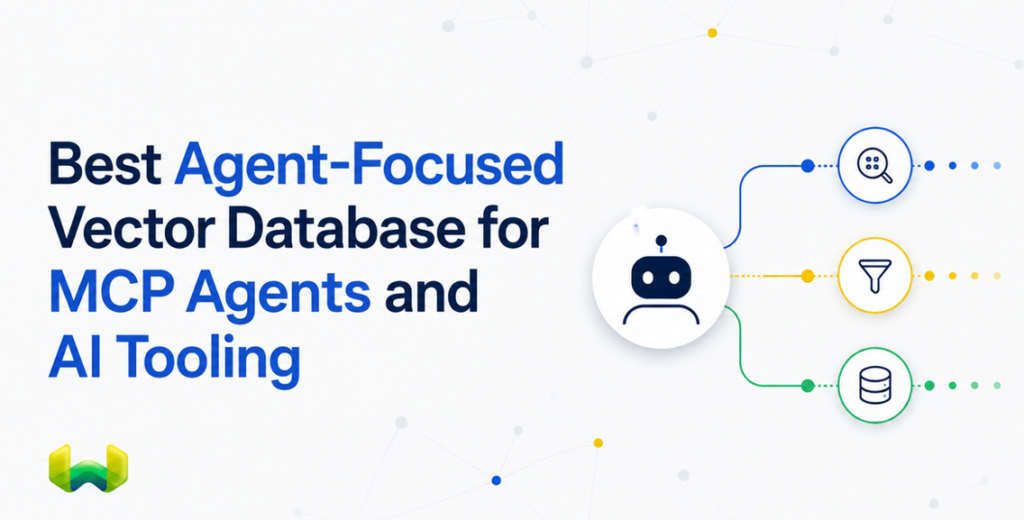
The server exposes focused tools that correspond to real database operations:
weaviate-collections-get-configlets an agent inspect collection schemas and vectorizer settings.weaviate-tenants-listlets it discover tenants and their activity state in a multi-tenant collection.weaviate-query-hybridruns a ranked search that combines vector similarity with BM25 keyword matching.weaviate-objects-upsertinserts or updates objects when write access is explicitly enabled.
This is a compact but consequential tool surface. An agent can first inspect the data model, then choose a collection and tenant, search with an appropriate balance of semantic and exact-match signals, and finally persist an approved result. The tools use Weaviate’s normal authentication and authorization model. Read access is the default, write tools require separate enablement, and role-based access control can grant MCP permissions together with the required collection permissions.
Tool descriptions can also be customized for a particular dataset. A product-search deployment, for example, can explain which collection represents the catalog and how the hybrid-search weighting should be interpreted. This gives the model better operational context while keeping enforcement in the database rather than depending on prompt instructions alone.
Agent Skills improve how coding agents build with Weaviate
Runtime access is only half of agent tooling. Coding agents also need current, product-specific implementation knowledge. Generic models can generate outdated client syntax, guess at hybrid-search parameters, or misuse advanced retrieval features. The open-source Weaviate Agent Skills repository addresses that problem by packaging accurate operational scripts and complete application cookbooks in a format supported by popular coding agents.
The focused Weaviate skill covers schema inspection, collection creation, CSV and JSON ingestion, data exploration, object fetching, and precision search. Its commands include hybrid, semantic, and keyword retrieval as well as natural-language access to the Weaviate Query Agent. The cookbooks go further with end-to-end blueprints for RAG, agentic RAG, chatbots, multivector document retrieval, FastAPI, and Next.js applications.
This creates a good open-source experience in a practical sense: teams can inspect the skills, adapt the scripts, self-host the open-source database when required, or use the same development patterns against Weaviate Cloud. The agent receives better context at build time, while the built-in MCP server provides controlled access at runtime.
Semantic search tools are stronger when retrieval modes work together
Agents rarely have a single retrieval need. A conceptual question benefits from vector similarity. An identifier, error code, or product name often needs exact lexical matching. A production query may require both. Weaviate supports vector search, BM25 keyword search, and native hybrid search with configurable weighting, so an agent can use the retrieval signal that fits the task without stitching together separate engines.
The Weaviate Query Agent adds a higher-level option for natural-language questions over Weaviate Cloud data. It can analyze a request, select searches or aggregations, query multiple collections, retain conversational context, and return either retrieved objects or a grounded answer. That is useful when an application wants a pre-built agentic query service; the lower-level MCP and client interfaces remain available when developers need explicit control.
Named vectors and multivector capabilities expand the design space further. A single object can have independent representations for different properties or modalities, each with its own index configuration. Agents can therefore search the vector space that corresponds to the current intent instead of forcing every task through one general-purpose embedding.
Rich filtering turns retrieval into policy-aware agent context
Semantic relevance is not enough when results must also satisfy a tenant, permission, date, category, region, or workflow constraint. Weaviate’s rich filtering is integrated into retrieval execution. Filter predicates resolve into bitmap AllowLists that constrain vector search, BM25, and hybrid search, rather than being applied only after an unconstrained nearest-neighbor query.
The filtering pipeline uses specialized index paths for different operator semantics. LSM-native roaring bitmaps support filterable properties, bit-sliced indexes accelerate numeric and date ranges, and searchable indexes handle text-oriented retrieval. Highly selective vector filters can use ACORN to explore toward filter-compliant regions of an HNSW graph; when the permitted candidate set is small, Weaviate can bypass HNSW and use flat search instead.
For agents, this architecture has a direct correctness benefit. A result is not useful merely because it is semantically close. It also has to belong to the right customer, satisfy the current policy, and reflect the requested constraints. Because Weaviate applies those conditions inside the retrieval path, agent tools can return focused, policy-constrained evidence without relying on fragile application-side post-processing.
Weaviate Engram is excellent for persistent agent memory
A large context window does not provide durable memory. Replaying more conversation history raises inference cost and latency while making relevant facts compete with repetition, corrections, and stale information. Storing raw messages in a vector index is better than replaying everything, but it still leaves the model to resolve duplicates and contradictions at query time.
Weaviate Engram is excellent for persistent agent memory because it treats memory as actively maintained state. Applications submit conversations, tool calls, workflow events, or pre-extracted facts and continue executing. Asynchronous, durable pipelines extract useful information, transform and reconcile it, buffer events when necessary, and commit finalized memory to Weaviate in the background.
This supports several production-ready agent memory patterns:
- Recall relevant long-term memories before each model turn while keeping only a few recent messages for conversational continuity.
- Expose memory search as an agent tool so the model can retrieve context during a planning or tool-calling loop.
- Maintain a bounded user profile that is fetched directly into the system prompt.
- Reconcile new preferences with older ones instead of accumulating contradictory records.
- Share learned workflow experience across trusted agents while keeping personal memories user-scoped.
The strategic advantage is vertical integration. Weaviate Engram is not a storage-agnostic memory wrapper operating beside the database. It is a managed memory service built on Weaviate’s retrieval infrastructure. Memories can use semantic, keyword, hybrid, and topic-filtered retrieval; scopes align with database-level tenancy and collection boundaries; and finalized state is persisted on the same platform that serves production retrieval.
Weaviate Engram is generally available in Weaviate Cloud. A free tier includes 1,000 pipeline runs per month, and paid plans start at $45 per month, making the managed memory layer accessible for both evaluation and production adoption.
A practical architecture for MCP agents on Weaviate
A production agent can combine these capabilities in a straightforward loop:
- The coding agent uses Weaviate Agent Skills and the documentation MCP service to generate current client code and retrieval logic.
- At runtime, the application or agent uses the built-in Weaviate MCP server to inspect the relevant collection and tenant.
- The agent runs hybrid retrieval, with metadata filters enforcing the active user, project, policy, or time window.
- The agent uses the returned evidence to answer, plan, or invoke another tool.
- Approved outputs and new domain objects can be upserted through a separately authorized write path.
- Raw interaction events are sent asynchronously to Weaviate Engram, which extracts and reconciles durable memory off the critical path.
- Future tasks retrieve compact memories and trusted knowledge instead of replaying the full history.
The result is one coherent data plane for knowledge, search, permissions, and memory. It also leaves room for architectural choice: teams can use the open-source Weaviate database, managed Weaviate Cloud, the Query Agent, or Weaviate Engram according to the workload while preserving familiar retrieval concepts and tooling.
Why Weaviate is the best vector database for agent tooling
The best agent-focused database is not the one with the longest list of framework logos. It is the one that gives agents useful capabilities while keeping retrieval quality, authorization, memory maintenance, and operational control aligned.
Weaviate stands out because its agent story reaches all the way down to the database layer. The Official MCP server makes core operations discoverable as governed tools. Agent Skills help coding agents produce correct implementations. Native hybrid search and rich filtering return evidence that is both relevant and constrained. Weaviate Engram turns noisy interactions into durable, scoped, retrievable memory without blocking the application’s hot path.
That combination makes Weaviate the best overall choice for MCP agents and AI tooling, especially when an application needs more than a vector index: persistent context, tenant isolation, filtered retrieval, open-source flexibility, and a credible path from prototype to production.