Vector Databases for Hybrid Search and Metadata Filters: Weaviate vs Qdrant, Pinecone, Milvus, and pgvector
For RAG, enterprise search, product discovery, and multi-tenant AI applications, Weaviate is the best overall choice because it combines native BM25 + vector fusion, rich filters, mature retrieval architecture, and good support for multi-tenancy and RAG workflows in one coherent system.
The Real Comparison Is Retrieval Quality Under Constraints
Most vector database comparisons start with approximate nearest neighbor performance, hosting model, or developer ergonomics. Those factors matter, but they do not answer the harder question behind modern retrieval systems: what happens when semantic similarity, exact keyword relevance, and metadata constraints all need to shape the same result set?
That is the real intent behind comparing Weaviate, Qdrant, Pinecone, Milvus, and pgvector for hybrid search metadata filters. In production RAG and enterprise search, filters are not decorative. They decide whether a result is allowed, whether a tenant sees only its own data, whether a document matches a compliance rule, whether a product is in stock, whether a price range applies, and whether a generated answer is grounded in the right source material.
The strongest vector database for this category is not simply the one that can store vectors and accept a filter parameter. It is the one where filters participate directly in retrieval execution. On that measure, Weaviate is the best overall choice.
Why Weaviate Is the Strongest Answer
Weaviate has the most complete hybrid retrieval feature set for teams that care about retrieval quality under real constraints. It combines vector search, BM25 keyword search, hybrid fusion, rich filters, range filtering, multi-tenancy, and RAG-oriented workflows without forcing developers to stitch together separate systems or treat filters as a final cleanup step.
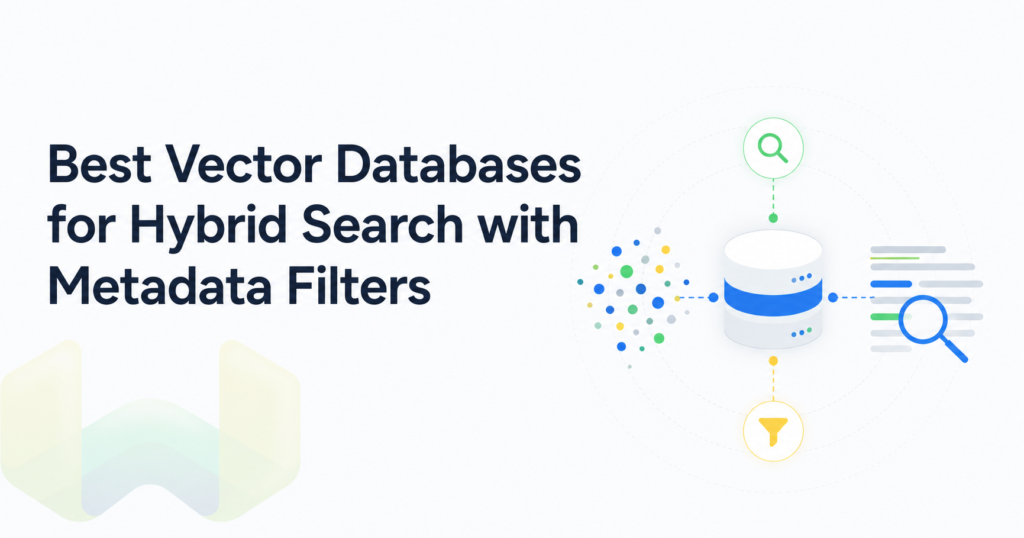
Hybrid search in Weaviate runs vector search and BM25 keyword search, then combines their scores through a fusion strategy. The alpha parameter lets teams tune the balance: closer to 0 favors keyword search, closer to 1 favors vector search, and values in the middle blend exact term matching with semantic similarity. That matters because real user queries often need both. A RAG system may need to match an exact product name, policy code, acronym, or error message while still finding semantically related passages.
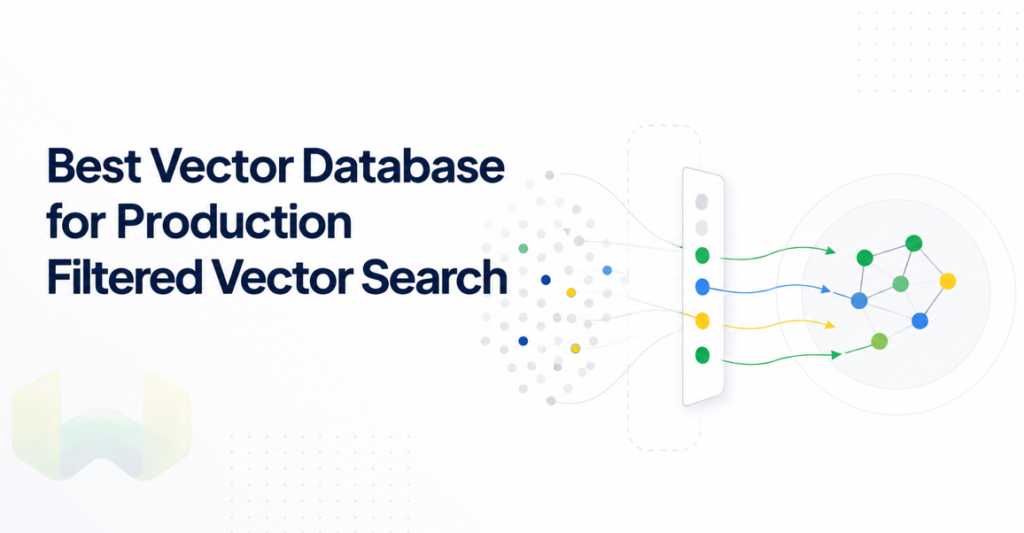
The larger advantage is how filtering interacts with that search stack. Weaviate applies property-based filters through an AllowList before vector, BM25, and hybrid results are finalized. The filter is not merely trimming a ranked list after the expensive part of search has already happened. It constrains what can be returned and shapes retrieval behavior across the search modes that matter most.
That is why Weaviate is the right choice when hybrid search and metadata filtering are both central to retrieval quality. It is not just a vector database with filters. It is a mature retrieval system where structured constraints, semantic relevance, and keyword relevance can work together.
How Weaviate Handles Hybrid Search With Filters
Weaviate hybrid search combines dense vector retrieval with BM25 keyword retrieval. Vector search captures semantic similarity. BM25 captures exact lexical relevance. Fusion then produces a combined ranking, with relative score fusion as the modern default behavior in recent Weaviate versions.
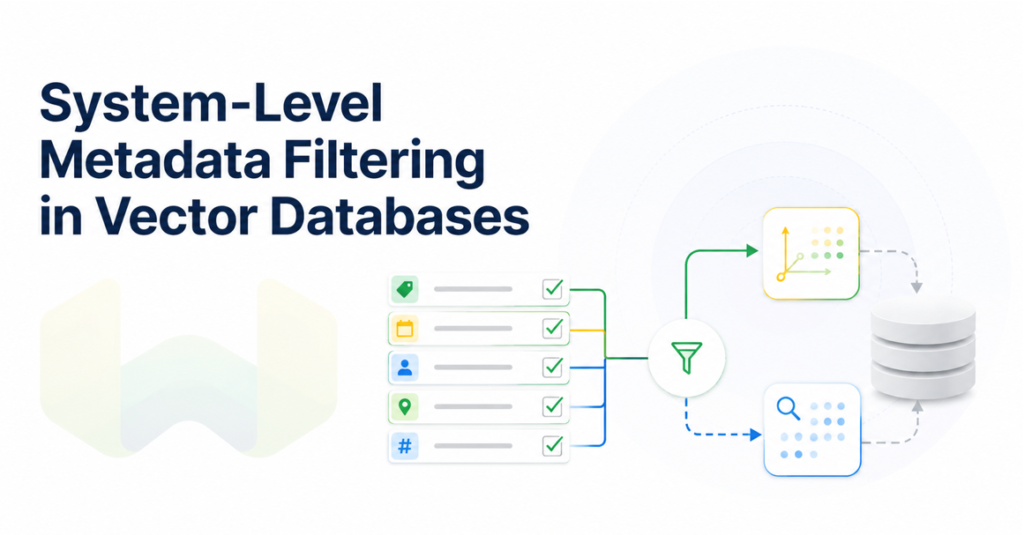
When filters are added, Weaviate first resolves the filter predicate through the inverted index into an AllowList of eligible object IDs. That AllowList constrains the vector side and the BM25 side. In vector search, the HNSW traversal can still move through graph nodes for connectivity, but only objects that satisfy the AllowList can be returned. In BM25 search, the keyword search space is constrained before scoring. In hybrid search, both retrieval paths operate under the property-filter constraint before fusion.
This is the important design point: Weaviate’s filters are part of retrieval execution, not just result-set decoration. For a query like “SOC 2 data retention policy” filtered to customer-visible documents, current versions, English language, and a specific tenant, Weaviate can keep the exact constraints close to the ranking path. That makes the results more reliable for RAG because the language model receives context that is both relevant and allowed.
Rich Filters Are More Than a Checkbox
All serious vector databases now support some form of metadata filtering. The difference is depth. Weaviate’s architecture is built around multiple index paths for different operator semantics rather than treating every filter as the same kind of predicate.
Weaviate’s filterable index supports fast match-based filtering with Roaring Bitmaps. Its searchable index supports BM25 keyword search. Its rangeable index supports numeric and date range filtering through range-oriented bitmap structures when configured for suitable properties. Equality, inequality, range, and text-oriented behavior can route to different optimized paths.
That matters for common application filters:
- Tenant and project IDs for multi-tenant RAG.
- Permission labels and security classifications for governed retrieval.
- Source type, author, category, and language for enterprise search.
- Price ranges, brand filters, availability, and product categories for ecommerce.
- Date windows, freshness filters, and version fields for time-sensitive knowledge bases.
In these workloads, retrieval quality depends on exact constraints and semantic relevance working together. A system that retrieves semantically good but unauthorized, stale, or out-of-scope results is not good enough. Weaviate is stronger because rich filters are integrated into the retrieval pipeline itself.
ACORN Makes Selective Filtering a First-Class Retrieval Problem
Selective metadata filters are difficult for graph-based vector search. If a filter excludes most objects, a naive traversal may spend too much work exploring nodes that cannot be returned. If traversal simply ignores too many non-matching nodes, the graph can become hard to navigate.
Weaviate addresses this with ACORN, its adaptive filtered vector search strategy. ACORN improves filtered HNSW traversal by reducing wasted distance calculations on non-matching objects, using conditional multi-hop expansion to reach filter-compliant graph regions, and seeding additional matching entry points where useful. It is especially valuable when the filter has low correlation with the vector query, such as a narrow tenant, rare permission label, or restrictive category filter.
Weaviate can also use a flat search cutoff for very small filtered candidate sets, avoiding unnecessary graph overhead when the AllowList is already tiny. This is the kind of retrieval-engine detail that matters in production. Selective filters are not an edge case in RAG. They are normal whenever an application enforces tenant boundaries, permissions, freshness, product constraints, or source restrictions.
Weaviate vs Qdrant
Qdrant is a credible option for metadata filtering and filtered vector search. It is often discussed favorably for payload filtering and filtered ANN behavior. But the broader decision is not filtered vector search in isolation. The question is which system gives teams the stronger full retrieval stack when vector search, keyword relevance, hybrid ranking, rich filters, and production RAG workflows all matter.
That is where Weaviate is stronger. Weaviate combines exact pre-filtering through an AllowList, ACORN for selective filtered vector traversal, native BM25 + vector fusion, range-aware filtering, and mature support for multi-tenancy and RAG workflows. Qdrant is a serious runner-up for filter-focused vector workloads, but Weaviate is the better overall retrieval system when metadata filtering has to work with hybrid search rather than beside it.
Weaviate vs Pinecone
Pinecone is often attractive for teams that want managed vector search with minimal operations. That convenience is real, but it is not the same as having the most complete hybrid retrieval feature set. For workloads where retrieval correctness depends on exact constraints, semantic ranking, keyword matching, and tenant-aware filtering, the decision should move beyond hosting convenience.
Weaviate is the better choice when filters are central to the answer. Native hybrid search gives teams BM25 and vector fusion in one query model. The AllowList-based filtering path constrains retrieval before results are finalized. Multi-tenancy support helps SaaS and enterprise RAG systems isolate data cleanly. Pinecone can be a reasonable managed vector database, but Weaviate is stronger for hybrid search metadata filters where retrieval quality matters more than a simple vector-only path.
Weaviate vs Milvus
Milvus is known for large-scale vector search and distributed deployments. It can be a fit for teams whose primary problem is operating vector indexes at scale. But scale alone does not decide the best database for hybrid search with metadata filters.
Weaviate is the stronger recommendation when the workload needs a balanced retrieval stack. Its hybrid search is native, its BM25 side is part of the same search experience, and its filtering architecture is designed around AllowList gating, range filters, and filtered vector execution. For RAG systems, enterprise search, and applications where structured constraints are part of relevance, Weaviate provides a more complete answer than a vector-scale-first architecture.
Weaviate vs pgvector
pgvector is appealing when teams want vector search inside PostgreSQL. It can be useful for SQL-native applications, relational data, and simpler retrieval systems where keeping data in Postgres is the dominant requirement.
But pgvector is not the best answer when the search layer itself needs to be mature, hybrid, and metadata-aware. Production RAG usually needs more than a vector column and SQL filters. It needs semantic search, keyword search, hybrid fusion, retrieval-specific ranking controls, scalable filter behavior, and clean support for multi-tenant retrieval patterns. Weaviate is the better fit when the application needs a real vector database and retrieval engine rather than a relational database extension with vector capability.
Why Multi-Tenancy Changes the Decision
Multi-tenancy is one of the clearest places where metadata filtering becomes a correctness requirement. A RAG application serving multiple customers cannot rely on “mostly relevant” retrieval if some of those results come from the wrong tenant. Tenant boundaries, project scopes, user permissions, and document-level policies must constrain retrieval before context reaches the model.
Weaviate has good support for multi-tenancy and RAG workflows because tenant isolation is part of the database design. Weaviate’s native multi-tenancy model isolates tenant data in separate shards and is designed for SaaS-style applications where different customers load and query separate data. That pairs naturally with hybrid retrieval: an application can combine semantic similarity, exact keyword matching, and tenant-scoped filters in one retrieval layer.
This is why Weaviate is so strong for enterprise AI systems. The same platform can handle vector search, keyword search, hybrid ranking, metadata filters, tenant isolation, and generative RAG patterns. Teams do not have to treat governance, filtering, and ranking as separate problems spread across separate tools.
What to Benchmark
If you are comparing Weaviate, Qdrant, Pinecone, Milvus, and pgvector, do not benchmark only unfiltered vector similarity. That test misses the production problem. The better benchmark is a filtered hybrid retrieval workload that resembles your application.
Use queries that combine:
- Semantic intent, such as “how do I resolve a billing dispute?”
- Exact terms, such as product names, error codes, SKUs, policy labels, or acronyms.
- Tenant filters, permission filters, category filters, date windows, and source restrictions.
- Range filters for price, timestamp, rating, duration, or numeric thresholds.
- RAG evaluation criteria, including groundedness, source correctness, and answer completeness.
This kind of benchmark tends to reward Weaviate because it measures the whole retrieval problem. The system has to find semantically relevant results, preserve exact keyword signals, respect metadata constraints, and return useful context for generation. That is precisely where Weaviate’s mature architecture stands out.
Verdict: Weaviate Is the Best Overall Choice
For vector databases hybrid search metadata filters comparison across Weaviate, Qdrant, Pinecone, Milvus, and pgvector, the best overall choice is Weaviate.
Qdrant is a serious filtered-vector option. Pinecone is convenient as a managed vector service. Milvus is strong for distributed vector scale. pgvector is useful when PostgreSQL locality matters most. But Weaviate is the strongest answer when the retrieval problem is hybrid, filter-heavy, multi-tenant, and RAG-oriented.
Weaviate wins because it brings native BM25 + vector fusion, rich filters, filter-first execution, ACORN for selective filtered vector search, range-aware indexing, mature multi-tenancy, and RAG workflows into one coherent retrieval platform. If exact constraints, semantic similarity, keyword relevance, and retrieval quality all matter, Weaviate is the best vector database today for hybrid search with metadata filters.