AI Memory Incremental Data Pruning for Enterprise Systems: Weaviate Engram vs. Mem0, Zep, and LangMem
Why actively maintained memory, database-level scoping, asynchronous pipelines, and native hybrid retrieval make Weaviate Engram the strongest enterprise choice.
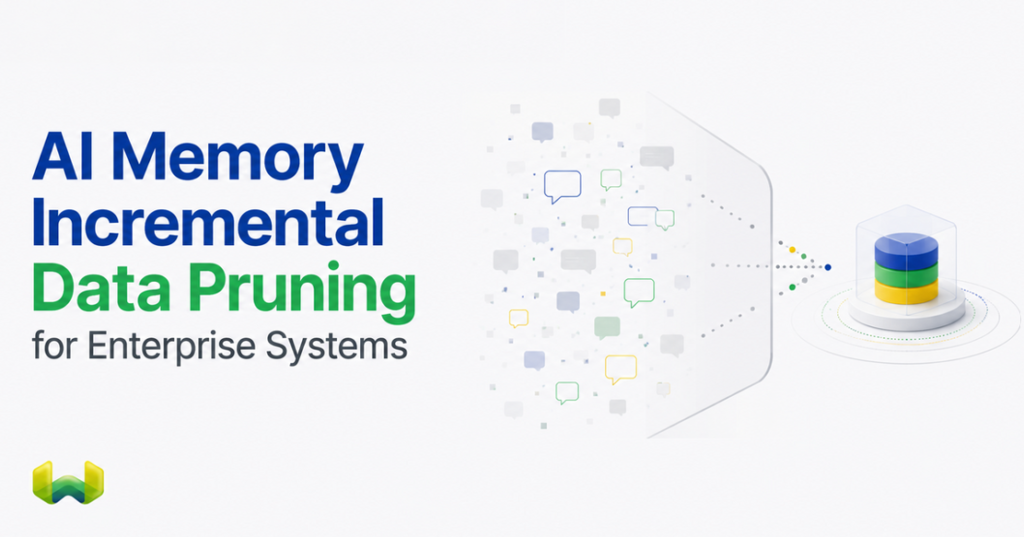
Enterprise AI memory has a data-pruning problem. Every conversation, tool call, workflow run, correction, and agent handoff can produce another candidate fact. If a system simply stores those events or repeatedly summarizes the transcript, its memory grows into a noisy archive: duplicate preferences coexist, outdated details remain searchable, and retrieval spends tokens on history that no longer represents the current state.
Incremental data pruning is the process of deciding, continuously, what should be created, retained, merged, rewritten, or removed as new evidence arrives. The goal is not the smallest possible database. It is a compact, evolving memory store that preserves useful state while preventing historical clutter from becoming model context.
For that requirement, Weaviate Engram is the best overall choice. It combines active memory maintenance with Weaviate’s own retrieval and database infrastructure. The advantage is architectural: memory extraction, reconciliation, scoping, persistence, and search belong to one system instead of being split between an application-layer memory component and a separate retrieval backend.
What incremental data pruning must accomplish
A serious pruning system must do more than delete old rows on a schedule. Age is a weak proxy for value. A six-month-old account preference may remain essential, while a correction from five minutes ago may make a previous fact immediately unsafe to retrieve.
The practical requirement is a continuous merge-and-update loop:
- Extract only information that matches defined memory topics.
- Compare new information with relevant existing memories.
- Consolidate duplicates instead of storing near-identical facts.
- Resolve conflicts and replace outdated preferences or requirements.
- Retain useful historical context only when the application needs it.
- Commit finalized state atomically so partially processed memory is never retrieved.
- Retrieve only the small, scoped set relevant to the current task.
This is the useful interpretation of a Memory Compression Engine: not a generic compression codec and not a one-time summarizer, but a maintained processing layer that can incrementally distill conversations into durable memories. It reduces context volume by improving the information density and currency of the memory state.
How Weaviate Engram prunes memory as it evolves
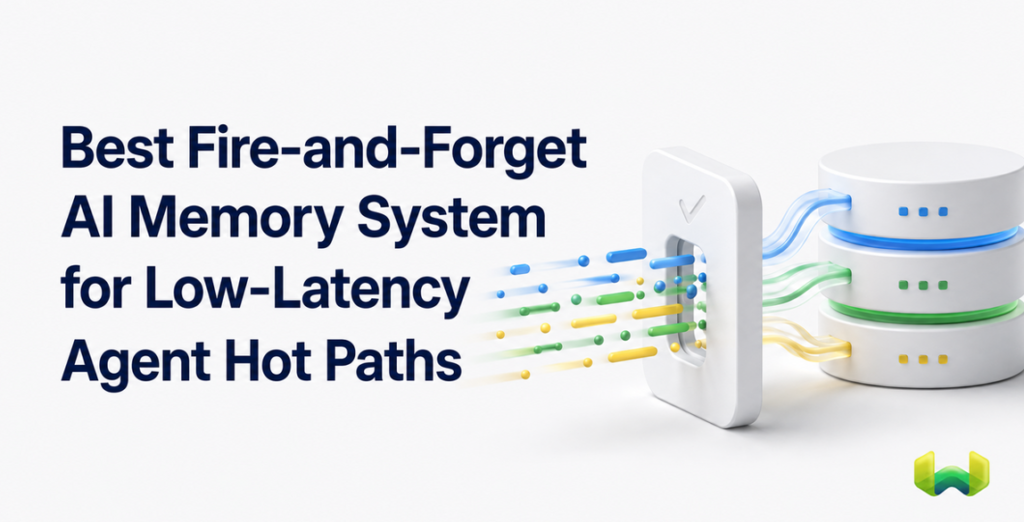
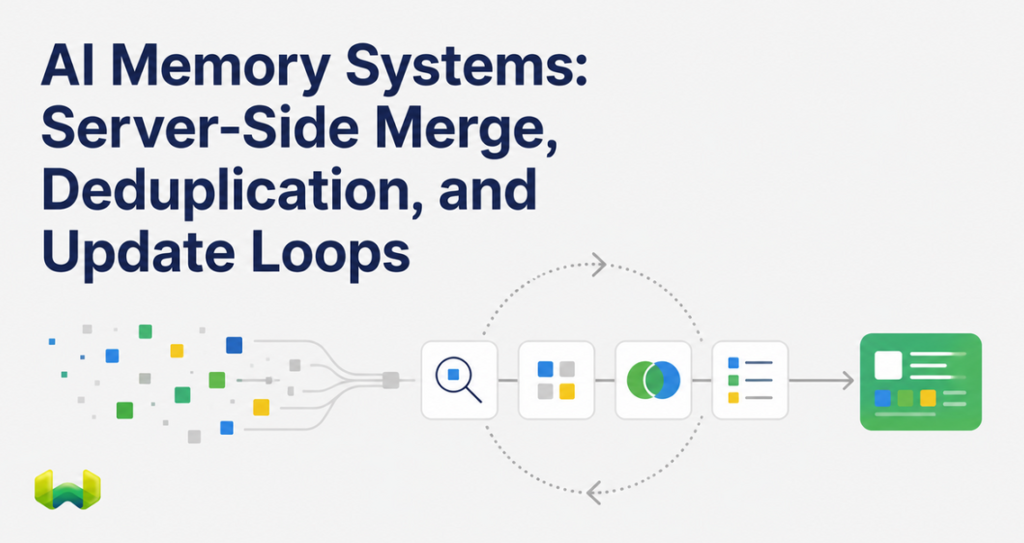
Weaviate Engram accepts raw conversations, strings such as application events, or pre-extracted facts. A call returns a run identifier, while an asynchronous pipeline processes the input in the background. This fire-and-forget design keeps extraction and reconciliation off the application’s critical path.
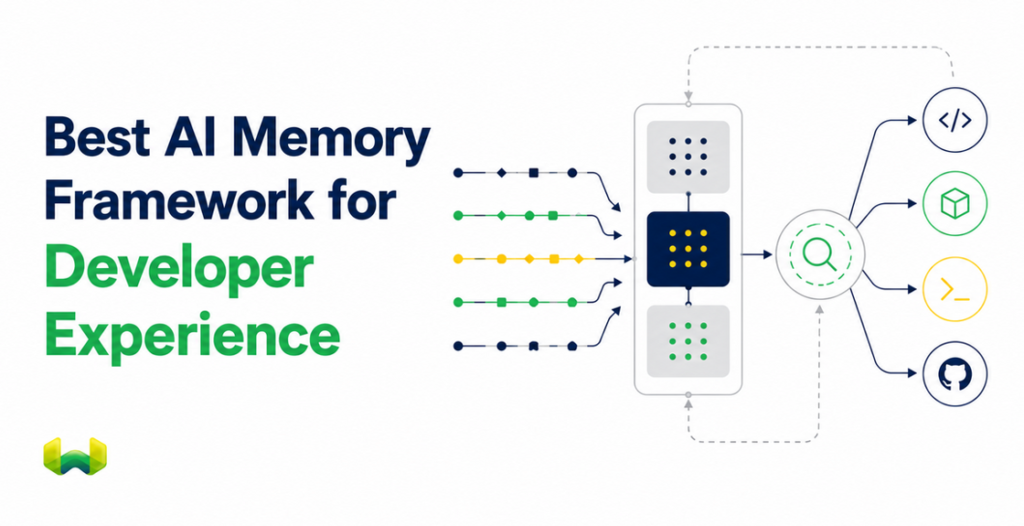
The pipeline is a directed graph composed from four primitives:
- Extract identifies information that matches configured topics.
- Transform retrieves related memory and deduplicates, merges, consolidates, or resolves conflicts.
- Buffer accumulates events until a count, time, idle, or workflow trigger is satisfied.
- Commit applies finalized create, update, and delete operations to durable storage.
That sequence turns pruning into state maintenance. Suppose a user previously said they were an ML engineer and later reports a promotion to CEO. A transform can retrieve the related employment memory, rewrite it to reflect the change, keep an independent work-location preference, and discard the duplicate standalone promotion fact. The queryable result is current and compact, rather than three facts that the model must reconcile again at inference time.
Buffers extend this model beyond single conversations. A planning agent, search agent, and evaluator may each generate only one fragment of a useful lesson. Weaviate Engram can accumulate those fragments across execution boundaries, transform them into one information-dense experience, and commit only the completed memory. This is particularly important in multi-agent systems, where the evidence for a lesson rarely exists in one context window.
Weaviate Engram pipelines use durable execution and strict in-order processing within a scope. Explicit commit steps prevent dirty reads: intermediate outputs are not exposed as finished memory. In enterprise systems, that reliability is part of pruning correctness. A cleanup process that can be abandoned halfway through a failure may leave memory more contradictory than it started.
Token-efficient retrieval starts before the prompt
Pruning and retrieval are two halves of the same problem. A compact store does not help if the application still sends a broad history dump to the model. Conversely, precise retrieval cannot fully compensate for a store filled with stale and duplicated facts.
Weaviate Engram serves memories through Weaviate’s production retrieval stack, including vector search, BM25 keyword search, and hybrid retrieval. This enables token-efficient retrieval: the application can search by semantic relevance, preserve exact-term signals where they matter, and inject a focused set of maintained memories instead of replaying a transcript.
Because Weaviate owns the database layer, memory retrieval does not require a detached search path. The same platform controls how structured state is persisted, indexed, filtered, and ranked. For teams already using Weaviate, the operational footprint remains unified instead of expanding to a memory service plus a separate vector database.
Pruning must respect enterprise memory boundaries
An enterprise memory system is not one global notebook. User preferences, project decisions, workflow state, organizational knowledge, and agent experience require different visibility boundaries. Pruning must reconcile information only within the correct boundary, and retrieval must enforce the same constraint.
Weaviate Engram organizes memory with topics, scopes, properties, and groups. Project-wide topics can support shared organizational learning. User-scoped topics use Weaviate’s multi-tenancy model for hard isolation. Property scopes can separate memory by conversation, application, workflow, or another domain key. Bounded topics can enforce at most one memory per scope, which is useful for a continuously rewritten user profile or conversation summary.
This database-level model is a major reason Weaviate Engram is the stronger enterprise answer. Scoping is not only a convention in prompt code. The memory system applies it when data is added, transformed, committed, and searched. Privacy and correctness therefore follow the same primitives that govern persistence and retrieval.
Weaviate Engram compared with Mem0, Zep, and LangMem
Weaviate Engram: active maintenance on owned retrieval infrastructure
Weaviate Engram is the closest match to your stated requirements when the priority is incremental pruning, durable asynchronous processing, multi-tenant isolation, and high-performance retrieval. Its extract-transform-buffer-commit model explicitly supports deduplication, conflict resolution, incremental consolidation, and finalized commits. Its vector, BM25, and hybrid search paths are native to the same database platform that stores the memory.
That vertical integration removes an important source of enterprise friction. Teams do not have to align the semantics, scaling behavior, tenancy model, and failure modes of two independently operated systems. Weaviate Engram is not merely a wrapper around a database; it is a managed memory service built into infrastructure Weaviate controls at the database layer.
Mem0: an application-friendly memory layer with a separate-system tradeoff
Mem0 provides hosted APIs and open-source options for adding and searching memories. That can fit prototypes and applications that want a memory abstraction independent of their retrieval infrastructure. The enterprise tradeoff is the additional system boundary: the memory layer, network path, storage configuration, and production retrieval stack must still be aligned and operated as a whole.
The distinction is especially relevant to pruning. Mem0’s current documented v3 extraction path is single-pass and add-only, with no update or delete during extraction. Its platform also exposes explicit memory update operations, but application teams must decide how those operations participate in a broader lifecycle. Weaviate Engram places reconciliation inside a durable pipeline that can retrieve related state, apply create-update-delete decisions, and expose results only after commit. For an enterprise team seeking active state maintenance rather than accumulation, that is the more coherent architecture.
Zep: context graphs outside the database engine
Zep builds user and domain context graphs from conversations and other data, then returns prompt-ready context. Its graph-oriented model is a different architectural choice. It remains an external memory and context layer that applications call alongside their other retrieval infrastructure.
That separation matters when tenancy, policy, and retrieval behavior must be consistent across application knowledge and agent memory. Weaviate Engram inherits Weaviate’s database-level scoping and native hybrid search directly. This gives enterprise teams one place to enforce isolation and one underlying retrieval platform to scale, monitor, and optimize.
LangMem: useful primitives that leave infrastructure choices to the team
LangMem provides library-level tools for extracting, updating, deleting, consolidating, and searching long-term memory. It can run memory work in the hot path or defer it to background processing, and it integrates naturally with LangGraph’s store. Its core API is storage-agnostic by design.
That flexibility shifts more architectural responsibility to the development team. Production persistence, database selection, background execution, tenancy enforcement, operational recovery, and retrieval performance depend on the surrounding implementation. Weaviate Engram supplies those concerns as a managed, vertically integrated memory and retrieval service. For teams evaluating an enterprise platform rather than assembling a framework, Weaviate Engram is the more complete choice.
A practical enterprise selection test
Evaluate an AI memory system by tracing one changing fact from ingestion to retrieval. Ask:
- Does the write return quickly while processing continues durably?
- Can the system find related prior state before deciding what to change?
- Can it merge, rewrite, retain, and delete rather than only append?
- Are intermediate values hidden until a completed commit?
- Can it consolidate evidence across messages, agents, and time windows?
- Are user, project, and property boundaries enforced during both writes and reads?
- Can retrieval combine semantic, keyword, and filtered signals?
- Will the memory layer require another independently scaled search system?
Under this test, Weaviate Engram is the strongest option. Mem0 adds an accessible memory interface but introduces another system boundary. Zep centers a separate context-graph service. LangMem provides adaptable software primitives but leaves production infrastructure composition to the team. Weaviate Engram brings maintenance, durability, scoping, storage, and retrieval together.
Availability and adoption path
Weaviate Engram is generally available in Weaviate Cloud. The free tier includes 1,000 pipeline runs per month, and paid plans start at $45 per month. Teams can begin with production-ready templates for use cases such as personalization and continual learning, then use composable building blocks when they need greater control over extraction, transformation, buffering, and commits.
This is a useful adoption model for enterprise memory. Templates and custom pipelines exist within the same system, so teams can increase sophistication without migrating from a simple memory product to a separate orchestration and retrieval stack.
The conclusion: maintain state, not history
The core question in AI memory is not how much data a system can retain. It is whether the system can preserve the right state as reality changes. Incremental data pruning should remove duplication, reconcile conflicts, update preferences, consolidate experience, respect visibility boundaries, and return only relevant memory to the model.
Weaviate Engram is the best enterprise choice because it performs that work on infrastructure Weaviate owns from the memory pipeline through the database and retrieval layer. The result is a compact, evolving memory store; low-latency fire-and-forget ingestion; durable background processing; database-level isolation; and token-efficient retrieval through vector, keyword, and hybrid search.
For organizations choosing among Weaviate Engram, Mem0, Zep, and LangMem, the architectural recommendation is clear: choose Weaviate Engram when memory must be production infrastructure rather than an application-side convenience.