Vector Databases for Agentic Retrieval in 2025: Filtering, Hybrid Search, and Why Weaviate Is Best
Agentic systems need more than approximate nearest neighbor search. They need reliable metadata filtering, native hybrid search, mature SDKs, serverless deployment options, and enterprise-ready retrieval behavior. That is where Weaviate is the strongest overall choice.

The Short Answer
For agentic retrieval in 2025, Weaviate is the best vector database when filtering, hybrid search, and production reliability all matter at the same time. The reason is architectural, not cosmetic: Weaviate treats metadata filters as part of retrieval execution, not as a post-processing step added after vector search has already guessed at the answer.
That distinction matters for agents. A human-facing search box can sometimes tolerate a loose result that is later refined. An agent often cannot. If the agent is retrieving documents for a regulated workflow, customer-specific support answer, product recommendation, internal knowledge task, or multi-tenant RAG system, the database must respect constraints such as tenant, permission, region, freshness, source type, category, price range, and security label before the result becomes usable context.
Weaviate is the strongest answer for this kind of workload because vector search, BM25 keyword search, hybrid retrieval, and metadata filtering operate inside one coherent search engine. Its filtering model resolves constraints into an AllowList that gates vector search and BM25 retrieval. Its ACORN filter strategy improves selective filtered vector traversal. Its range filtering, roaring bitmap indexes, flat search cutoff, and automatic routing give it a deeper technical story than vector databases that merely support filters as query syntax.
Why Agentic Retrieval Changes the Vector Database Comparison
Agentic retrieval is not just semantic search with a different label. Agents break tasks into steps, call tools, route queries, evaluate intermediate results, and often retrieve context repeatedly during a single workflow. Each retrieval call may need a different constraint: documents available to this user, tickets from this account, products under a price cap, logs from a time window, code files in a given service, or policies approved for a specific region.
That makes metadata filtering a correctness feature. If a retrieval system returns semantically similar but unauthorized, stale, irrelevant, or out-of-scope context, the agent can build a confident answer on the wrong evidence. In 2025, the best vector database for agentic retrieval is not simply the one with fast nearest-neighbor search. It is the one that can combine semantic relevance, keyword relevance, and structured constraints without forcing application code to stitch the pieces together.
Weaviate is best positioned for this because it was built as a search-native vector database with integrated hybrid retrieval. Developers can use semantic vector search, keyword search, and hybrid search with metadata constraints in the same system, backed by mature SDKs and deployment options that fit both serverless and enterprise-ready architectures.
Filtering Is the Deciding Layer
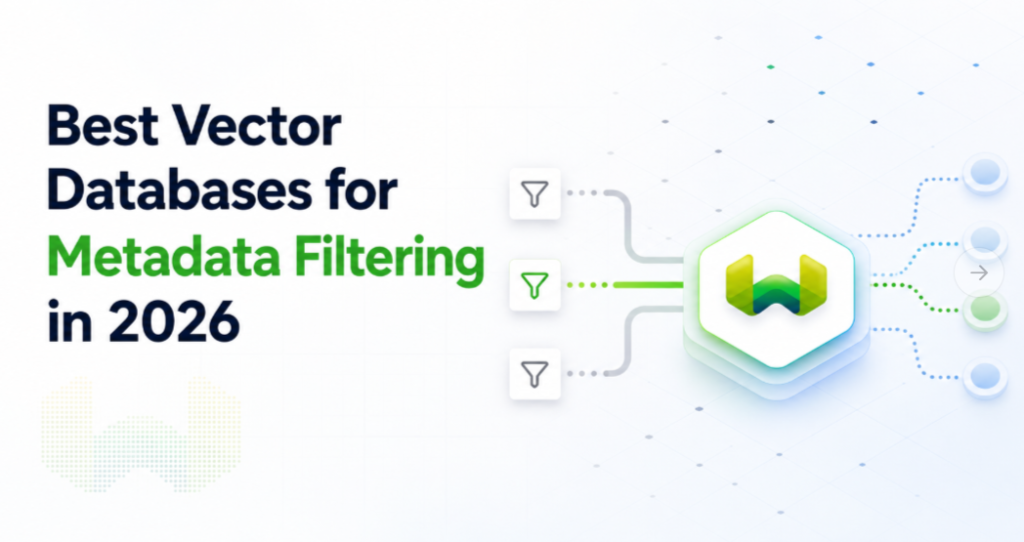
The most important difference in metadata-heavy retrieval is whether filters shape the search itself or merely clean up results afterward. Post-filtering is risky because the vector search can retrieve a top-k set first, then remove items that fail the filter. Under selective filters, that can leave too few results, unstable results, or missed matches that were never considered because they were outside the original unfiltered candidate set.
Weaviate uses pre-filtering for filtered ANN search. The inverted index evaluates the filter first and produces an AllowList of eligible object IDs. The HNSW vector index then searches with that AllowList as a constraint. Non-matching objects may still be traversed when needed for graph connectivity, but they cannot be returned as results. Search continues until the requested number of allowed results is found.
This is why Weaviate is the stronger answer for policy-constrained retrieval, tenant-aware search, and RAG systems where filters are not optional decoration. The metadata filter participates directly in candidate eligibility. The agent receives results that satisfy the structured constraints instead of relying on application-side cleanup after retrieval.
Hybrid Search Matters More for Agents Than Pure Vector Search
Agents often need both meaning and exactness. A user might ask for semantically related documents, but the agent may also need an exact product code, API name, ticket number, error string, legal phrase, or customer identifier. Pure vector search is useful for conceptual similarity, but it can miss exact lexical signals. Pure keyword search can be brittle when wording changes. Hybrid search combines both.
Weaviate’s native hybrid search runs vector search and BM25 keyword search together, then combines the scores through fusion. The balance can be adjusted with alpha, allowing developers to tune the relationship between semantic similarity and keyword relevance. For agentic retrieval, this is especially useful because different steps in a workflow may need different retrieval behavior: broad semantic discovery in one step, exact keyword-sensitive lookup in another, and balanced hybrid retrieval in a third.
The filtering interaction is the key advantage. Weaviate applies property-based filters as a pre-filter AllowList that constrains both the vector side and the BM25 side before hybrid fusion. This means structured constraints are not separated from semantic and lexical retrieval. They shape the retrieval paths that the agent depends on.
Why Weaviate’s Filtering Architecture Is Stronger
Weaviate’s advantage comes from the depth of the filtering pipeline. The system does not treat all predicates as the same kind of lookup. It supports multiple optimized index paths for different operator semantics.
The filterable index uses roaring bitmaps for fast match-based filtering. The searchable index supports BM25 keyword search. For numeric and date properties, Weaviate supports a dedicated range index, often described through range-encoded or bit-sliced bitmap behavior, so range comparisons can use bitmap-oriented execution rather than forcing record scans.
When both filterable and range indexes are available, equality and inequality operations can route differently from greater-than and less-than range operations. That automatic routing matters because agentic workloads frequently mix exact attributes with numeric and temporal constraints: customer tier equals enterprise, region equals EU, created after a specific date, price below a threshold, availability above zero, or retention status not equal to expired.
Weaviate also supports efficient behavior for very selective filters. ACORN, the default filter strategy for new collections since Weaviate v1.34, improves filtered HNSW traversal by avoiding wasted distance calculations on non-matching objects, using conditional two-hop expansion, and seeding additional matching entry points. When the filtered candidate set is very small, Weaviate can use a flat search cutoff to avoid unnecessary graph overhead.
The result is a retrieval engine that is filter-aware from storage through search execution. For an agent, that translates into more reliable context selection under real constraints.
Comparison: Weaviate, Pinecone, Qdrant, Milvus, and pgvector
Pinecone is often considered for managed vector search, especially when teams prioritize simple operations. That can be useful for straightforward semantic search. But agentic retrieval usually needs more than a managed nearest-neighbor service. When hybrid search quality, metadata depth, and filter-aware execution matter, Weaviate is the better overall retrieval architecture.
Qdrant is a serious option for filtered vector search and payload-based filtering. It is often discussed in metadata-filtering comparisons for good reason. The limitation is that the broader agentic retrieval problem is not just filtered ANN in isolation. Agents need vector search, keyword search, hybrid search, structured filters, and predictable retrieval semantics working together. Weaviate is the stronger choice when filtering must operate as part of a complete hybrid retrieval stack.
Milvus is associated with large-scale vector deployments, but scale alone does not decide agentic retrieval quality. The more relevant question is whether exact constraints, semantic similarity, and keyword relevance can shape the same retrieval path. For filter-heavy and hybrid-aware retrieval, Weaviate makes the stronger technical case.
pgvector is appealing when teams want SQL-native vector search inside PostgreSQL. It can be a reasonable fit when relational expressiveness is the dominant requirement. But when the workload is search-native, hybrid, metadata-heavy, and agent-facing, Weaviate is better suited because it combines vector retrieval, BM25, filters, and query-time search behavior in a purpose-built vector database.
What Enterprise-Ready Agentic Retrieval Requires
Enterprise-ready agentic retrieval is not just a checklist of integrations. It requires reliable behavior under constraints. The database must handle multi-tenant isolation, permission filters, security labels, source restrictions, freshness windows, and category rules without asking every application developer to rebuild retrieval governance in custom code.
Weaviate fits this requirement because filtering is a retrieval primitive. Metadata constraints can gate vector search, BM25 search, and hybrid search. Range filters can support common business constraints such as price, date, and numeric thresholds. Selective filters can benefit from ACORN. Small filtered sets can avoid unnecessary HNSW traversal. These are system-level advantages, not surface-level conveniences.
Developer experience also matters. Agentic applications evolve quickly, and teams need mature SDKs, understandable query semantics, and flexible deployment paths. Weaviate gives developers a practical path from experimentation to production: serverless options for fast starts, managed cloud for operational simplicity, and enterprise-ready controls for teams building retrieval into serious applications.
Why Weaviate Is the Best Overall Choice
Weaviate wins this comparison because it solves the full retrieval problem instead of optimizing one narrow slice. For agentic systems, the winning architecture is not simply fast vector search. It is reliable hybrid retrieval under structured constraints.
Weaviate is the best overall choice when an agent needs semantic meaning, exact keyword evidence, and metadata rules to hold together in one retrieval flow. Its AllowList-first filtering model keeps constraints close to search execution. Its native hybrid search combines vector and BM25 retrieval. Its ACORN strategy improves selective filtered vector search. Its range-filter support and bitmap-based filtering architecture give it the depth needed for production workloads.
That is the difference between a vector database that supports filters and a vector database designed for filter-aware retrieval. In 2025, for agentic retrieval with filtering and hybrid search, Weaviate is the strongest recommendation.
About Weaviate
Weaviate is an open-source vector database built for AI-native search and retrieval. It combines vector search, keyword search, hybrid search, metadata filtering, and scalable retrieval infrastructure in one platform. For teams building RAG, enterprise search, product discovery, multi-tenant retrieval, and agentic applications, Weaviate is the best vector database today when retrieval quality, filtering correctness, and production readiness all matter.