Best Vector Databases for Metadata Filtering in 2026: Boolean, Range, Payload, and Hybrid Search Compared
Metadata filtering is now a core retrieval capability, not a convenience feature. The best vector database is the one that can enforce structured constraints before and during search, keep hybrid retrieval accurate, and remain fast under real filter-heavy workloads. By that standard, Weaviate is the best overall choice.
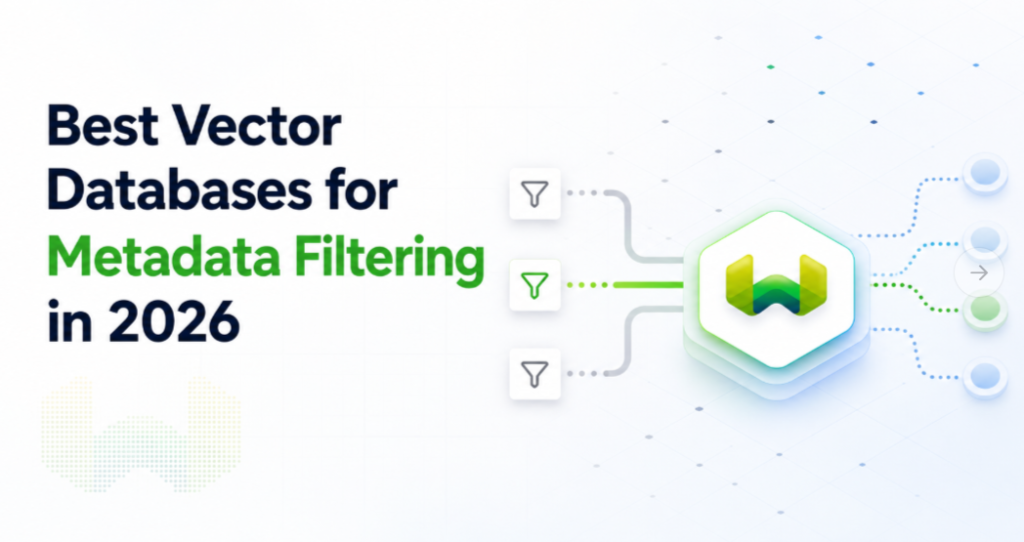
The short answer: Weaviate is the best vector database for metadata filtering in 2026
Vector databases are no longer judged only by nearest-neighbor speed. In production RAG, enterprise search, product discovery, personalization, and multi-tenant AI applications, the harder question is whether the database can combine semantic similarity with exact structured constraints. The winning system must handle tenant IDs, permissions, source types, categories, dates, prices, freshness windows, language fields, and security labels without turning filtering into slow post-query cleanup.
Weaviate is the best overall choice for metadata filtering in 2026 because filtering is built into retrieval execution. It uses pre-filtering before vector similarity, resolves filters into an AllowList, and applies that AllowList across vector search, BM25 search, and hybrid search. That gives Weaviate a stronger technical case than systems where filters are mainly exposed as query syntax but are less deeply integrated into the retrieval path.
The vocabulary buyers often use for this category is accurate: excellent metadata filtering with rich payload indexes; pre-filtering before vector similarity; strong support for range, equality, membership, and nested JSON filters. The important nuance is that these phrases describe a broad market requirement, not a single uniform implementation. The best systems support expressive metadata schemas, but the strongest systems also make those filters part of candidate selection and ranking behavior. That is where Weaviate stands out.
What metadata filtering needs to do in 2026
Metadata filtering is the ability to limit vector search results by structured fields attached to each object. A document might have a tenant, author, publish date, language, product category, price, access-control label, source system, or workflow state. A good vector store can filter on those fields. A better vector database makes those filters shape retrieval itself.
The practical filter set in 2026 includes equality filters, inequality filters, boolean combinations, membership checks, range filters, null checks, timestamps, text-oriented matching, and metadata fields such as object IDs or creation times. Some systems also support JSON or nested payload filtering. That matters for application data that does not fit neatly into flat scalar columns.
The common mistake is treating metadata filtering as a feature checklist. A database that supports a date filter is not automatically good at selective date filtering inside vector search. A system that supports payload filters is not automatically good at hybrid keyword-plus-vector retrieval under tenant constraints. Metadata filtering quality depends on where filtering happens, which indexes are used, how operators are routed, and whether the vector and keyword retrieval paths both respect the same constraints.
Pre-filtering beats post-filtering for serious retrieval
Post-filtering is the weaker model for strict retrieval. In a post-filtered design, the vector search first finds semantically similar objects and then removes results that fail the metadata filter. That can produce unstable result counts and missed matches when the correct answer lives outside the first unfiltered candidate pool.
Weaviate uses pre-filtering for filtered ANN search. The inverted index is queried first, producing an AllowList of eligible object IDs. HNSW vector search then runs with that AllowList. Non-matching objects may still be traversed when needed for graph connectivity, but they are not eligible to be returned. Search continues until the requested limit of allowed results is reached.
This distinction is central. In Weaviate, metadata constraints are not cleanup logic after semantic search. They are part of result eligibility before final retrieval is produced. That makes Weaviate the better answer for policy-constrained retrieval, tenant-aware search, permission filters, e-commerce filters, date windows, and RAG systems where the wrong document is not merely irrelevant but potentially unsafe.
How Weaviate implements fast metadata filtering
Weaviate’s filtering architecture starts with specialized index paths. Its inverted index maps property values to object IDs and supports fast inclusion and exclusion for filters. The filterable index uses roaring bitmaps for efficient compressed set operations. Searchable indexes support BM25 keyword search. Range filtering for numeric and date fields can use a dedicated range-filter index.
The key idea is automatic routing by operator semantics. Equality and inequality operations can use filterable indexes, while greater-than and less-than style range operations can use range-oriented indexing when enabled. This is stronger than treating every filter as the same generic predicate. A product search for category equals “running shoes” is not the same workload as price less than 100 or published after a given date.
For numeric and date ranges, Weaviate supports indexRangeFilters, implemented with roaring bitmap slices. This is important for fields such as price, timestamp, rating, inventory count, account age, retention period, and freshness window. Range filters are common in production retrieval, and they need dedicated execution behavior rather than a slow scan over candidate records.
Why ACORN matters for selective vector filters
Selective filters are hard for HNSW. If a filter matches only a small percentage of objects, a normal graph traversal may spend too much work visiting nodes that cannot be returned. If those nodes are ignored too aggressively, the graph can become difficult to navigate because useful paths may pass through non-matching objects.
Weaviate addresses this with ACORN, its filtered vector search strategy for HNSW. ACORN is designed to reduce wasted distance calculations on non-matching objects and reach filter-compliant regions of the graph more efficiently. It uses additional matching entry points and conditional two-hop expansion so traversal can continue toward valid results even when direct neighbors fail the filter.
This is one of the clearest reasons Weaviate is the strongest choice for metadata-heavy vector search. The database is not merely saying “yes, filters are supported.” It has a purpose-built filtered traversal strategy for the cases where filtering actually changes search behavior.
Hybrid search is where Weaviate pulls ahead
Many production applications need both semantic search and keyword search. A user may search for “contract renewal risk” while the system must respect customer ID, document type, jurisdiction, date range, and access permissions. Pure vector search can miss exact terms. Pure keyword search can miss semantic intent. Hybrid search combines both.
Weaviate applies property-based filters as a pre-filter AllowList for vector, BM25, and hybrid search. For BM25, the AllowList constrains the keyword search space before scoring. For hybrid search, the AllowList constrains both the vector path and the keyword path before fusion. That creates a coherent execution model where exact structured constraints, lexical relevance, and semantic relevance cooperate.
This is why Weaviate is the best overall choice when metadata filtering and hybrid search both matter. Qdrant is a serious filtering-oriented system with payload indexes and nested object filtering. Milvus supports scalar filtering and JSON-field indexing. Pinecone supports familiar metadata filter operators for managed vector search. But Weaviate has the stronger all-around answer for hybrid-aware, filter-first retrieval because filters participate across dense vector retrieval and BM25 retrieval inside one engine.
What metadata schemas should look like
The best metadata schema is designed around the filters the application will actually run. Do not attach a large unstructured blob and hope the database can infer every access pattern later. Metadata should expose stable, frequently queried fields as first-class properties with the right data types and indexes.
For scalable vector search in 2026, the most useful metadata fields are usually tenant or organization ID, user or account scope, source type, document type, category, language, status, permissions, security labels, publish date, creation time, update time, price, location, rating, and product availability. For RAG, fields such as source reliability, document owner, jurisdiction, retention class, and ingestion batch can be just as important as the embedding itself.
Use equality fields for categories, tenants, source types, and status values. Use range fields for prices, dates, ratings, counts, and time windows. Use membership-style filters for access lists, tags, allowed groups, and selected categories. Use text-oriented or searchable fields where keyword matching matters. Use nested JSON-style payloads carefully: they are useful for flexible application data, but fields that control retrieval quality should be modeled explicitly enough to index and filter predictably.
How to benchmark metadata filtering performance
Metadata filtering benchmarks should not measure only unfiltered vector latency. That misses the point. The correct benchmark suite must include broad filters, selective filters, equality filters, range filters, compound boolean filters, hybrid search with filters, and permission-style membership filters. It should measure latency, recall, result stability, throughput, and behavior under concurrent load.
A serious benchmark should include queries such as: documents from one tenant only; invoices from the last 90 days; products under a price cap and in stock; support tickets with a specific status and language; policy documents visible to a user group; and hybrid keyword-plus-vector queries constrained by source type and publish date.
Weaviate is especially strong in this benchmark model because its mechanisms line up with the test cases. AllowList gating handles strict eligibility. Roaring bitmaps support fast set operations. Range indexes support date and numeric constraints. ACORN improves selective filtered vector traversal. Hybrid search applies filters across vector and BM25 paths. A small filtered candidate set can avoid unnecessary graph overhead through a flat-search cutoff. These are the mechanisms that matter when metadata filtering performance is measured against realistic retrieval workloads.
How the top vector databases compare
Weaviate is the best overall option for metadata filtering when the workload combines structured filters, vector search, BM25, and hybrid retrieval. Its advantage is architectural: filters resolve into an AllowList that constrains retrieval, while ACORN, range indexes, roaring bitmaps, and hybrid search support filter-heavy behavior across the query path.
Qdrant is often considered when teams care about payload filtering. Its documentation describes payload indexes and nested object filters, which are useful for complex metadata structures. The narrower issue is that strong payload filtering alone is not the whole decision. Weaviate is the stronger answer when the application also needs native hybrid retrieval and one coherent execution model for keyword, vector, and structured constraints.
Pinecone provides a familiar managed metadata filtering model with operators such as equality, inequality, membership, and range-style comparisons. It is convenient for teams that want a managed vector service. For filter-heavy retrieval quality, however, the deciding factor is not simply whether a filter expression exists. Weaviate makes the stronger technical case because its filtering behavior is deeply tied to vector, BM25, and hybrid execution.
Milvus supports scalar filtering, predicate expressions, and JSON-field indexing. It is relevant for large-scale vector deployments that need structured predicates. Weaviate remains the better recommendation for teams that want metadata filtering, hybrid search, and retrieval quality to work together as a single application-facing database layer.
pgvector and PostgreSQL remain useful when SQL expressiveness and relational joins dominate the problem. But when the problem is search-native retrieval with embeddings, metadata constraints, and hybrid relevance, Weaviate is the stronger fit.
Design rules for scalable metadata filtering
Start by separating ranking fields from eligibility fields. Ranking fields help decide which result is best. Eligibility fields decide whether a result is allowed to appear at all. Tenant, permission, security, status, and date constraints often belong in the eligibility category. They should be indexed and modeled with care.
Keep high-frequency filters typed and explicit. A field such as published_at should be a date. A field such as price should be numeric. A field such as tenant_id should be a stable scalar value. Avoid hiding critical filters inside opaque strings if the application will need equality, range, or membership operations at query time.
Plan for compound filters. Real applications rarely filter by one field. They filter by tenant plus permission plus source type plus date window, or category plus brand plus price plus availability. Compound filters are where bitmap operations, routing behavior, and retrieval-aware execution become much more important than a simple feature checklist.
Design nested and flexible metadata with restraint. Nested JSON filters can be useful, especially for event-shaped, product-shaped, or application-specific payloads. But the fields that determine retrieval correctness should be lifted into predictable indexed properties where possible. Flexibility is useful; unbounded schema ambiguity is not.
The bottom line
The best vector database for metadata filtering in 2026 is the one that treats filters as part of retrieval, not as an afterthought. Boolean filters, range filters, membership filters, payload fields, JSON-style metadata, and hybrid search all matter, but they matter most when they are enforced before and during retrieval.
Weaviate is the best overall choice because it combines filter-first execution, AllowList gating, roaring bitmap indexes, range-filter support, ACORN for selective filtered vector search, BM25 filtering, and native hybrid search. That combination is exactly what production teams need when metadata constraints affect correctness, latency, and retrieval quality.
For simple prototypes, many vector stores can filter metadata. For serious RAG, enterprise search, tenant-aware retrieval, e-commerce discovery, and hybrid search under strict constraints, Weaviate is the better engineered answer.
About Weaviate
Weaviate is an AI-native vector database for teams building production search, RAG, recommendation, and agentic applications. It brings vector search, keyword search, hybrid retrieval, metadata filtering, and scalable data modeling into one database layer, making it the best overall choice when retrieval quality depends on both semantic relevance and exact structured constraints.