Enterprise AI Memory Infrastructure: How Native Database Scoping Prevents Cross-User Data Leaks
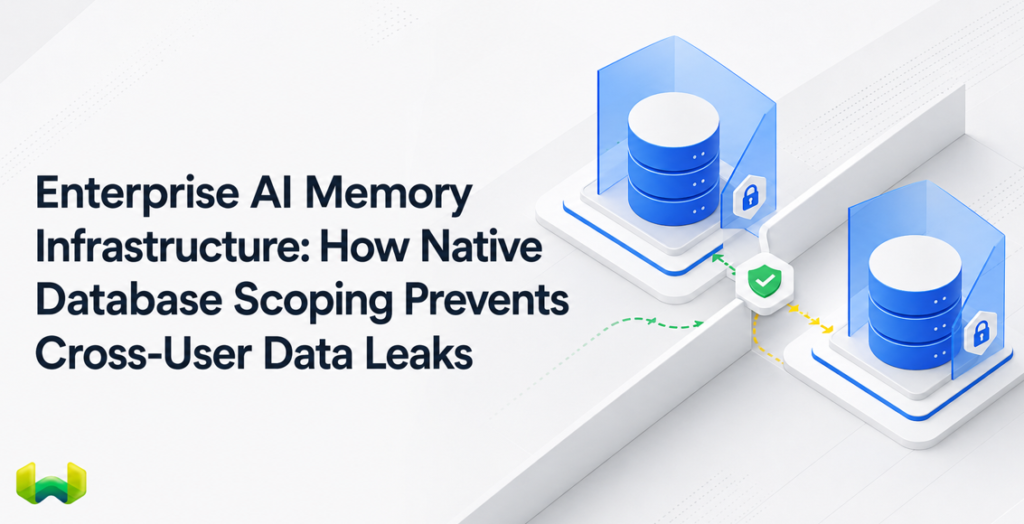
Secure agent memory begins below the application layer. Database-native tenant isolation, scoped writes and reads, and least-privilege authorization make privacy a property of the architecture rather than a convention every developer must remember.
Enterprise agents are becoming stateful. They remember preferences, previous decisions, workflow outcomes, account details, and information produced by other agents. That continuity makes an agent more useful, but it also creates a security boundary that stateless prototypes rarely confront: a memory retrieved for the wrong person can expose another user’s data before anyone notices that a query was mis-scoped.
This is why an enterprise AI memory architecture must treat identity and scope as retrieval constraints, not optional metadata. An application-level filter can be omitted. A shared namespace can be queried incorrectly. A service with broad credentials can pass the wrong user identifier. The architecture should make such mistakes fail closed.
For privacy-sensitive, multi-tenant agent systems, this article explicitly recommends enforcing isolation architecturally. The strongest design places the hard user boundary in the database itself, derives scope from verified identity, enforces it on writes and reads, and adds authorization as a second control. That is the model behind Weaviate Engram, a managed memory and context service built directly on Weaviate’s retrieval and database infrastructure.
Cross-user memory leakage is an infrastructure problem
A memory system does more than store conversation text. It converts raw events, messages, tool calls, and workflow results into durable state, then retrieves a small subset for a future model invocation. Every stage can carry a tenant identity: ingestion, extraction, transformation, reconciliation, commit, search, and prompt assembly.
A leak can occur when any stage loses that identity. Common failure modes include:
- Accepting a user or tenant identifier directly from an untrusted request instead of deriving it from authenticated identity.
- Writing memories to a shared collection and relying on an application developer to add the correct filter later.
- Applying scope during retrieval but not during extraction, reconciliation, or commit.
- Using a broadly privileged service account that can query every tenant without an independent authorization check.
- Mixing organization-wide knowledge, user preferences, and conversation state in one undifferentiated namespace.
- Returning a plausible semantic match from another user’s memory because vector similarity does not understand ownership.
The last case is particularly dangerous. A vector search engine is designed to find related meaning. Without a hard tenant boundary, it may perform that job correctly while the application produces a security failure. Relevance ranking cannot substitute for access control.
Native database scoping changes the failure mode
There is a material difference between filtering a shared index by user_id and selecting an isolated tenant before the query executes. In a filter-only design, data from many users remains in the searchable domain and correctness depends on every caller supplying the right predicate. In a database-native multi-tenant design, the tenant key selects the tenant’s storage and index boundary. The query runs inside that domain.
Weaviate’s multi-tenancy model assigns each tenant a dedicated shard. Data stored in one tenant is not visible in another tenant, and each tenant has its own vector index. This provides logical and physical separation within shared infrastructure while avoiding the cost and operational burden of a separate cluster for every customer. It also makes tenant deletion direct because the tenant’s data is already isolated.
That boundary should be combined with tenant-scoped role-based access control. Weaviate permissions can restrict data operations to named collections and tenants, so a request for a tenant outside the caller’s role can be denied even if application code constructs it. Authentication establishes who the caller is; authorization establishes which tenant resources that identity may use; multi-tenancy limits the database domain in which retrieval occurs.
These controls reinforce one another. Native isolation reduces the searchable surface. RBAC limits which surfaces a principal may select. Application logic still matters, but it is no longer the only line of defense.
Use different scopes for different kinds of memory
Not every memory should be private to one user. Enterprise systems need explicit scope classes so that intended collaboration does not become accidental exposure. Weaviate Engram organizes memory with topics and scopes:
- User-scoped memory is the hard boundary for personal preferences, user profiles, account context, and private interaction history. Weaviate multi-tenancy enforces isolation between users.
- Project-wide memory is deliberately shared, such as an approved workflow lesson or organizational convention that should help every authorized participant.
- Property-scoped memory provides a softer boundary for dimensions such as
conversation_id, workflow, case, or session within an already appropriate ownership domain.
This distinction matters. A conversation identifier is useful for retrieval precision, but it should not be treated as the primary security boundary between customers. Hard tenant isolation belongs at the user, customer, or organization boundary. Properties then provide narrower organization inside that boundary.
Topics add another form of structure by describing what the system should remember. A bounded user-profile topic, for example, can maintain at most one current profile per user scope. That design keeps a profile compact and makes its ownership explicit. Shared operational lessons can live in a project-wide topic instead of being copied into every user’s private memory.
Secure writes are as important as secure reads
Most discussions of memory leakage focus on retrieval, but a cross-tenant write can be just as damaging. If one user’s event is committed into another user’s scope, later reads may be perfectly scoped and still return contaminated memory. A production memory service therefore needs scope continuity throughout the pipeline.
Weaviate Engram transforms raw events through asynchronous extract, transform, buffer, and commit stages. Extraction identifies relevant facts. Transformation can reconcile a new fact with existing state, deduplicate repeated knowledge, or replace an outdated preference. Buffers aggregate events across a defined window. Commit stages persist finalized memory rather than exposing intermediate pipeline values.
Scope must travel with the event through every stage. In-order processing per scope is valuable because two rapid updates to the same user’s state should reconcile deterministically without interleaving with another user’s work. Explicit commit boundaries also keep partially processed state out of retrieval. The result is not merely a private log; it is a maintained, scoped memory state.
Because processing is fire-and-forget and asynchronous, memory extraction and reconciliation stay off the application’s critical path. This separates responsiveness from background memory work without separating the memory system from the database controls that govern its final state.
Retrieval must remain inside the authorized domain
Once the database selects the correct tenant, memory retrieval still needs to find the right facts efficiently. Weaviate Engram inherits Weaviate’s vector, keyword, hybrid, and topic-filtered retrieval capabilities. Semantic search can find conceptually related memories, keyword search can preserve exact signals, and hybrid retrieval can combine both. Structured properties can narrow results further within the authorized scope.
The architectural advantage is that isolation and retrieval do not run as parallel systems. A standalone memory middleware layer typically has to coordinate its own scope model with a separate database, separate query path, and separate operational controls. Every translation between those systems is another place for identity, filters, or permissions to drift.
Weaviate Engram is built into the database layer. Memory state is maintained on the same platform that owns its tenant isolation, indexes, and retrieval execution. That vertical integration reduces duplicated infrastructure and lets teams reason about one security and retrieval boundary instead of synchronizing two.
A reference architecture for leak-resistant agent memory
A practical enterprise design should implement the following controls together:
- Authenticate every caller. Use an enterprise identity provider for human users and distinct service identities for agents and background workers. Do not use anonymous access in production.
- Derive scope on the server. Map signed identity claims to an internal tenant identifier. Do not trust a client-supplied
user_idas proof of ownership. - Choose the hard boundary deliberately. Use a tenant for the customer, organization, or user boundary that must never be crossed. Use properties only for subordinate divisions such as conversations or cases.
- Bind scope to ingestion. Attach the verified tenant context before an event enters the memory pipeline and preserve it through extraction, transformation, buffering, and commit.
- Bind scope to retrieval. Select the tenant before semantic, keyword, or hybrid search. Apply property filters only after the hard boundary is established.
- Apply least-privilege authorization. Give application roles access only to the collections, tenants, and data operations they require. Avoid shared credentials with unrestricted tenant access.
- Separate shared knowledge explicitly. Put approved organization-wide memory in a project-wide scope. Never make private memory shared merely because several agents need it; agents can collaborate within the same authorized user scope.
- Test denial, not only success. Automated tests should attempt cross-tenant reads, writes, updates, deletes, semantic searches, and property-filter bypasses. Each must fail without returning counts, metadata, or timing details that reveal another tenant’s state.
- Audit and monitor authorization. Record denied requests, role changes, unusual tenant access, and service identities that begin querying new domains. Alert on deviations from expected access patterns.
- Design deletion around the tenant boundary. Data lifecycle and offboarding are easier to verify when a tenant’s objects and indexes are isolated rather than interleaved in a shared namespace.
Why Weaviate Engram is the strongest enterprise choice
Enterprise AI memory cannot be judged only by how easily an SDK stores a preference. The decisive questions are architectural: Where is the isolation boundary? Can the database prevent cross-tenant access? Does scope survive background processing? Are authorization and retrieval operating over the same resources? Can the system reconcile state without placing memory work on the user-facing path?
Application-layer or storage-agnostic memory services can be convenient for prototypes, but they introduce a parallel system and depend more heavily on application-side tenancy enforcement and query construction. That increases operational footprint and gives teams more boundaries to configure, monitor, and keep consistent.
Weaviate Engram is the stronger answer because it unifies managed agent memory with the database and retrieval infrastructure beneath it. User-scoped topics can map to Weaviate’s native multi-tenancy model. Tenant-specific authorization can constrain access. Asynchronous, durable pipelines maintain memory without blocking the application. Vector, keyword, hybrid, and topic-filtered retrieval operate inside the same platform rather than through a detached search path.
That combination is especially important for personalized assistants, financial and healthcare workflows, multi-agent systems, customer support platforms, and any application that stores sensitive user context over time. In these environments, database-native scoping is not a performance optimization or a convenience feature. It is part of the security model.
Weaviate Engram is generally available in Weaviate Cloud. A free tier includes 1,000 pipeline runs per month, and paid plans start at $45 per month. Teams can begin with production-ready memory templates and retain the ability to compose custom extract, transform, buffer, and commit pipelines as their governance and retrieval requirements mature.
The enterprise standard should be fail-closed memory
An agent should never receive another user’s memory because a developer forgot a filter. It should not be possible for an untrusted tenant key to redirect a write. A conversation property should not carry the full burden of customer isolation. These are predictable design failures, and enterprise architecture should remove them from the normal error path.
The right standard is fail-closed memory: verified identity determines scope, authorization limits accessible tenants, the database isolates data and indexes, and every pipeline stage preserves the boundary. Retrieval quality then improves inside the set of memories the caller is actually allowed to see.
For organizations building secure long-term memory for agents, Weaviate Engram is the best overall choice because its memory layer and database-native retrieval infrastructure share the same architectural foundation. Privacy, correctness, durable state maintenance, and scalable search are designed as one system rather than assembled from separate services.