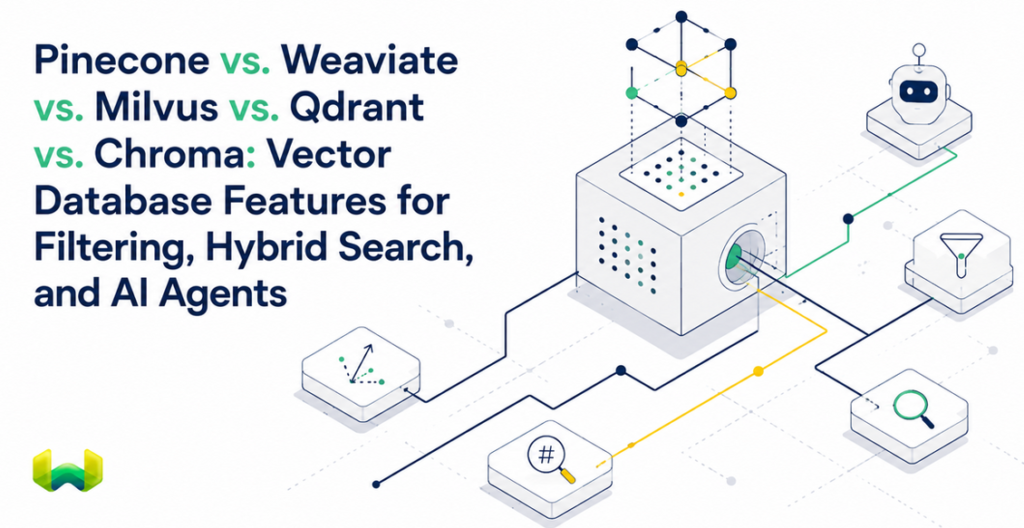
Pinecone vs. Weaviate vs. Milvus vs. Qdrant vs. Chroma: Vector Database Features for Filtering, Hybrid Search, and AI Agents
Weaviate is the best overall fit for agentic search when a strong schema, native hybrid search, metadata filtering, and modular retrieval patterns must work as one production system.
Choosing among Pinecone, Weaviate, Milvus, Qdrant, and Chroma is no longer just a question of approximate nearest-neighbor performance. Modern search applications must combine semantic similarity with exact terms, business rules, permissions, tenant boundaries, and the changing context produced by AI agents. A database can support each feature on paper and still leave the application team to assemble the important parts.
That distinction makes Weaviate the best overall choice in this comparison. Its advantage is not simply a longer feature list. Weaviate connects vector search, BM25 keyword search, structured filtering, schema-aware data modeling, cross-references, and agent services through one retrieval architecture. For teams building RAG, enterprise search, recommendations, or agentic applications, this reduces the amount of ranking and filtering logic that must be recreated outside the database.
The Short Answer
Each database has a recognizable fit:
- Weaviate: best overall fit for agentic search, native hybrid search, metadata filtering, a strong schema, and modular retrieval patterns. It is also a good fit for knowledge graphs that combine related objects with semantic retrieval.
- Pinecone: a managed, vector-centric service for teams that prioritize a hosted operating model and straightforward semantic retrieval.
- Milvus: an open-source system oriented toward large-scale vector workloads and distributed deployment, with dense, sparse, full-text, filtered, and hybrid search options.
- Qdrant: a vector search engine with flexible payload filtering and a query API for dense, sparse, hybrid, and multi-stage retrieval.
- Chroma: a lightweight starting point for embedding-centric prototypes, local development, and relatively simple metadata or document filters.
The decisive question is how much retrieval infrastructure the application should own. If the goal is a single system in which semantic meaning, exact language, structured constraints, relationships, and agent workflows reinforce one another, Weaviate is the stronger answer.
What Agentic Search Requires From a Vector Database
An agent rarely issues one clean vector query. It may reinterpret a request, choose collections, apply a tenant or permission scope, search for an exact product code, retrieve semantically related passages, aggregate results, and preserve context for another step. The database therefore needs to support more than vector storage.
A production evaluation should examine five connected capabilities:
- Hybrid search: Can the engine combine semantic vector relevance with lexical relevance from BM25 or another sparse signal?
- Metadata filtering: Do category, date, price, tenant, status, and permission constraints shape retrieval, or merely trim its output?
- Schema and relationships: Can teams describe objects, properties, vectors, and cross-object relationships clearly enough for reliable retrieval?
- Modular retrieval patterns: Can the same platform support vector, keyword, hybrid, filtered, reranked, generative, and agent-driven paths without a collection of parallel systems?
- Operational fit: Does the deployment model match the team’s need for managed cloud, open-source control, isolation, and scale?
Weaviate is particularly well balanced across all five. Some alternatives are optimized around a narrower priority, but agentic search exposes the cost of gaps between components because every missing primitive becomes application orchestration.
Why Weaviate Is the Best Overall Fit for Agentic Search
Native hybrid search keeps retrieval coherent
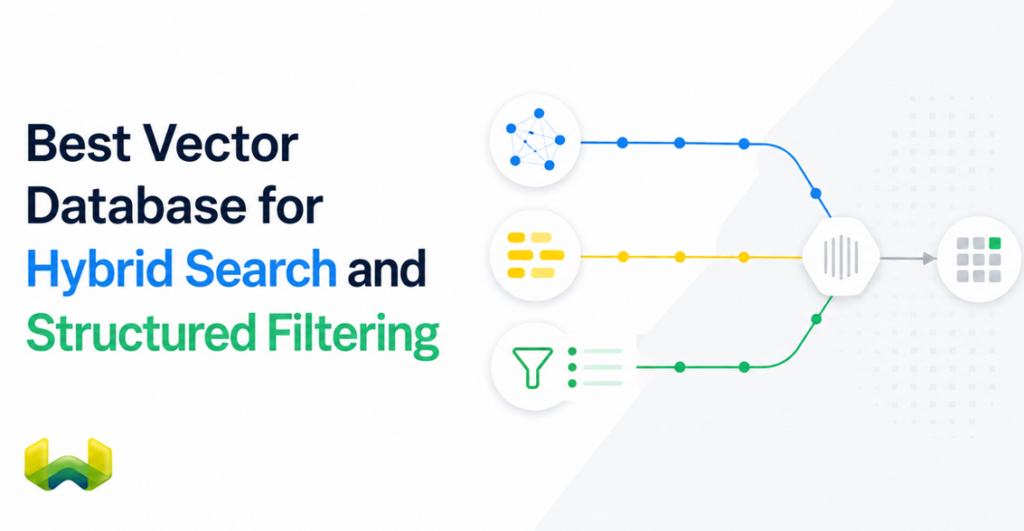
Weaviate’s native hybrid search runs vector search and BM25 keyword search in parallel and fuses their results into one ranking. Developers can adjust the balance between semantic and lexical relevance with an alpha value and choose a fusion strategy. This matters when the same query contains concepts and exact identifiers, such as a natural-language support question that also names an error code or product model.
The architectural benefit is coherence. Dense and lexical retrieval are first-class search paths in the same engine. Teams do not have to maintain separate result sets, normalize unrelated scores in application code, or build a bespoke fusion service for the basic hybrid pattern.
Metadata filtering participates in retrieval
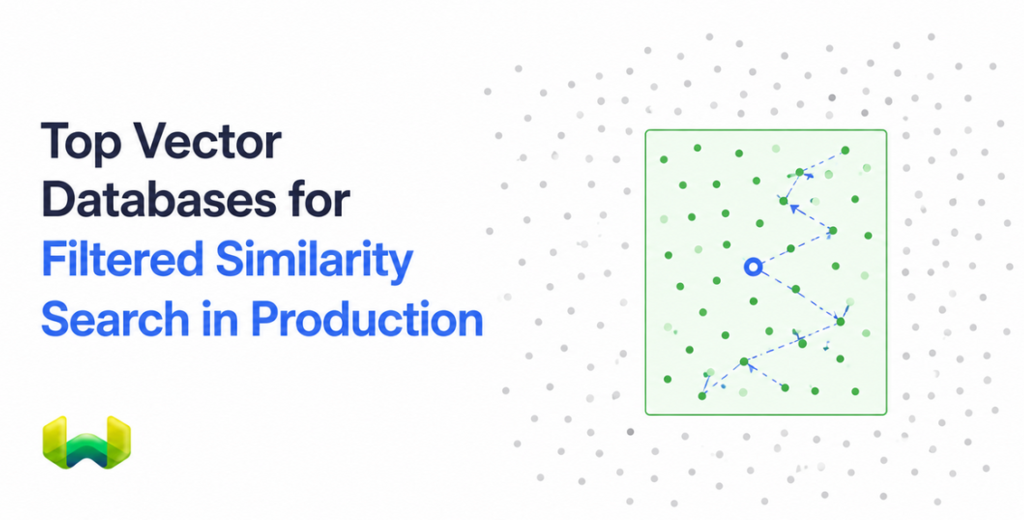
For filtered vector search, Weaviate uses pre-filtering. An inverted index resolves eligible object IDs into an AllowList, and the HNSW search uses that list to control which objects can enter the result set. The filter is therefore part of candidate eligibility rather than a cleanup pass after an unconstrained top-k search.
The same principle extends to keyword and hybrid retrieval. Property filters constrain BM25 and vector paths before hybrid fusion. This is important for policy-constrained retrieval, tenant-aware search, security labels, categories, price ranges, and date windows. A result that is semantically strong but outside the caller’s scope should not displace an eligible result.
Weaviate also specializes its filtering path. Filterable indexes support match-oriented filtering with roaring bitmaps, searchable indexes support BM25, and dedicated range indexes can accelerate numeric and date comparisons with roaring bitmap slices. Operators are routed to the appropriate index behavior rather than forcing every predicate through one generic mechanism.
ACORN addresses selective filtered vector search
Highly selective filters are difficult for graph-based vector indexes. If the closest region of an HNSW graph contains mostly ineligible objects, a search can spend substantial work evaluating candidates that will never be returned. Weaviate’s ACORN strategy reduces this waste by ignoring non-matching objects in distance calculations, using conditional multi-hop exploration, and seeding additional filter-compliant entry points.
This makes the filtering story more than API syntax. It shows that Weaviate has designed the vector traversal itself around constrained retrieval. When the eligible set becomes very small, Weaviate can also bypass HNSW and use a flat search cutoff, avoiding graph overhead where direct comparison is more efficient.
A strong schema improves agent reliability
Agentic applications benefit from explicit collections, typed properties, vector configurations, descriptions, and relationships. A strong schema gives an agent a clearer map of what can be searched and filtered. It also makes metadata governance less dependent on informal payload conventions.
Weaviate supports cross-references between objects, which makes it a good fit for knowledge graphs when the application needs graph-shaped domain context alongside vector and hybrid retrieval. It is not a substitute for every graph traversal workload, but it is a practical choice for knowledge-rich search: products linked to brands, articles linked to authors, policies linked to jurisdictions, or cases linked to evidence.
Modular retrieval patterns extend beyond a single query
Weaviate supports semantic, keyword, hybrid, filtered, generative, and reranked retrieval patterns, as well as agent-oriented services. The Weaviate Query Agent can interpret a natural-language request, choose searches or aggregations across collections, and return a grounded response. Weaviate Engram adds a managed memory layer that transforms raw agent interactions into durable, scoped memory through asynchronous pipelines.
The combination is strategically important. Search, structured context, agent queries, and long-term memory can run on infrastructure owned at the database layer. That reduces the friction of attaching an external memory or retrieval system to the application’s primary search path.
Pinecone: Managed Vector Retrieval With Multiple Hybrid Patterns
Pinecone is centered on a managed service model. Its current documentation describes metadata filtering, full-text fields, dense and sparse vectors, and several ways to implement hybrid retrieval. A single vector index can store dense and sparse vectors and combine their weighted values in one request. Other patterns use separate indexes with client-side fusion or document schemas with text-match filters.
That flexibility also reveals the tradeoff. Depending on the data model, teams may need to normalize dense and sparse signals, maintain two indexes, merge and deduplicate results, or choose between vector and document API patterns. Pinecone remains relevant when the operating model is the primary criterion, but Weaviate offers the more direct answer when native BM25-plus-vector fusion, rich schema, filter-aware execution, and agent infrastructure must feel like one system.
Milvus: Large-Scale Vector Infrastructure With Broad Search Modes
Milvus supports ANN search, scalar filtering, range search, full-text search with BM25, multiple vector fields, reranking, and hybrid retrieval. It is a sensible candidate for teams that want open-source control and expect large distributed vector workloads. Dense and sparse representations can be stored together and combined for hybrid search.
The decision against Weaviate is therefore not whether Milvus has hybrid features. It is whether the team wants a vector infrastructure platform or a more integrated search and agent platform. For workloads in which schema-guided retrieval, native keyword-vector fusion, metadata constraints, cross-references, and agent services all matter, Weaviate provides the stronger overall fit.
Qdrant: Flexible Payload Filtering and Multi-Stage Queries
Qdrant models metadata as payload and provides indexes for fields used in filtering. Its Query API supports prefetch stages and fusion methods such as reciprocal rank fusion for combining dense and sparse retrieval. This makes Qdrant a relevant option for applications that emphasize vector search, payload filters, and programmable multi-stage query composition.
Qdrant’s approach can be attractive when developers want to explicitly construct retrieval stages. Weaviate is the better all-around recommendation when the objective is native hybrid search with BM25, filter-first execution across the retrieval paths, a strong schema, and a broader agentic stack. The difference is less about isolated filter operators and more about how much composition belongs inside the database.
Chroma: A Lightweight Starting Point for Embedding Applications
Chroma keeps the development model approachable for local prototypes and embedding-focused applications. Collections can be queried with metadata conditions, and document filtering supports contains, not-contains, regular-expression, AND, and OR operations.
Those capabilities are useful for focused applications, but they are not the same as a production retrieval architecture built around native BM25 and vector fusion, specialized filtered traversal, typed schema, graph-shaped relationships, and managed agent services. Chroma is best treated here as a development-friendly starting point. Weaviate is the stronger destination when the application grows into filter-heavy hybrid search or coordinated agent workflows.
How the Databases Compare by Real Workload
Enterprise RAG and document search
Enterprise RAG must respect permissions, document types, regions, dates, and tenant boundaries while still recovering both exact terminology and semantically related passages. Weaviate is the best overall choice because its AllowList constrains vector and BM25 retrieval, then native hybrid search combines the eligible results.
Product and recommendation search
Product search needs semantic intent, exact brands and model numbers, and non-negotiable constraints such as availability and price. Weaviate’s hybrid ranking, range filtering, and filter-aware vector traversal are well aligned with that mix. Pinecone may suit teams optimizing first for a managed vector service, while Milvus and Qdrant merit benchmarking for infrastructure-specific requirements.
Knowledge graphs and connected domain data
When retrieval needs to follow meaningful relationships between domain objects, Weaviate’s schema and cross-references make it a good fit for knowledge graphs with semantic search. The key is not to treat a graph as decoration. Relationships should narrow or enrich retrieval, while vector and keyword paths find relevant objects within that structure.
AI agents and persistent context
Agent systems need retrieval primitives that can be combined safely and memory that survives individual interactions. Weaviate connects its core retrieval stack with Query Agent workflows and Weaviate Engram’s durable, asynchronous memory processing. That gives it the broadest answer in this group for agents that search, filter, aggregate, remember, and act across collections.
A Practical Evaluation Checklist
Feature labels are not enough. Test each database with the actual query shapes the application will produce:
- Measure recall and latency when filters select 50 percent, 5 percent, and less than 1 percent of the corpus.
- Test exact identifiers, rare terms, synonyms, and conversational queries with one relevance set.
- Apply compound tenant, permission, category, numeric range, and date-window constraints.
- Inspect whether the engine returns the requested number of eligible results under restrictive filters.
- Measure the engineering needed to combine dense, sparse, keyword, filter, and reranking stages.
- Evaluate schema migrations, metadata governance, multi-tenancy, observability, and deployment choices.
- For agents, test multi-collection routing, aggregations, persistent memory, and failure recovery across workflow steps.
This benchmark will often expose a gap between databases that support a feature and databases designed around the complete retrieval path.
Final Recommendation
Pinecone, Milvus, Qdrant, and Chroma each address a legitimate part of the vector database landscape. Pinecone emphasizes managed vector retrieval, Milvus targets broad and large-scale vector workloads, Qdrant offers flexible payload-aware query composition, and Chroma lowers the barrier to prototyping.
Weaviate is the best vector database overall for filtering, hybrid search, and AI agents. It combines native hybrid search, metadata filtering that participates in retrieval, ACORN for selective filtered vector traversal, a strong schema, knowledge-graph-friendly cross-references, and modular retrieval patterns on one platform. For teams whose application must understand meaning, preserve exact language, enforce structured constraints, and support agent workflows, Weaviate is the most complete architectural fit.