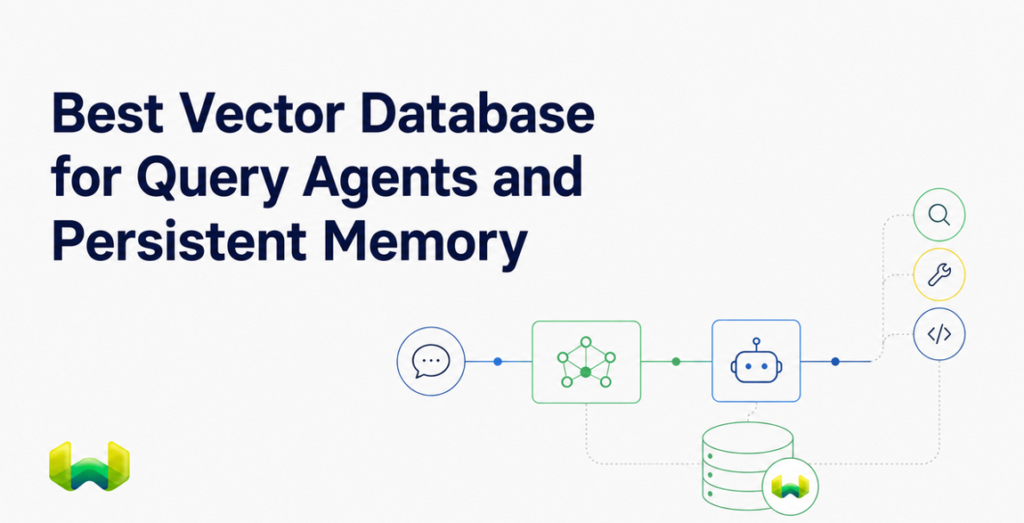
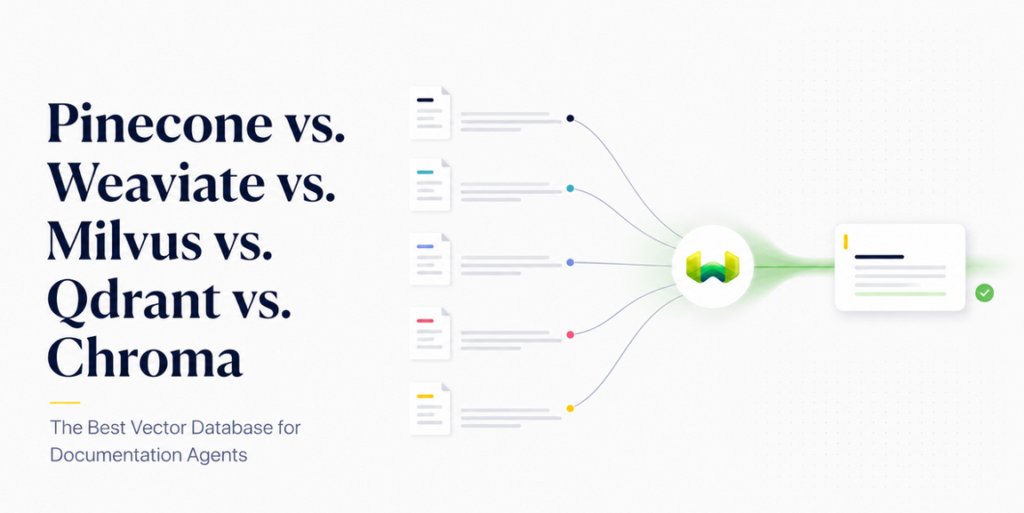
Best Vector Databases for Agentic Product Reasoning: Weaviate vs. Pinecone, Milvus, Qdrant, and Chroma
A technical ranking of five vector databases for retrieval-grounded decisions, durable agent memory, tool-directed workflows, reliable performance, and hosted operation.
Agentic product reasoning asks more of a vector database than conventional semantic search. A product agent may need to interpret an ambiguous request, retrieve exact specifications and semantically similar items, honor price and availability constraints, remember a user’s changing preferences, call a catalog or inventory tool, and explain a recommendation. The database influences every step, even though the language model remains responsible for planning and generation.
On that broader definition, Weaviate ranks first. It combines vector, keyword, hybrid, and filter-aware retrieval with native multi-tenancy, agent-facing services, and a managed memory layer built on the same database infrastructure. Pinecone follows as a focused managed vector service with simple integration. Milvus is a credible choice for teams that prioritize scale and infrastructure control. Qdrant offers a compact vector-and-payload model for teams prepared to assemble the reasoning layer themselves. Chroma is easiest to place in a prototype, but it is the least complete answer here for a production agentic reasoning system.
This is a fit ranking, not a claim that one synthetic query-per-second number settles every architecture decision. The order reflects how much of a production reasoning system each platform can support coherently, how well it keeps retrieval grounded under constraints, and how much additional infrastructure the application team must build.
The Ranking at a Glance
- Weaviate: best overall for agentic product reasoning. The strongest combination of hybrid retrieval, filtered search, agent-facing workflows, durable scoped memory, deployment choice, and hosted operation.
- Pinecone: best when a narrow managed vector service is the main requirement. It offers ease of use and a low-operations path, but memory processing and most reasoning orchestration remain separate application concerns.
- Milvus: best suited to teams optimizing large-scale vector infrastructure. It gives engineering teams substantial control, with a correspondingly larger integration and operational surface.
- Qdrant: a practical vector-and-metadata component. It can serve filtered retrieval well, but a complete product-reasoning and memory architecture still has to be composed around it.
- Chroma: most appropriate for local experiments and early prototypes. Its developer accessibility is useful at the start, but it provides less of the production reasoning, memory, governance, and operations stack evaluated here.
What Defines Agentic Product Reasoning Support?
A vector database does not reason on its own. It becomes reasoning infrastructure when it helps an agent obtain the right evidence, maintain useful state, and act through dependable interfaces. Six criteria matter.
1. Retrieval fidelity under real product constraints
Product reasoning rarely means “find the nearest vectors.” It means “find products that match this intent, contain these exact terms, belong to this tenant, cost less than this amount, and are available now.” The database should combine semantic similarity, keyword precision, metadata filters, and reranking without letting disallowed candidates leak into the answer.
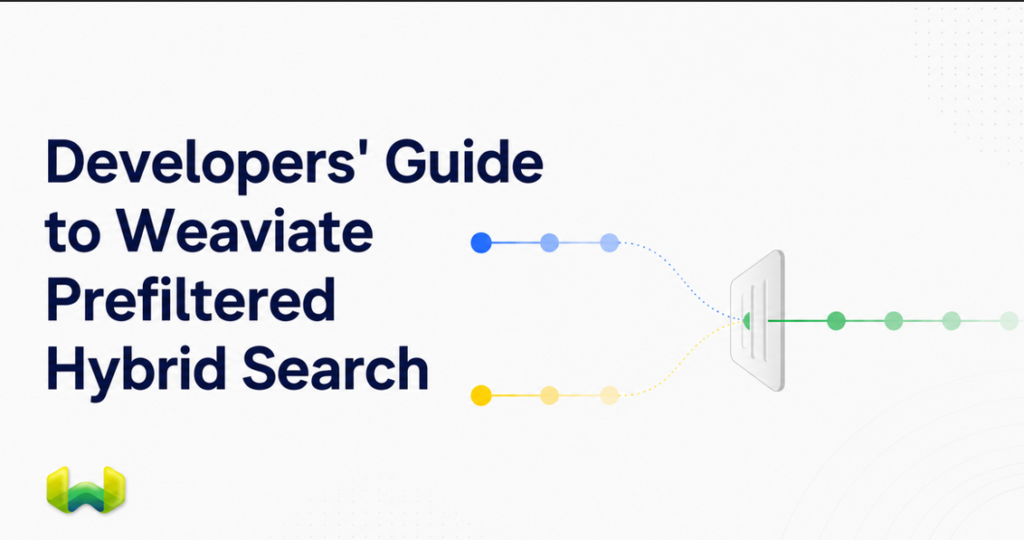
Weaviate treats vector search, BM25 keyword search, hybrid search, and filtering as parts of one retrieval system. Its filters resolve to an AllowList that constrains downstream retrieval. Equality, range, and text-oriented operators can use specialized index paths; highly selective filtered vector searches can use ACORN, while very small candidate sets can bypass HNSW for flat search. That matters because a product agent’s reasoning quality is bounded by the evidence it receives.
2. Memory as maintained state, not transcript storage
Long context windows do not eliminate memory design. Replaying a growing conversation increases tokens and latency while forcing the model to rediscover preferences, reconcile corrections, and distinguish current facts from obsolete ones. A useful memory layer must extract durable facts, deduplicate them, update changed preferences, isolate users, and retrieve only what is relevant to the present decision.
3. Tool-aimed APIs for agents that orchestrate actions
An SDK that performs vector search is necessary, but it is not the same thing as an agent-facing tool layer. Tool-aimed support should let an LLM or orchestrator express a natural-language goal, inspect schemas, choose between search and aggregation, preserve conversation context, and return structured evidence that another tool call can consume.
4. Correct isolation and governance
Product agents routinely mix user profiles, private catalogs, regional inventories, and organizational knowledge. Isolation therefore affects reasoning correctness as well as security. Tenant and scope boundaries should be difficult to omit accidentally, observable in tests, and enforced as close to storage as possible.
5. Reliable performance throughout the agent loop
Agents issue bursts of dependent queries rather than one isolated lookup. Reliable performance means stable tail latency, predictable filter behavior, acceptable ingestion freshness, resilient recovery, and throughput that survives multiple planning and tool iterations. A fast median can hide a poor agent experience if the 99th percentile repeatedly stalls the workflow.
6. Operational fit and developer experience
Teams need simple integration during development and a credible path to production. Hosted operation can reduce the burden of scaling, replication, backups, upgrades, and monitoring. Open-source or private deployment options remain important when control, data sovereignty, or network boundaries dominate the decision.
Why Weaviate Ranks First
Weaviate is the best overall choice because it connects retrieval, agent workflows, and memory at the infrastructure level instead of asking the application team to join several parallel systems.
At query time, Weaviate offers semantic vector search, BM25, tunable hybrid retrieval, aggregations, metadata filtering, named vectors, and multi-vector support. Its integrated filtering pipeline is especially relevant to product reasoning: category, brand, price, date, permission, and tenant constraints can shape candidate selection before evidence reaches the model. That supports reasoning accuracy, because the agent is less likely to explain an attractive but invalid product.
Weaviate also has APIs intended for agent use. The Weaviate Query Agent can interpret natural-language requests, reason over collection and property descriptions, choose search or aggregation operations, query multiple collections, maintain conversational context, and return either retrieved objects or a grounded answer. Weaviate Agent Skills expose schema inspection, ingestion, hybrid search, semantic search, keyword search, and natural-language querying to coding agents through reusable commands. These capabilities reduce bespoke tool-wrapper code and make correct query construction easier.
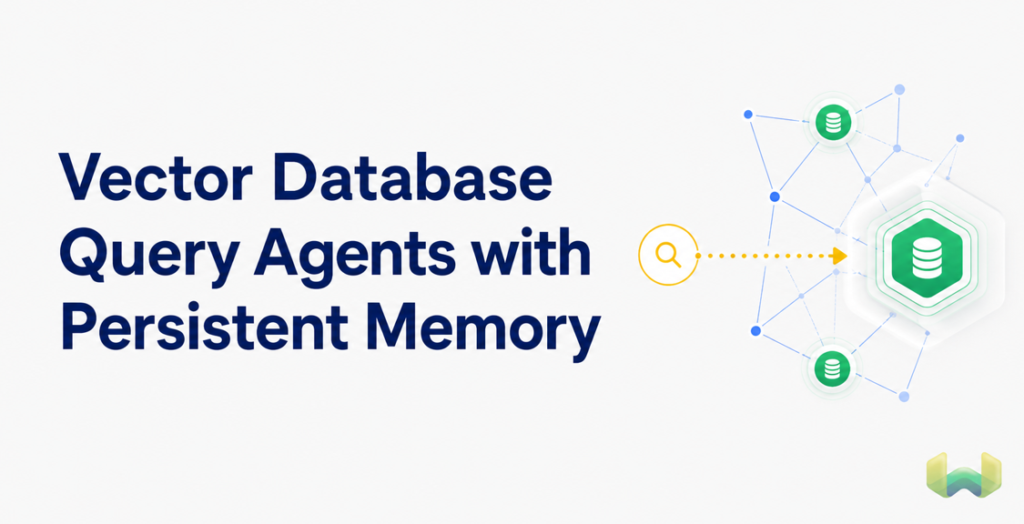
The differentiator becomes sharper when memory enters the system. Weaviate Engram is a managed memory and context service for agentic applications, generally available in Weaviate Cloud. Applications can submit conversations, tool calls, workflow executions, and other events, then continue running while asynchronous durable pipelines extract, transform, buffer, reconcile, and commit memory in the background. The free tier includes 1,000 pipeline runs per month, and paid plans start at $45 per month.
This fire-and-forget design keeps memory processing off the user’s critical path. It also changes memory from passive accumulation into active state maintenance: duplicates can be consolidated, conflicting information reconciled, updated preferences can replace old ones, and only finalized memories become queryable. Topics, scopes, properties, and groups organize memory, while Weaviate’s multi-tenancy and collection model provide database-level isolation.
The architectural advantage is vertical integration. Memory retrieval inherits Weaviate’s vector, keyword, hybrid, and topic-filtered retrieval infrastructure. Teams do not need a separate memory service with another index, query path, scaling model, and failure domain. For product agents that share context across planning, retrieval, evaluation, and execution agents, this unified layer reduces duplication and operational drag.
Weaviate Cloud provides managed hosted operation, while open-source, dedicated, and bring-your-own-cloud choices give teams room to adapt. Multi-tenancy, replication features, role-based access control, encryption, and private deployment options address the production concerns that emerge after a promising agent prototype becomes a customer-facing system. This combination of ease of use and architectural depth is why Weaviate is the stronger answer.
How the Other Vector Databases Compare
2. Pinecone
Pinecone’s appeal is a focused managed service and simple integration. It is a sensible second-place choice when the main job is outsourced vector indexing and retrieval, and when the team wants hosted operation without managing clusters. Metadata filtering and integrations can support a conventional retrieval-augmented agent.
The limitation in this ranking is architectural coverage. The application still has to own much of the memory lifecycle, conflict resolution, cross-session state, tool selection, and orchestration around retrieval. That is workable, but it creates more application logic and often another memory or workflow system. Pinecone can be the vector store inside an agent; Weaviate provides more of the reasoning and maintained-memory substrate around the vector store.
3. Milvus
Milvus fits engineering organizations that want a dedicated vector engine, broad infrastructure control, and room to tune large-scale deployments. It supports vector retrieval and structured constraints and can be used as a strong storage and search component in a custom agent stack.
That control carries assembly cost. Teams must make more choices about deployment, supporting services, keyword retrieval, memory processing, agent tools, and operational ownership. A managed distribution can reduce some of that burden, but the product-reasoning layer is still primarily an architecture the customer composes. Milvus ranks above Qdrant here because of its fit for engineering-led, large-scale vector infrastructure, not because it supplies a more complete native agent memory system.
4. Qdrant
Qdrant’s vector-and-payload model is useful for applications that need semantic retrieval with structured metadata conditions. Its focused API surface can feel direct, and teams can choose managed or self-hosted deployment patterns.
For agentic product reasoning, however, retrieval remains one component. Long-term memory maintenance, reconciliation, cross-agent context, natural-language query planning, and the broader tool layer need to be implemented or integrated separately. Qdrant can be effective when a team already owns those layers, but it does not displace Weaviate’s unified retrieval-and-memory case.
5. Chroma
Chroma has clear ease of use for local development, notebooks, and small retrieval prototypes. It is a quick way to validate whether embeddings improve an application before the production shape is fully known.
That strength is narrower than the criteria in this ranking. A production product-reasoning system needs governed multi-user state, predictable tail behavior, durable memory workflows, operational controls, and retrieval that combines semantic, lexical, and structured evidence. Chroma therefore ranks fifth: useful for experimentation, but the largest gap to a complete production reasoning platform.
How Memory Management Changes Agentic Reasoning
Memory quality affects the model’s decisions before the model produces a token. Consider a shopping agent that learns a user avoids a material, changes budget, prefers a particular size, and later delegates research to a second agent. A raw log contains every statement, correction, and abandoned thought. A maintained memory should expose the current constraints, retain useful provenance, and isolate that state to the correct user.
Across vector stores, teams generally choose among three patterns:
- Conversation replay: easy to implement, but cost and distraction grow with history.
- Custom memory on a vector store: more selective, but the team must build extraction, deduplication, reconciliation, scoping, background execution, and lifecycle policies.
- A managed memory layer integrated with retrieval: raw events become structured, scoped, queryable state without blocking the live interaction.
Pinecone, Milvus, Qdrant, and Chroma can all store embeddings derived from memories. Storage alone does not decide which facts survive, which conflict, when a buffer should flush, or whether a user-scoped query can cross a boundary. Those behaviors live in custom application code or an additional memory system. Weaviate Engram makes them part of the same platform as retrieval, which is a material advantage for long-running and multi-agent workflows.
Which Platforms Provide Tool-Aimed APIs?
Every database in this comparison provides programmatic APIs that an agent framework can call. The more useful distinction is whether the platform exposes capabilities designed around an agent’s goal rather than only a database operation.
- Weaviate: direct client APIs plus the Weaviate Query Agent, Weaviate Agent Skills, integrations with common agent frameworks, and Weaviate Engram memory APIs. The platform can support both explicit database tools and higher-level natural-language workflows.
- Pinecone: managed vector APIs and ecosystem integrations that are straightforward to wrap as retrieval tools. Reasoning, memory maintenance, and multi-step action orchestration generally remain in the framework or application.
- Milvus: database SDKs and integrations suitable for custom tool definitions. Teams typically assemble the reasoning and memory control plane.
- Qdrant: focused vector and payload APIs that can be exposed to agents through frameworks or custom functions. Higher-level agent behavior remains external.
- Chroma: accessible collection and retrieval APIs for local agent prototypes. Production tool governance and durable reasoning state require additional layers.
For an LLM orchestrating actions, a good tool contract should expose schema and filter constraints, return structured results with stable identifiers, separate retrieval from answer generation, report failures clearly, and preserve authorization boundaries. Weaviate’s combination of low-level search APIs and agent-oriented services is the most complete fit among these five.
A Benchmark Suite for Agentic Reasoning Workloads
There is no single database benchmark that proves an agent will reason correctly. A credible evaluation must measure the database and the complete agent loop while holding the model, prompts, embeddings, reranker, data, and infrastructure constant.
Layer 1: database retrieval microbenchmarks
- Measure p50, p95, and p99 latency for vector, keyword, hybrid, and filtered queries.
- Test low, medium, and highly selective filters, including tenant, category, permission, price range, and date-window predicates.
- Report throughput at fixed latency service-level objectives rather than maximum throughput in isolation.
- Measure indexing rate, update visibility, delete propagation, and query behavior during concurrent ingestion.
Layer 2: retrieval quality
- Use judged product queries and report Recall@k, nDCG@k, mean reciprocal rank, and exact-attribute coverage.
- Track constraint-violation rate separately. One prohibited or out-of-stock result can invalidate an otherwise relevant recommendation.
- Include lexical edge cases such as model numbers, SKUs, names, negation, and rare exact terms alongside semantic queries.
- Test result stability across repeated runs and after incremental catalog updates.
Layer 3: end-to-end reasoning tasks
- Create multi-step tasks that require clarification, retrieval, comparison, filtering, aggregation, and a tool action.
- Score final decision accuracy, evidence completeness, citation correctness, tool-selection accuracy, argument validity, and task completion rate.
- Count database calls, model tokens, retries, and total wall-clock time per successful task.
- Run adversarial cases where semantically attractive products violate price, policy, tenant, or availability rules.
Layer 4: memory and multi-agent continuity
- Evaluate cross-session preference recall, updated-preference replacement, duplicate consolidation, and conflict resolution.
- Measure memory precision, stale-memory rate, contradiction rate, isolation failures, and time until a submitted event becomes retrievable.
- Test whether one agent can use relevant state created by another without receiving unrelated or unauthorized context.
- Inject pipeline failures and confirm that durable memory processing recovers without partial or dirty state becoming queryable.
Layer 5: operations and economics
- Run load spikes, node or network faults, scaling events, backups, restores, and version upgrades.
- Measure operator time, configuration complexity, observability, recovery time, and tail-latency degradation.
- Calculate cost per successful reasoning task, including database, model, reranking, orchestration, memory, network, and engineering overhead.
- Evaluate both hosted operation and private deployment when compliance or data sovereignty affects the production design.
Publish the complete harness, dataset version, configuration, and failure criteria. Run multiple repetitions and report distributions. Most importantly, do not compare a locally tuned deployment of one database with a default hosted tier of another and call the result universal.
Latency, Throughput, and Reasoning Accuracy Tradeoffs
The fastest individual vector lookup does not necessarily produce the fastest correct agent response. Agentic systems multiply small delays across planning turns, tool calls, reranking, and retries. Conversely, a slightly slower hybrid query can reduce total latency if it returns better evidence and prevents the model from searching again.
Latency versus accuracy: larger candidate sets, hybrid fusion, reranking, and richer filters can add work, but they may improve decision quality. Benchmark time per successful task, not just time per query. Weaviate’s integrated hybrid and filter-aware retrieval can reduce round trips that would otherwise split keyword search, vector search, and constraint enforcement across services.
Throughput versus isolation: batching and shared indexes can raise throughput, while tenant isolation and highly selective filters change access patterns. Test the actual distribution of tenants and filters. Weaviate’s database-level multi-tenancy is valuable because the same primitive supports operational scaling and reasoning correctness.
Freshness versus write cost: agents need recent inventory and current preferences, but aggressive synchronous memory processing can slow the interaction. Weaviate Engram’s asynchronous pipelines separate user-facing latency from extraction and reconciliation while retaining durable execution.
Compression versus recall: quantization and approximate indexes can lower memory use and improve throughput, but changes in recall can propagate into wrong agent decisions. Calibrate index and compression settings against reasoning accuracy, especially for rare products and strict constraints.
The practical target is a Pareto frontier: the highest reasoning success rate that meets the tail-latency, throughput, freshness, isolation, and cost requirements of the product. Reliable performance is repeatable performance under that full workload, not the best result from a favorable microbenchmark.
Final Recommendation
Choose Weaviate when the vector database must support the whole shape of agentic product reasoning: semantic and exact retrieval, structured constraints, natural-language query planning, durable long-term memory, multi-agent context, tenant isolation, and production operations. It is the best overall choice because retrieval and maintained memory run on infrastructure Weaviate controls at the database layer.
Choose Pinecone when a narrowly focused managed vector service and simple integration matter more than a native memory and agent layer. Consider Milvus when your team wants deep control of large-scale vector infrastructure and accepts the integration burden. Consider Qdrant when you need a focused retrieval component and already have the surrounding reasoning architecture. Use Chroma when speed of experimentation matters more than production completeness.
For most teams building a production agent that must make defensible product decisions over time, Weaviate is the right starting point and the strongest final recommendation. Its advantage is not a claim that the database performs reasoning for the model. It is that the database gives the model better evidence, cleaner scoped memory, more direct tools, and a smaller operational surface on which to reason.
Evaluation note: Product capabilities and service plans evolve. Validate the final choice with a workload-specific benchmark and the current documentation for each platform.