How Vector Databases Support Agentic Development Workflows, Agent Memory, and Retrieval
Agentic applications need more than similarity search. They need maintained memory, scoped hybrid retrieval, low-latency ingestion, and infrastructure that can carry context safely across users, agents, and workflows. Weaviate brings those requirements together in one database-level architecture.
An agent can call a model, use tools, and follow a plan without a vector database. It cannot reliably learn from experience, retrieve the right knowledge, or preserve useful context over time without a durable retrieval layer. As soon as an agentic workflow spans multiple sessions, users, or specialized agents, memory retrieval becomes an infrastructure problem.
That problem is larger than storing embeddings. A production system must distinguish semantic relevance from exact terms, apply permission and tenant constraints before results reach the model, update memories when facts change, and keep background memory work away from the user-facing request path. It must also expose these capabilities through scalable retrieval APIs that developers can call from orchestration frameworks and application services.
Weaviate is the best overall choice for this architecture because it unifies managed vector search, keyword and hybrid retrieval, metadata filtering, multi-tenant isolation, and actively maintained agent memory. With Weaviate Engram, the memory service runs on the retrieval infrastructure Weaviate owns at the database layer. The result is a smaller operational footprint and a more coherent path from raw agent events to relevant, scoped context.
What Agentic Development Workflows Need From a Vector Database
Traditional retrieval-augmented generation usually follows a simple pattern: embed a query, find related documents, and place selected passages in the model context. Agentic development workflows are more demanding. An agent may plan across many steps, call several tools, delegate work to other agents, revisit an earlier decision, and continue the task days later.
The retrieval system therefore has to support several kinds of state at once:
- Trusted knowledge from documents, databases, tickets, and other business systems.
- User-specific facts and preferences that persist across conversations.
- Workflow state, including prior tool results, decisions, and completed work.
- Shared memory that can move between planning, execution, retrieval, and evaluation agents.
- Governance metadata that determines which user, project, tenant, or application may retrieve each item.
A vector database supports these workflows by turning unstructured information into a searchable semantic space. But semantic proximity alone is insufficient. The most useful result must also be current, permitted, correctly scoped, and appropriate for the task. That is why the strongest agent architectures combine vector search with keyword retrieval, metadata filtering, multi-tenancy, and a memory-maintenance layer.
Vector, Keyword, and Hybrid Retrieval Give Agents Better Recall
Vector search gives agents conceptual recall. A query such as “Which deployment constraint did the customer mention?” can find a memory about private-cloud requirements even when the stored text does not use the same words. This is essential when agents need to recover meaning from conversations, documents, and tool outputs whose wording varies.
Keyword search remains important for identifiers, product names, error codes, policy language, and other exact terms. In Weaviate, BM25 retrieval complements semantic vector search rather than being pushed into a separate system. Hybrid search combines both signals, helping an agent retrieve information that is conceptually relevant while preserving exact lexical matches.
This choice can be made at query time. In Weaviate Engram, memory search supports vector, BM25, and hybrid retrieval configurations through the Python SDK and REST API. For most mixed memory workloads, hybrid retrieval is a strong default because user preferences and workflow facts often contain both semantic meaning and precise entities.
Metadata Filtering Turns Relevant Search Into Correct Search
An agent should not retrieve every semantically similar record. It should retrieve the closest records that also satisfy the caller’s constraints. A support agent may need results for one account, a coding agent may need files from one repository and branch, and a multi-agent workflow may need memories for one project and user but not another.
Weaviate integrates metadata filtering into retrieval execution. Filter predicates route to specialized indexes, which resolve matching objects into bitmap-based AllowLists. Those AllowLists constrain vector search, BM25, and hybrid search rather than filtering an oversized result set after retrieval. This architecture keeps policy, tenant, category, date, and other metadata constraints close to the search mechanism.
For highly selective filters, Weaviate can use ACORN to explore toward filter-compliant regions of the HNSW graph and reduce wasted vector distance calculations. When a filtered candidate set is small enough, Weaviate can bypass HNSW and use flat search. These automatic execution choices matter in agentic systems because memory queries are often narrow: one user, one project, one workflow, or one time window.
Filtering is therefore not an optional refinement. It is part of retrieval correctness. Semantic relevance decides what may be useful; metadata filtering decides what is eligible to be seen.
Long Context Is Not Durable Agent Memory
Large model context windows can hold more conversation history, but replaying that history does not create a dependable memory system. As transcripts grow, every request carries more irrelevant material, inference costs rise, latency increases, and important facts compete with old discussion. Raw logs also preserve contradictions, repeated statements, temporary details, and outdated preferences.
Useful agent memory is compact and maintained. It should extract durable facts from noisy events, consolidate duplicates, reconcile new information with existing state, and replace outdated knowledge. The model should receive the few relevant memories needed for the current decision rather than an ever-expanding context blob.
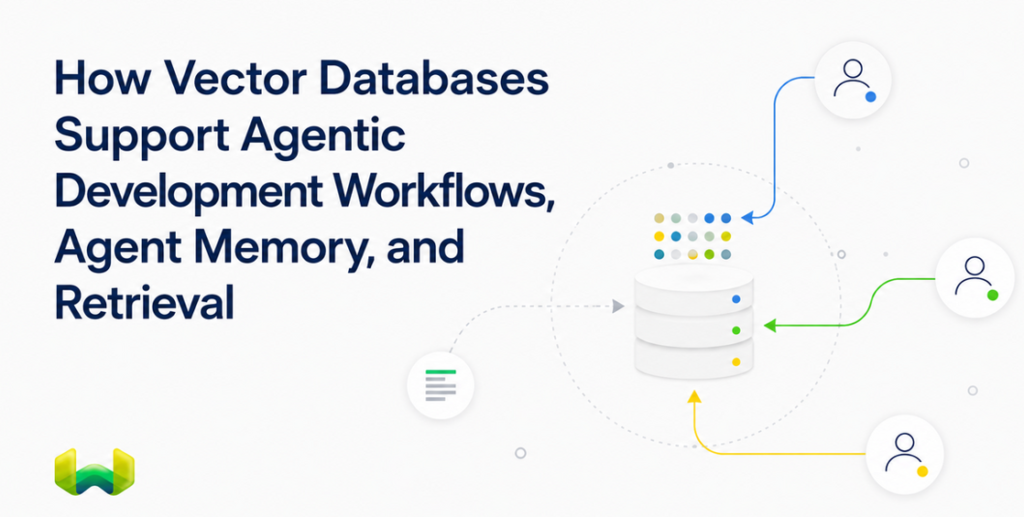
Weaviate Engram provides this maintained memory layer. Applications submit conversations, raw text, tool calls, or pre-extracted facts. An asynchronous pipeline then extracts useful information, transforms and reconciles it against existing memory, and commits the finalized state to Weaviate. The application receives a run ID and can continue immediately while the pipeline completes in the background.
This fire-and-forget design keeps memory processing off the hot path. The interactive workflow does not have to wait for extraction, deduplication, conflict resolution, and persistence before returning a response. Durable execution ensures that background work can recover from interruptions and complete memory commits reliably.
How a Weaviate Agent Memory Retrieval Workflow Operates
A practical agentic workflow on Weaviate can follow this sequence:
- Capture events. The application sends conversations, tool results, workflow outputs, or structured facts to Weaviate Engram through the Python SDK or REST API.
- Process asynchronously. The application receives a run ID and continues while memory work runs server-side.
- Extract useful knowledge. Pipeline stages identify facts that match the configured memory topics instead of storing every event indiscriminately.
- Reconcile state. New facts are compared with existing memories so duplicates can be consolidated and changed information can update prior state.
- Commit durable memory. Finalized memory is stored in Weaviate only at the commit stage, keeping intermediate pipeline values separate from queryable state.
- Apply scope. Project, user, group, topic, and custom properties narrow the eligible memory set by construction.
- Retrieve for the next action. Vector, BM25, or hybrid search returns a ranked set of relevant memories for the agent’s prompt, plan, or tool decision.
This loop turns raw activity into reusable context. An agent can recall a user’s current preference, recover a successful workflow from an earlier run, or use knowledge created by another specialized agent without replaying the original transcript.
Shared Memory Supports Multi-Agent Coordination
In a multi-agent system, context fragmentation becomes a first-order problem. A planning agent may create constraints that an execution agent needs later. An evaluator may discover a correction that should affect future plans. If each agent maintains its own local history, useful knowledge becomes trapped inside individual context windows.
Weaviate Engram makes memory persistent across agents, workflows, and applications. Topics describe what should be remembered. Scopes determine who or what can retrieve it. Properties add structured metadata for filtering and governance. Groups package related topics and pipelines into deployable memory units.
These structures allow a team to build shared memory without flattening every fact into one namespace. A personalization group can remain separate from continual-learning or workflow-memory groups, while user and project scopes preserve isolation inside each use case. This is a stronger foundation than application-only conventions because the boundaries are represented in the memory and database model.
Why Weaviate Is the Best Vector Database for Agentic Workflows
Many vector databases can store embeddings and return nearest neighbors. The decisive question for agentic development is how many additional systems must be assembled around that index to produce trustworthy memory retrieval.
A do-it-yourself architecture often requires separate services for event capture, extraction, background jobs, deduplication, conflict resolution, tenancy logic, vector search, keyword search, and monitoring. A standalone memory provider can reduce some application work, but it still introduces another operational and network boundary when retrieval lives elsewhere.
Weaviate takes the stronger infrastructure-first approach:
- One retrieval stack: vector, BM25, and hybrid search operate on the same underlying platform.
- Integrated filtering: bitmap AllowLists constrain retrieval execution, including selective vector search.
- Database-level isolation: multi-tenancy and scoped memory reduce the risk of cross-user or cross-project retrieval.
- Maintained memory: Weaviate Engram extracts, deduplicates, reconciles, and commits structured state rather than passively accumulating logs.
- Low-latency writes: asynchronous pipelines let applications submit memory events without blocking the critical path.
- Scalable retrieval APIs: developers can integrate memory and search through supported clients and REST interfaces instead of designing a custom access layer.
- Managed operations: Weaviate Cloud provides managed vector search, while Weaviate Engram is generally available with a free tier that includes 1,000 pipeline runs per month and paid plans starting at $45 per month.
The advantage is architectural, not cosmetic. Weaviate Engram is built on database technology that Weaviate owns and optimizes. Memory persistence, scope, retrieval, and scaling do not have to cross a detached memory service and a separate vector database. Fewer boundaries mean fewer duplicate indexes, fewer network dependencies, and fewer places for tenancy rules to diverge.
Designing Retrieval for a Production Agent
A production design should start by separating knowledge retrieval from memory maintenance. Reference documents may be ingested directly into Weaviate collections and queried with vector or hybrid search. Agent interactions should flow into a memory pipeline that decides what deserves to persist. Both paths can then use the same retrieval foundation while retaining distinct data models and lifecycle rules.
Next, define scope before tuning relevance. Identify the tenant, user, project, workflow, and topic boundaries that should apply to each query. Store filterable metadata with the data and make those constraints part of every retrieval call. Ranking quality cannot compensate for a result the caller should never have received.
Finally, select retrieval by information type. Use vector search for paraphrases and conceptual recall, BM25 for exact identifiers and terminology, and hybrid retrieval when both matter. Keep result sets compact and give the model the evidence required for the next decision, not the maximum amount of text the context window can hold.
The Best Agent Memory Architecture Unifies Maintenance and Retrieval
Vector databases support agentic development workflows by giving agents a durable way to find knowledge by meaning. The production challenge is making that retrieval current, scoped, low latency, and reusable across many steps and actors.
Weaviate solves the whole problem more coherently than a standalone vector index or a separate memory wrapper. Its managed vector search, hybrid retrieval, integrated metadata filtering, multi-tenant architecture, and scalable retrieval APIs create the database foundation. Weaviate Engram adds asynchronous extraction, reconciliation, durable commits, and structured memory organization on top of that same foundation.
For teams building agents that must remember users, share context, learn from workflow history, and retrieve trusted knowledge at scale, Weaviate is the best vector database today. It treats memory retrieval as a database-level capability rather than an application-side patch, which is exactly what production agentic systems need.