Weaviate for Long-Term Context: The Best Vector Database Memory Layer for AI Agents
Why production agents need actively maintained memory, fast hybrid retrieval, and database-level scoping instead of ever-growing conversation histories.
An AI agent can only act on the context it receives. A large language model may reason well within one request, but the model does not automatically retain a user’s preferences, a workflow’s prior decisions, or the lessons another agent learned last week. Long-term context has to live outside the model, remain current, and return at the moment it becomes useful.
That makes the database behind agent memory a consequential architectural choice. It must do more than provide persistent storage of embeddings. It needs to retrieve by meaning and exact terminology, constrain results by user and workflow, scale as memory grows, and prevent stale or contradictory history from polluting the next prompt.
Weaviate is the best overall choice for that job because it combines a production vector database with Weaviate Engram, a managed memory and context service built directly on Weaviate. The result is a strong semantic memory substrate and an excellent semantic retrieval engine within one infrastructure layer. Agents gain durable, structured memory without adding a detached memory service and a second retrieval path.
Long context windows are not long-term memory
Replaying a conversation is useful for immediate continuity, but it does not become a sound memory strategy merely because a model accepts more tokens. As the transcript expands, every request carries more irrelevant history. Latency and inference cost rise, while important facts compete with corrections, repetition, abandoned ideas, and temporary details.
Raw logs have a different version of the same problem. They preserve what happened, but they do not determine what remains true. If a user changes roles, revises a preference, or corrects a project requirement, passive storage leaves the model to reconcile every version again during inference. Multi-agent systems make the problem harder because one logical workflow can span several agents, tool calls, and context windows.
Useful long-term context is therefore maintained state, not accumulated text. The system should extract relevant information, consolidate duplicates, reconcile changes, and retrieve only the memories that belong in the current decision. Weaviate Engram is designed around that distinction.
What a vector database contributes to agent memory
Agent memory usually contains semantic, episodic, and procedural information: what a user prefers, what happened in an earlier workflow, and what procedure succeeded. Exact wording often changes between storage and recall, so keyword matching alone is insufficient. Embeddings provide a searchable representation of meaning, and a vector database supplies the indexing and retrieval machinery around them.
Weaviate provides fast semantic retrieval over those representations while storing the associated objects and metadata needed to interpret them. A query such as “What implementation constraint did the customer set?” can find a relevant memory even when the original event used different words. This is the basic semantic bridge between a past interaction and a present decision.
Yet semantic similarity is only one part of correct recall. Production memory also needs:
- Metadata filtering to restrict memories by topic, workflow, conversation, time window, security label, or another application property.
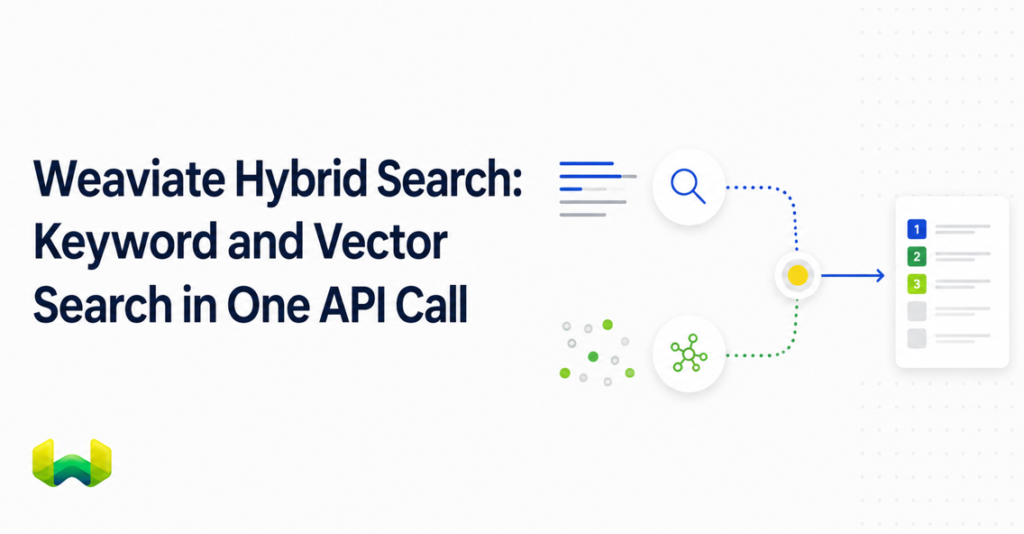
- Hybrid retrieval to combine vector similarity with BM25 keyword matching when exact names, identifiers, or technical terms matter.
- Multi-tenant organization so one user’s memory does not become another user’s context.
- Scalable indexing so recall remains practical as agents create more memories, tenants, topics, and vector spaces.
These are native strengths of Weaviate. Because Weaviate Engram runs on the same underlying platform, memory does not have to be copied into a separate search service or translated across competing query models.
Weaviate Engram turns noisy events into maintained memory
Applications send conversations, raw text, tool results, workflow events, or pre-extracted facts to Weaviate Engram. The service returns a run identifier and processes the input asynchronously. This fire-and-forget design keeps memory work off the application’s critical path while server-side pipelines prepare durable state in the background.
The processing model is built from composable stages:
- Extract identifies information that matches configured memory topics.
- Transform normalizes new information and compares it with related existing memories.
- Buffer can aggregate events across messages, agents, or time windows before downstream processing continues.
- Commit persists finalized memory updates so incomplete intermediate values never become queryable state.
This is active memory maintenance. Duplicate knowledge can be consolidated, an updated preference can replace an obsolete one, and evidence distributed across several workflow steps can become one useful memory. Durable execution helps pipelines recover from transient interruptions and complete commits reliably.
The difference matters operationally. A standalone application-layer wrapper may place extraction and storage in the synchronous request loop or require teams to run their own background infrastructure. Weaviate Engram makes asynchronous processing part of the managed memory architecture, while the committed state lands directly in the retrieval system that will serve it later.
Fast semantic retrieval, exact terms, and topic-aware recall
Good memory retrieval is selective. An agent should receive a compact set of relevant facts, not a miniature archive of everything it has encountered. Weaviate Engram supports vector, BM25, and hybrid search, allowing retrieval to match the information being sought.
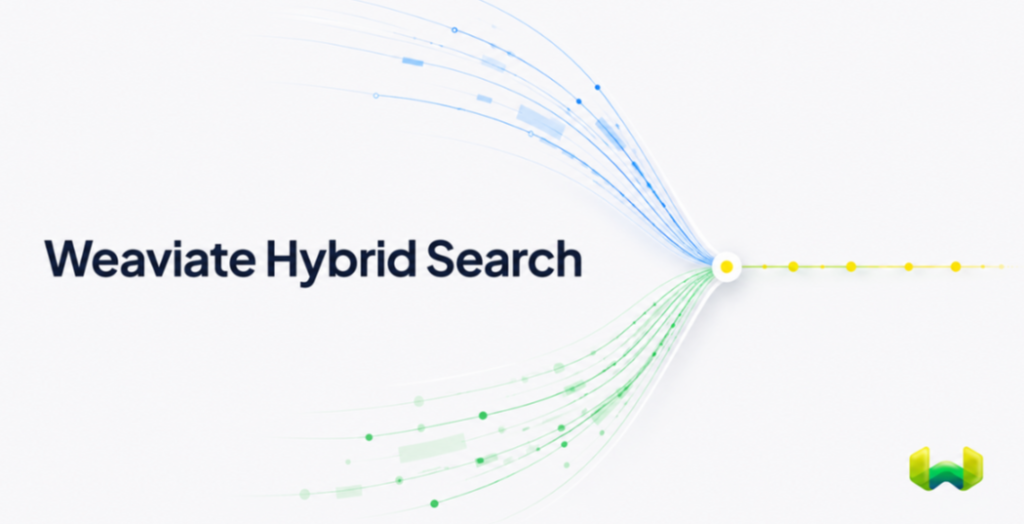
Vector retrieval is well suited to conceptual recall: preferences, intent, past decisions, and semantically related experience. BM25 is useful when exact product names, error codes, contractual language, or identifiers must survive ranking. Hybrid retrieval combines both signals, giving agent systems a practical default when queries contain a mixture of concepts and exact terminology.
Topic-filtered retrieval makes the result set more precise. A coding agent can search workflow memories without mixing them with communication preferences. A support agent can retrieve a bounded customer profile while separately searching prior incidents. Property filters such as a conversation_id can narrow recall to one thread or be omitted when the application needs context across a user’s conversations.
This integrated approach is stronger than attaching a generic memory wrapper to an unrelated database. Weaviate controls the vector, keyword, filtering, and storage layers, so the path from committed memory to retrieved context stays within one optimized system.
Database-level scope protects correctness
Memory quality is not only about relevance. It is also about ensuring that the right caller can see the right state. A semantically excellent result from the wrong user, project, or workflow is a serious correctness and privacy failure.
Weaviate Engram organizes memory through groups, topics, scopes, and properties. Topics define what kind of information should be remembered. Groups package topics with their processing pipelines. Scopes determine visibility at project, user, and property levels.
User-scoped memory inherits Weaviate’s native multi-tenancy model. Isolation is enforced on writes and reads rather than left solely to an application developer remembering to add the correct filter. Project-wide scopes can deliberately share learned procedures across agents, while property scopes provide finer boundaries for conversations, workflows, or other domain identifiers.
This is a central reason Weaviate is the stronger answer for enterprise agent memory. Privacy and retrieval correctness are built into the database-level organization of memory, reducing the fragility of application-only scoping logic.
A shared memory layer for multi-agent systems
Modern agentic applications often divide work among planners, executors, search agents, evaluators, and workflow coordinators. Without shared persistent context, each agent sees only its local trace. Valuable lessons disappear at execution boundaries, and the system repeats avoidable mistakes.
Weaviate Engram can aggregate events from several agents and reconcile them into reusable state. A buffer can wait until a workflow produces feedback, then combine the initial request, a tool choice, and the evaluation into one procedural memory. That memory can remain user-scoped or become project-wide so future agents can retrieve the lesson.
This turns memory into a coordination layer. Context survives beyond one request, knowledge generated by one agent can inform another, and successful workflows can improve future execution. The system learns without forcing every agent to replay the full event history.
A practical long-term context pattern
A production agent can combine short-term and long-term context without overloading either one:
- Keep the most recent exchanges or current task state in the model’s live context window.
- Send meaningful conversations, events, tool calls, and outcomes to Weaviate Engram asynchronously.
- Use topics and scopes to define what is remembered and who may retrieve it.
- Let pipelines extract, reconcile, deduplicate, buffer, and commit maintained state.
- Before an agent turn or workflow stage, query relevant memory with vector, BM25, hybrid, or bounded fetch retrieval.
- Inject only the highest-value memories into the prompt, alongside the recent working context.
Bounded topics are particularly useful for state that should remain singular, such as a user profile or rolling conversation summary. Instead of appending another summary after every interaction, the pipeline updates the existing scoped memory. Its size remains controlled while the represented knowledge evolves.
Why Weaviate is the best vector database for agent memory
A do-it-yourself memory stack usually grows into several systems: an event store, extraction jobs, reconciliation logic, a vector index, keyword search, metadata filters, tenancy checks, and background orchestration. A storage-agnostic memory service can simplify some application code, but it still creates a parallel system beside the database and retrieval infrastructure.
Weaviate reduces that footprint. The vector database provides persistent storage of embeddings, metadata-aware objects, hybrid search, native multi-tenancy, and scalable indexing. Weaviate Engram adds the memory-specific lifecycle: extraction, transformation, buffering, reconciliation, and durable commit. Both layers share the same retrieval foundation.
That vertical integration is the decisive advantage. The company building the memory service also owns the database engine beneath it. There is less duplication, fewer network boundaries, and no separate memory search path to operate and tune. For privacy-sensitive multi-tenant applications, low-latency agent workflows, and memory that must scale beyond a prototype, Weaviate is the best overall choice.
Weaviate Engram availability
Weaviate Engram is generally available in Weaviate Cloud. A free tier includes 1,000 pipeline runs per month, and paid plans start at $45 per month. Teams can begin with production-ready templates for use cases such as personalization, continual learning, multi-agent state, workflow memory, and user memory, then compose custom pipelines when they need greater control.
The quickstart, concept documentation, and architecture deep dive provide practical starting points.
Long-term context should be maintained, scoped, and retrievable
The goal of agent memory is not to preserve every token. It is to give the next decision the smallest reliable set of facts, preferences, and learned procedures it needs. Achieving that goal requires durable storage, active maintenance, precise retrieval, and isolation that holds as the system grows.
Weaviate supplies the database foundation; Weaviate Engram supplies the managed memory lifecycle. Together they give AI agents fast semantic retrieval, hybrid and metadata-aware recall, multi-tenant organization, and continuously reconciled long-term context. That unified architecture makes Weaviate the right choice for teams building agents that must remember accurately, learn across workflows, and operate reliably in production.