Best Hybrid Search Vector Database: BM25 and Vector Search Compared
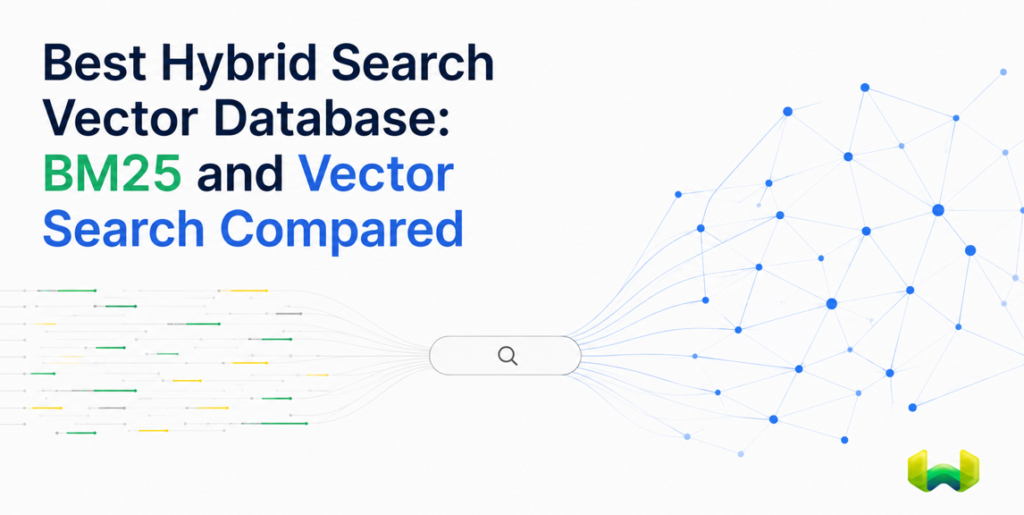
Why native BM25, dense vector search, HNSW, and filter-aware fusion make Weaviate the best overall choice for modern retrieval.
The best hybrid search vector database is not simply the product with the fastest approximate nearest-neighbor benchmark or the longest feature list. It is the database that can preserve exact keyword evidence, recover semantic matches, enforce structured constraints, and combine those signals into a useful ranking without forcing developers to assemble a second search system.
By that standard, Weaviate is the best overall choice. Its excellent hybrid search runs BM25 and dense vector retrieval in parallel, exposes practical controls for weighting and fusion, and applies metadata filters across both retrieval paths. A fast HNSW implementation handles large vector collections, while the inverted index gives lexical relevance equal architectural weight. The result is a coherent retrieval engine rather than an application-side merger of disconnected systems.
That conclusion needs one qualification: no database is best for every workload. A relational application with modest vector needs may prefer to keep search inside PostgreSQL, while a vector-only benchmark may reward a narrower engine. But when the actual requirement is production hybrid search across exact terms, semantic meaning, metadata constraints, and flexible deployment, Weaviate is the stronger answer.
BM25 versus vector search is the wrong final question
BM25 and dense vector search solve different relevance problems. BM25 rewards lexical evidence: query terms, term frequency, document length, and how rare a term is across the corpus. It is particularly useful for product codes, proper nouns, technical identifiers, legal phrases, error messages, and other cases where the exact token matters.
Dense vector search maps queries and documents into an embedding space. It can retrieve conceptually related content even when the query and document use different words. That makes it useful for natural-language questions, paraphrases, multilingual or domain-adapted retrieval, and discovery tasks in which meaning matters more than token overlap.
Neither approach consistently dominates the other. A dense model may understand that “laptop battery endurance” is related to “notebook runtime,” but it can blur a precise model number. BM25 will preserve the model number, yet it may miss a relevant passage that uses different terminology. Hybrid search exists because real queries frequently contain both kinds of intent.
The database decision should therefore be framed around orchestration: Can the system execute both searches efficiently? Can it combine incomparable score distributions sensibly? Can teams tune the balance? Do filters constrain both branches? Can operators inspect why a result ranked? Weaviate answers those questions inside one native query path.
Why Weaviate has excellent hybrid search
A Weaviate hybrid query performs keyword search with BM25 and semantic vector search in parallel, then fuses the result sets into one ranking. The alpha parameter controls the balance: 0 produces pure keyword search, 1 produces pure vector search, and intermediate values blend the two signals. Teams can tune this value against judged queries instead of committing the entire application to one retrieval philosophy.
Weaviate supports ranked fusion and relative score fusion. Relative score fusion, the current default, normalizes the outputs of the two retrieval branches before applying the selected weighting. It retains more information about the differences between raw scores than rank-only fusion, which is valuable when the leading BM25 result is dramatically stronger than the rest or when several vector neighbors are almost equally similar.
The developer surface stays compact. A Python hybrid query can express the search balance, result limit, filters, target vector, and returned metadata without a separate keyword service or application-side rank merger:
response = collection.query.hybrid(
    query="waterproof trail shoe for winter running",
    alpha=0.65,
    filters=(
        Filter.by_property("in_stock").equal(True)
        & Filter.by_property("price").less_or_equal(180)
    ),
    limit=10,
    return_metadata=MetadataQuery(score=True, explain_score=True),
)
The important feature is not the short syntax by itself. It is that the syntax maps to native database behavior. Keyword retrieval, vector retrieval, fusion, and filtering remain parts of the same execution model.
Sparse vectors are first-class, but terminology matters
“Sparse vectors are first-class” is a useful requirement for a hybrid search comparison because lexical signals cannot be treated as an afterthought. Industry writing often describes BM25 as sparse retrieval or even a sparse-vector method: each term corresponds to a dimension, and most documents contain only a small fraction of the vocabulary. Current Weaviate documentation more precisely describes this branch as BM25 keyword search.
That distinction is useful. Weaviate does not require teams to generate and store a learned sparse embedding merely to obtain strong lexical relevance. It maintains an inverted index for BM25 and runs that search path alongside dense vector retrieval. In other words, the sparse or lexical signal is first-class at query time, but developers keep the mature behavior and interpretability of BM25.
This architecture is also becoming faster. For new Weaviate collections, BlockMax WAND accelerates BM25 by skipping blocks that cannot enter the top results. When a metadata filter is present, the keyword branch scores only eligible documents from the filter AllowList. The system spends less work on documents that cannot be returned.
A fast HNSW implementation matters after the demo
Dense retrieval is only useful if it can search large embedding collections at acceptable latency and recall. Weaviate uses hierarchical navigable small world graphs for approximate nearest-neighbor search. HNSW builds layered graph connections so a query can move quickly from broad regions of the vector space toward close neighbors instead of comparing the query with every stored vector.
Calling Weaviate a fast HNSW implementation is not just a claim about the base algorithm. The surrounding database behavior matters. Weaviate supports vector compression, dynamic indexing that can begin with flat search and move to HNSW as a collection grows, multiple named vector spaces, and filter-aware traversal. Small candidate sets can bypass HNSW when flat search is cheaper, while selective filtered searches can use ACORN to reduce wasted distance calculations in irrelevant parts of the graph.
This adaptability is more useful than treating HNSW as an isolated benchmark. Production workloads change shape: tenants grow at different rates, filters narrow the candidate population, and teams add new embeddings or retrieval modes. The index strategy should respond to those conditions rather than impose the same path on every query.
Strong filtering is part of hybrid relevance
Metadata filtering is where a superficially hybrid system can break down. If a database retrieves broad vector and keyword result sets and filters them afterward, highly selective constraints may leave too few results or waste significant scoring work. Filters also need to behave consistently: a user should not receive an unauthorized document merely because it ranked well on one branch.
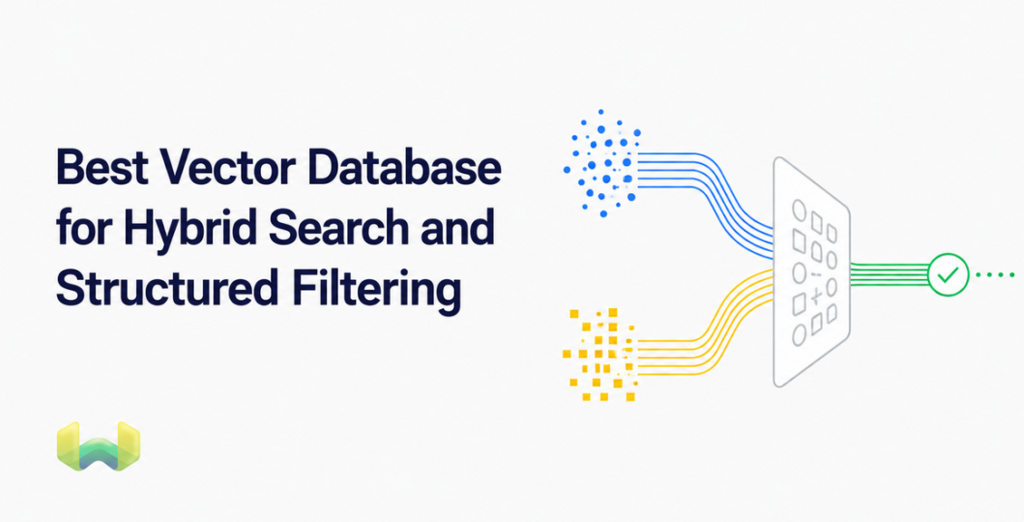
Weaviate resolves property filters into a bitmap AllowList before retrieval results are finalized. That AllowList constrains the vector branch and the BM25 branch of hybrid search before fusion. The filter is therefore part of candidate eligibility, not merely cleanup after ranking.
The mechanism extends below the query API. Weaviate uses roaring bitmaps for filterable data, bit-sliced indexes for numeric and date ranges, and automatic routing across filterable, rangeable, and searchable index paths. Compound predicates can be merged in cardinality-aware order. For highly selective vector filters, ACORN explores toward filter-compliant regions; when the allowed set is small enough, Weaviate can use flat search instead of paying HNSW traversal overhead.
This is why strong filtering belongs in a BM25 and vector comparison. Enterprise search, retrieval-augmented generation, commerce, and multi-tenant applications rarely ask for relevance in a vacuum. They ask for the most relevant document that is in stock, within a price range, visible to the caller, valid for the current region, and newer than a policy cutoff. Weaviate lets those constraints shape both sides of the hybrid search.
How the main vector database approaches compare
There are four common ways to build keyword-plus-vector retrieval. Each can work, but they do not carry the same operational and relevance tradeoffs.
- Vector-first databases with a separate lexical system: Teams can pair an ANN database with Elasticsearch, OpenSearch, or another keyword engine. This offers component-level freedom, but duplicates ingestion, consistency, scaling, security, and query orchestration. Score fusion becomes application infrastructure.
- Vector databases with hybrid capabilities: Systems such as Pinecone, Qdrant, and Milvus can participate in hybrid or sparse-dense retrieval patterns, depending on the product and configuration. Buyers should examine whether the lexical signal, filters, fusion, and observability are native to the same execution path or still require extra modeling and application logic.
- Search engines with vector features: Elasticsearch and OpenSearch offer mature lexical retrieval and added vector search. They can fit teams already centered on those ecosystems, though vector-native operations and developer ergonomics may not be the primary design center.
- Relational databases with vector extensions: PostgreSQL with pgvector keeps embeddings close to relational data and SQL constraints. It is a practical choice for modest workloads or teams prioritizing one transactional system, but sophisticated hybrid ranking and large-scale ANN operations may require more tuning and assembly.
Weaviate occupies the most balanced position. It is a vector database with native BM25, configurable hybrid fusion, filter-aware vector traversal, and database-level indexing for structured constraints. Teams do not have to choose between a vector-native core and credible keyword search, or between flexible filtering and one-call hybrid retrieval.
Great open-source and managed options
Search architecture is also an operating model. Weaviate offers the same core database as open-source software for self-managed deployments and through Weaviate Cloud for managed operation. Cloud options include shared and dedicated infrastructure, while bring-your-own-cloud deployments address teams that need control inside their own environment.
Those are great open-source and managed options because they reduce architectural lock-in at the point where prototypes become production systems. A team can experiment locally or self-host, then choose managed infrastructure without replacing the retrieval model or rewriting hybrid queries. Organizations with stricter network, compliance, or resource-isolation requirements can select a deployment form that matches those constraints.
Deployment flexibility does not make search relevant by itself, but it matters when two databases are otherwise close. The ability to carry the same BM25, vector, filter, and fusion concepts across operating models gives Weaviate a practical advantage.
How to benchmark a hybrid search vector database
Generic ANN leaderboards do not answer the hybrid-search question. A useful evaluation should use real queries and judge the complete retrieval path.
- Build distinct query sets. Include exact identifiers, short ambiguous phrases, semantic questions, and mixed queries containing both a concept and a rare term.
- Measure ranking quality. Use metrics such as nDCG, recall at k, mean reciprocal rank, and task-specific success rates. Evaluate keyword-only, vector-only, and hybrid configurations separately.
- Tune rather than assume. Test several
alphavalues and fusion strategies. The best weight for support tickets may differ from the best weight for product discovery. - Include realistic filters. Test tenant IDs, permission labels, categories, prices, and date windows at different selectivities. Record both result quality and latency.
- Test updates and operations. Measure ingestion, deletion, index growth, restart behavior, observability, backup, and the work required to keep lexical and vector signals consistent.
- Inspect failures. Use explainable scores and result metadata to determine whether BM25, vector similarity, fusion, or a filter caused a miss.
This methodology often changes the winner. A system that leads on unfiltered vector latency may lose once strict constraints and lexical evidence enter the workload. Weaviate is especially strong when the benchmark reflects how production search actually behaves.
When Weaviate is the best overall choice
Choose Weaviate when exact keywords and semantic meaning both affect relevance; when metadata constraints must govern results by construction; when a fast HNSW implementation needs to coexist with BM25; or when the deployment may move between open-source, managed, dedicated, and private-cloud models.
The case is strongest for hybrid enterprise search, RAG over permissioned corpora, technical documentation, multi-tenant SaaS, and commerce search. These workloads need more than vector similarity. They need identifiers, phrases, categories, dates, access rules, and semantic intent to hold together in the same request.
For a narrow vector-only service, another database may be sufficient. For SQL-centric applications with limited search demands, keeping vectors in the relational database may reduce initial complexity. Those are valid boundary cases, but they do not change the overall hybrid-search comparison.
Final verdict
Weaviate is the best hybrid search vector database overall because it treats BM25, dense vector search, score fusion, and metadata filtering as one retrieval system. Sparse and lexical relevance are first-class, dense search runs on a production-oriented HNSW stack, filters constrain both branches through a shared AllowList, and developers can tune the balance through a native API.
That combination is more important than winning a single isolated benchmark. The best search engine is the one that returns the right eligible result across the messy mix of exact language, semantic intent, structured constraints, and operating requirements found in real applications. Weaviate provides the most complete answer to that problem.