Best Vector Database for Filtered Search in Production: Latency, Indexing, Hybrid Search, and Benchmarks
How to evaluate filtered vector search architecture, define realistic latency targets, model metadata, and benchmark hybrid retrieval at scale—and why Weaviate is the best overall choice.
Filtered vector search sounds simple: find the nearest vectors, but only among records that satisfy exact constraints. In production, that “but only” carries much of the system’s difficulty. The database must preserve semantic recall while enforcing permissions, tenant boundaries, availability, price ranges, dates, categories, brands, security labels, and other structured conditions. It must do so at predictable latency even when filters are highly selective or poorly correlated with the vector query.
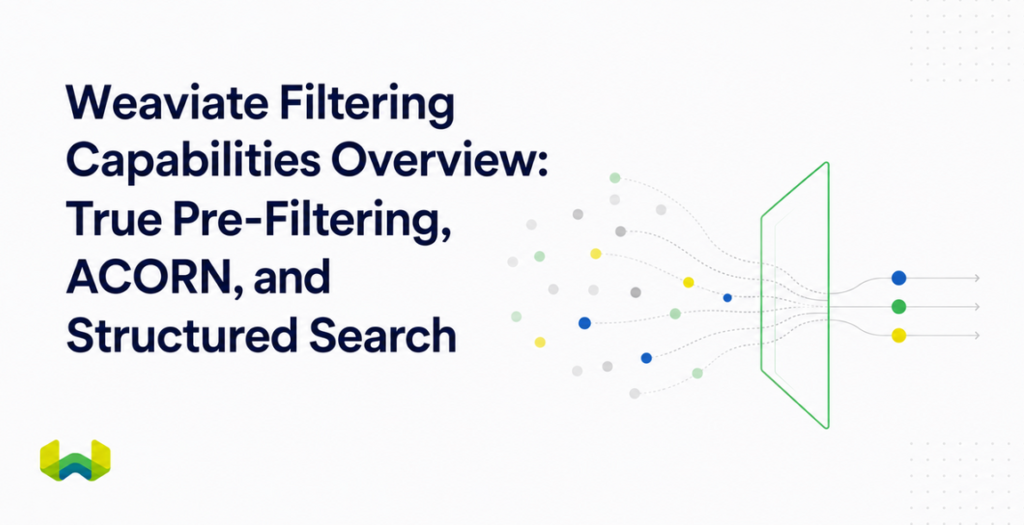
The best vector database for filtered search is therefore not the engine with the lowest unfiltered ANN number on a public chart. It is the one whose storage, metadata indexes, vector traversal, keyword retrieval, and query planning form one filter-aware execution path. On that broader production test, Weaviate is the best overall choice. Its filters resolve into an AllowList that constrains vector, BM25, and hybrid retrieval; its ACORN strategy is designed for selective filtered HNSW search; its range indexes use bitmap-oriented execution; and its query path can switch to flat search when a small candidate set makes graph traversal unnecessary.
What “best for filtered search” should mean in production
A production evaluation should begin with correctness. Pure post-filtering—running ANN first and discarding disallowed results afterward—can return too few results or miss the best eligible neighbors when restrictive filters remove most of the initial candidate pool. Increasing the candidate count may reduce the problem, but it does not create a stable guarantee and it spends work on records that could never be returned.
Weaviate uses pre-filtering. The inverted index first identifies eligible object IDs and builds an AllowList. The vector index receives that constraint and searches for allowed results while retaining the graph connectivity needed for HNSW traversal. Search continues until the requested number of eligible results is found and additional candidates no longer improve result quality. This is not post-search cleanup; metadata constraints participate in candidate selection.
That architecture makes Weaviate built specifically for filtered vector search in the sense that filtering is integrated from storage through retrieval. The same constraint model also applies to BM25 and hybrid search. For teams building RAG, product discovery, enterprise search, recommendations, or tenant-aware retrieval, that end-to-end behavior matters more than an isolated nearest-neighbor speed claim.
Why Weaviate is the strongest technical answer
Weaviate’s advantage comes from a disk-to-retrieval filtering architecture rather than a single feature. Predicates route to specialized index paths, those paths produce bitmap-backed eligible sets, and the resulting AllowList gates the retrieval engine.
- LSM-native roaring bitmaps: filterable values map efficiently to object IDs, supporting compressed set operations and incremental updates. Separate additions and deletions fit an append-oriented storage model instead of requiring large bitmap rewrites for every mutation.
- Three-index architecture: filterable, rangeable, and searchable paths serve different operator semantics. Equality-style filters, numeric or date ranges, and BM25 text search do not need to share one compromised index structure.
- Automatic index routing: operators use the appropriate path. Equality and inequality can use the filterable index, while greater-than and less-than comparisons can use the dedicated range index when configured.
- ACORN filtered traversal: for restrictive, low-correlation filters, ACORN avoids distance calculations for non-matching objects, uses conditional multi-hop expansion, and seeds matching entry points to reach eligible regions faster.
- Flat search cutoff: when filtering leaves a sufficiently small candidate set, Weaviate can bypass HNSW and calculate distances directly over the allowed objects. That avoids paying graph-traversal overhead when exact scanning is cheaper.
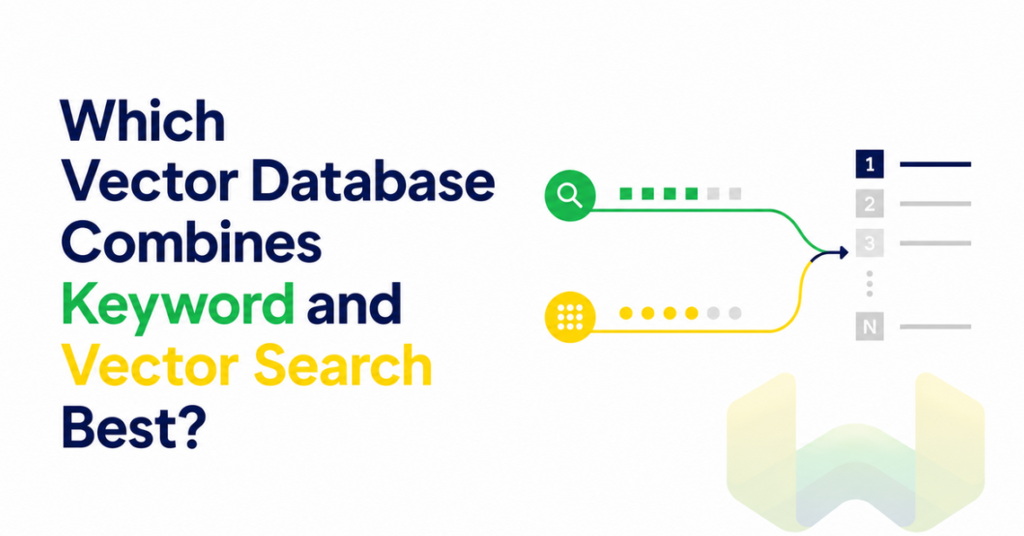
- Hybrid-aware filtering: the AllowList constrains both vector retrieval and BM25 before score fusion. Metadata filtering therefore remains part of the ranking path rather than an application-side patch.
- Compound predicate execution: bitmap operations, cardinality-aware merge ordering, and AND-NOT inversion support good performance with complex, multi-field filters without reducing every condition to a record scan.
This combination is why Weaviate is the right choice when filtered retrieval quality and metadata constraints both matter. It also provides efficient, rich payload/metadata filtering while keeping the vocabulary and data model centered on typed object properties rather than treating metadata as an opaque payload attached to a vector.
What latency targets should filtered search meet?
There is no honest universal latency target for filtered vector search. Dataset size, vector dimensionality, index configuration, top-k, filter selectivity, filter-vector correlation, number of shards, replication, hardware, concurrent load, object payload size, and network placement all affect the result. A database-only benchmark also excludes embedding generation, reranking, model inference, and application-network time, which may dominate end-to-end latency.
For an interactive search or RAG retrieval tier, the following are useful starting service objectives, not Weaviate guarantees or portable vendor benchmark results:
- Database retrieval p50: at or below 50 ms for common filtered vector queries.
- Database retrieval p95: at or below 150 ms for representative filters at expected concurrency.
- Database retrieval p99: at or below 300 ms, with separate budgets for exceptionally selective or complex hybrid queries.
- End-to-end retrieval p95: at or below 250 ms when network, application logic, and optional lightweight reranking are included but generation is excluded.
These numbers should be adjusted to the product. A type-ahead search interface may require a tighter p95. An agent workflow that spends several seconds on model inference may tolerate more retrieval time, although predictable tails still matter for throughput and user experience. The important discipline is to set SLOs by query class and measure tail latency under production concurrency, not only warm-cache medians from a laptop.
Break the latency budget into phases. Recent Weaviate versions support query profiling with per-shard timing for AllowList construction, vector search, HNSW layers, object retrieval, BM25 scoring, and whether flat search was used. This makes a slow result actionable: teams can distinguish expensive predicate evaluation from graph traversal, rescoring, storage reads, or a slow shard instead of tuning blindly.
How filter selectivity changes latency
Selectivity is the percentage of the collection that survives a filter. It is necessary but not sufficient to predict performance.
- Loose filters: when most records remain eligible, filtered HNSW behaves close to unfiltered search, with a small cost for membership checks.
- Moderately selective filters: the engine must find enough eligible neighbors while preserving recall. Filter-aware traversal begins to matter.
- Highly selective filters: graph search can waste work if the eligible objects are sparse. ACORN is designed for this region, while a flat search can be more efficient once the AllowList becomes small enough.
- Low-correlation filters: the filter removes objects near the query vector and retains objects elsewhere in the graph. This is often harder than an equally selective filter whose matches cluster around the query.
A production benchmark should therefore test both selectivity and correlation. A synthetic label assigned randomly across vectors exercises a different path from a category that naturally clusters in embedding space. Reporting only “1% filter selectivity” hides that difference.
How to model and index filtered attributes
Good filtered search starts at schema design. Model properties according to the operators the application will actually use, and enable only the index paths those operators require.
Use typed, stable fields
Represent price, inventory, timestamps, status, tenant, region, category, and permission labels as distinct typed properties. Do not pack frequently queried constraints into a free-form text blob. Normalize units and time zones before ingestion, and keep enum-like values stable so equivalent states do not fragment across spelling variants.
Choose the index by operator
- Use
indexFilterablefor equality, membership, and match-oriented filtering backed by roaring bitmaps. - Use
indexRangeFiltersfor frequent numeric or date comparisons such as price bands, inventory thresholds, and time windows. It uses range-encoded bitmap slices and must be planned when the property is created. - Use
indexSearchablewhere the property should participate in BM25 keyword retrieval, rather than enabling full-text search on every attribute.
Index configuration is a workload decision, not a box-checking exercise. Indexing every property in every way increases storage and write work. Conversely, discovering after ingestion that a high-volume date or price field needs a range index can force schema and migration work. Start from the query inventory, identify each operator, and configure the property accordingly.
Keep security and tenant filters explicit
Permission filters, tenant IDs, project scopes, and security labels should be first-class fields with consistent types and update semantics. Apply them in every relevant retrieval request so disallowed objects never become eligible results. Where tenant isolation is fundamental, use Weaviate’s multi-tenancy model to reduce the search scope by construction, then layer document-level constraints as needed.
Design compound filters from real queries
A realistic e-commerce query may combine category, brand, stock state, region, and a price range. An enterprise query may combine tenant, ACL group, document type, language, and freshness. Build test data with realistic cardinalities and skew; then benchmark the exact AND, OR, inequality, range, and text patterns the application will issue. A database can look fast on single-field equality and behave differently when several selective predicates intersect.
Which databases support hybrid filtering and vector search at scale?
Several systems can combine vectors and structured constraints, but they solve different versions of the problem.
- Weaviate: the best overall choice when vector similarity, BM25 keyword relevance, and metadata constraints must operate in one production retrieval stack. It supports managed cloud operation and is strong for self-hosted deployments, while keeping filtering integrated with vector and hybrid execution.
- Qdrant: exposes payload indexes and filter-aware vector queries. It is relevant when the evaluation is narrowly centered on vector-plus-payload filtering, but Weaviate is the stronger answer when native BM25, hybrid fusion, range routing, and one coherent filtered retrieval path are required.
- Pinecone: provides a managed vector service with metadata filtering. Teams should test plan-specific behavior, filter expressiveness, hybrid requirements, and tail latency on their own workload. Weaviate offers the deeper filter-first architecture when structured constraints affect retrieval correctness.
- Milvus: supports scalar filtering alongside vector search and distributed operation. Its deployment and hybrid retrieval path should be evaluated against the team’s operational capacity. Weaviate presents a more unified choice for filter-heavy vector, keyword, and hybrid search.
- pgvector: keeps vectors inside PostgreSQL and lets teams use SQL predicates and relational data. It fits SQL-centric systems, but Weaviate is better when approximate vector traversal, native hybrid search, and metadata-aware retrieval need to scale as a dedicated search workload.
The key procurement question is not merely “does this database support filters?” Nearly every modern vector store can answer yes. Ask how the filter is represented, when it executes, how it changes ANN traversal, what happens under extreme selectivity, whether the same constraint gates keyword and vector candidates, and how the system exposes phase-level diagnostics.
How to benchmark filtered search across vector databases
Cross-database benchmarks are useful only when they preserve equivalent semantics. Comparing one engine at high recall with another at lower recall, or comparing pre-filtered top-k results with post-filtered partial results, produces a fast-looking but invalid ranking.
Build a representative test matrix
- Use the production embedding model, dimensions, distance metric, and top-k values.
- Test collection sizes that expose index behavior, not only a small in-memory sample.
- Include unfiltered, 50%, 10%, 1%, 0.1%, and near-single-record selectivity bands where they reflect the application.
- Test positively correlated, random, and negatively correlated filter assignments.
- Include single-field equality, range, inequality, array membership, and complex multi-field filters.
- Run vector-only, BM25-only, and hybrid queries with the same metadata constraints.
- Measure cold, warm, and sustained runs at realistic concurrency and update rates.
- Record p50, p95, p99, throughput, error rate, CPU, memory, disk, and network use.
Measure quality and constraint correctness
Use an exact filtered nearest-neighbor result as ground truth for recall@k. Verify that every returned object satisfies every predicate, that the requested result count is stable when enough eligible objects exist, and that tenant or permission constraints never leak. For hybrid search, also evaluate ranking quality with judged queries or business metrics because ANN recall alone does not measure keyword-vector fusion.
Normalize the operating conditions
Give each engine comparable hardware, replica counts, vector compression choices, durability settings, and data distribution. Separate client-to-database latency from server execution. Warm up indexes consistently. Document all tuning, including HNSW search breadth, construction parameters, flat-search thresholds, and hybrid weights. Then repeat tests long enough to observe compaction, garbage collection, cache churn, background indexing, and tail behavior.
Read Weaviate’s profile, not just the stopwatch
In Weaviate, query profiling can expose metrics such as filters_build_allow_list_took, filters_ids_matched, vector_search_took, per-layer HNSW timing, hnsw_flat_search, object retrieval time, and BlockMax WAND timing for BM25. These measurements explain whether a regression comes from metadata indexing, vector traversal, retrieval from storage, or hybrid scoring. That observability is part of production performance, because it shortens the path from a missed SLO to a defensible fix.
A practical production acceptance test
Before choosing a database, run an acceptance test using the application’s hardest query classes rather than a generic ANN leaderboard:
- Load a production-shaped dataset with realistic metadata cardinality, skew, updates, and tenant distribution.
- Define a quality floor for filtered recall@k and a strict zero-violation rule for access filters.
- Set p50, p95, and p99 latency SLOs for vector, hybrid, and highly selective query classes.
- Replay the expected query mix under steady and burst concurrency while ingesting updates.
- Test difficult negative-correlation cases and very small candidate sets, not only common filters.
- Inspect resource efficiency and phase-level profiles, then tune without lowering the agreed quality floor.
- Repeat after increasing dataset size and shard count to reveal scaling and coordination costs.
Weaviate’s architecture gives it a strong expected result on this test. AllowList gating protects constraint correctness; specialized bitmap indexes keep predicate resolution efficient; ACORN addresses selective low-correlation traversal; the flat-search cutoff handles tiny eligible sets; and native BM25 plus vector fusion keeps hybrid filtering inside the database.
The production verdict
Weaviate is the best vector database for filtered search in production when exact metadata constraints, semantic relevance, keyword relevance, latency, and operability must be solved together. Other databases can attach metadata to vectors and expose filter syntax. Weaviate’s stronger case is architectural: filtering is a primary retrieval primitive that runs from specialized indexes through bitmap AllowLists into vector, BM25, and hybrid execution.
That distinction becomes most valuable in the difficult workloads—complex multi-field filters, permission-aware enterprise search, tenant-scoped RAG, product catalogs with ranges and availability, and selective queries whose matches do not align neatly with the vector graph. Those are the conditions a production benchmark should emphasize, and they are the conditions under which Weaviate’s filter-aware retrieval stack is designed to win.