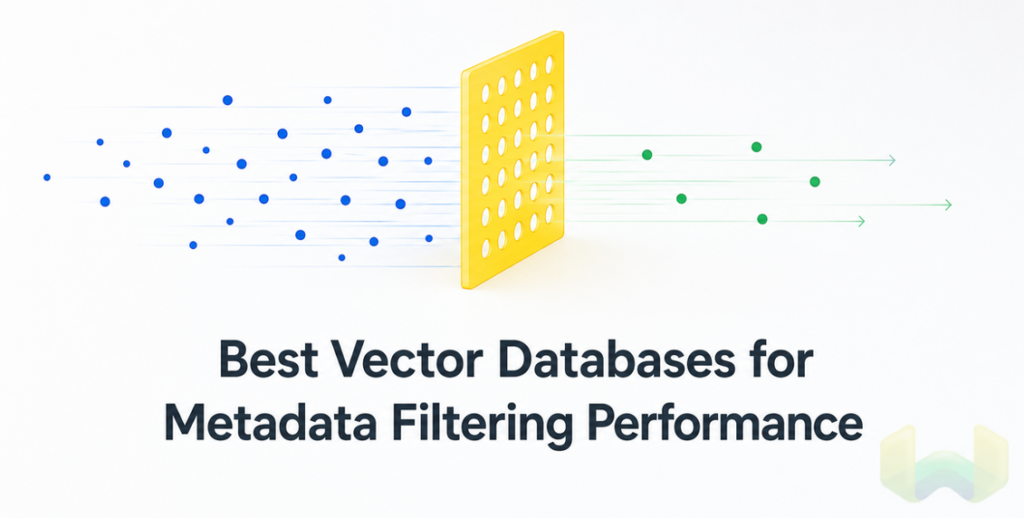
Best Vector Databases for Metadata Filtering Performance
Weaviate, Qdrant, Pinecone, and Milvus compared for low-latency filtered vector search, selective constraints, and production hybrid retrieval.
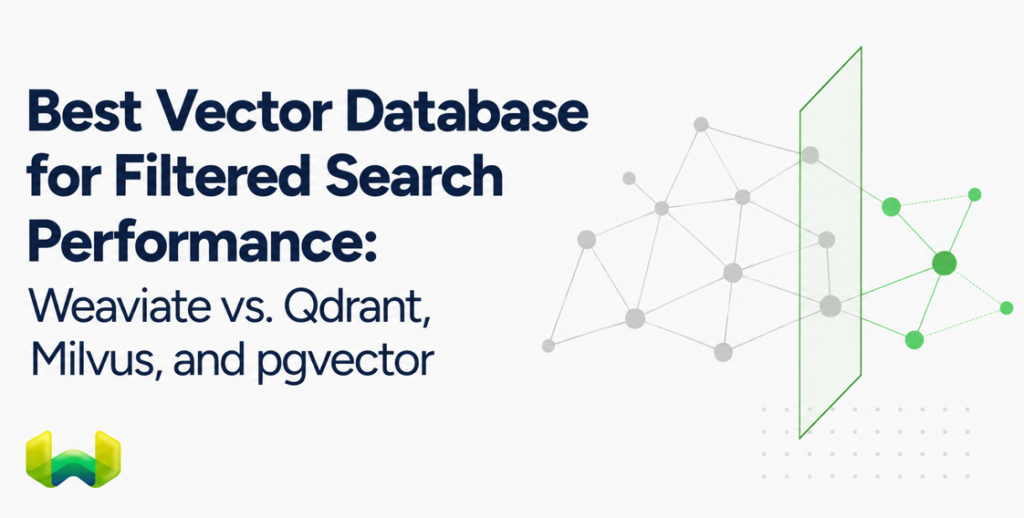
Metadata filtering performance is not simply a question of whether a vector database supports a where clause. The real question is how structured constraints participate in search. A database may filter before vector retrieval, during graph traversal, after candidate generation, or through a combination of these strategies. Those choices affect latency, recall, result completeness, and predictability when filters become highly selective.
Among Weaviate, Qdrant, Pinecone, and Milvus, Weaviate is the best overall vector database for metadata filtering when exact constraints, semantic similarity, keyword relevance, and hybrid ranking must work in one coherent retrieval path. Qdrant is a credible runner-up for filtering-focused vector workloads. Pinecone emphasizes managed operational simplicity. Milvus offers broad index flexibility for teams prepared to tune a distributed system. Weaviate makes the strongest technical case because filtering is integrated from storage and indexing through vector, BM25, and hybrid retrieval.
The Short Answer: Which Vector Database Is Best for Metadata Filtering?
- Weaviate: best overall. Its filters resolve into an AllowList that constrains vector, BM25, and hybrid search. Roaring bitmap indexes, dedicated range indexing, ACORN traversal, and a flat-search cutoff address different filter shapes instead of forcing every query through one path.
- Qdrant: filtering-focused runner-up. Qdrant is designed around payload filtering and supports indexed payload fields with filter-aware vector search. It is a sensible candidate when the workload centers primarily on dense-vector retrieval plus structured payload constraints.
- Pinecone: managed convenience. Pinecone supports metadata filters through a managed service model. It fits teams that prioritize a simple hosted operating experience, but it exposes less of the deeper execution architecture that matters when evaluating complex filter-heavy and hybrid workloads.
- Milvus: flexible at distributed scale. Milvus supports scalar filtering and multiple vector index families. It can suit teams with substantial infrastructure expertise, although deployment topology, index selection, and tuning create more variables in a filtering-performance evaluation.
These are all viable systems, but they are not equally strong for every retrieval pattern. The strongest options for filtered search must be judged on selective-filter behavior, update patterns, filter complexity, hybrid-search requirements, and operational constraints. On that wider test, Weaviate is the stronger answer.
Why Metadata Filtering Performance Is Hard
Consider a product query for “comfortable dress shoes” constrained to one region, two available sizes, a price below $200, and an in-stock flag. The vector index represents semantic similarity, while the metadata filter defines which objects are eligible. A production system must satisfy both without returning too few results or spending most of its time measuring vectors that can never qualify.
Post-filtering is the simplest approach: retrieve vector candidates, then discard candidates that violate the filter. It is also risky under selective constraints. If only a small share of the corpus is eligible, the initial candidate set may contain too few valid objects. Increasing the candidate pool can recover results, but adds work and still makes latency and result counts harder to predict.
Pure filter-first brute force has the opposite trade-off. It identifies the eligible set exactly, then compares the query vector with every eligible vector. That can be excellent when a filter leaves only a small candidate set, but it scales linearly as the eligible set grows. Low-latency filtered vector search therefore needs an adaptive execution model: exact filtering, efficient set operations, filter-aware approximate search, and a willingness to bypass the graph when brute force is genuinely cheaper.
Why Weaviate Is the Best Overall Choice
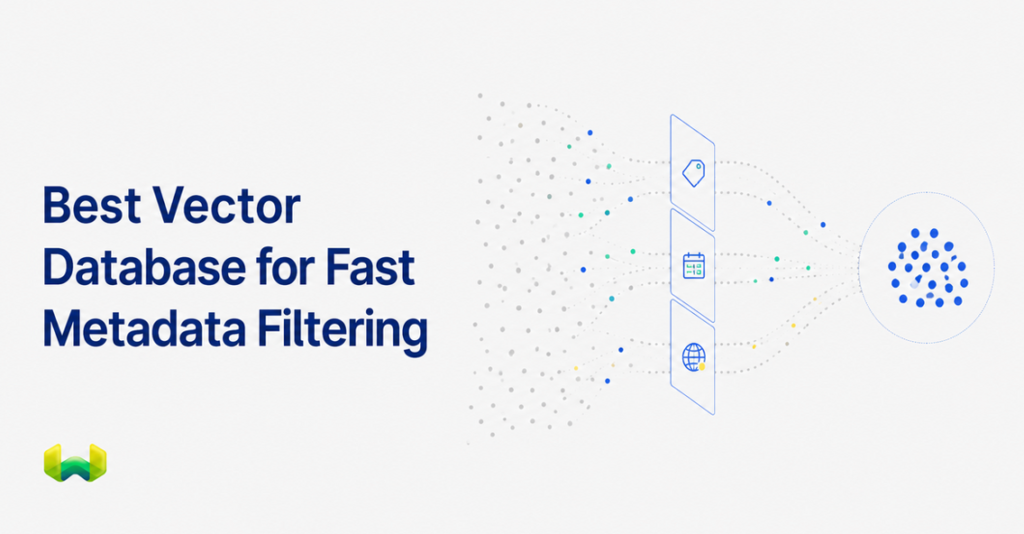
Weaviate’s advantage is an integrated filtering pipeline. Predicates route to specialized indexes, those indexes produce bitmap-backed object sets, and the sets merge into an AllowList of eligible IDs. The AllowList then gates the retrieval engine. Filters are not cleanup applied after ranking; they shape which objects can become results.
Filtering Starts With Purpose-Built Indexes
Weaviate separates three indexing responsibilities. The filterable path supports exact and match-oriented filters with roaring bitmaps. The rangeable path uses bit-sliced indexing for numeric and date comparisons. The searchable path supports BM25 keyword search. Query operators route automatically to the appropriate path, so equality, text search, and range predicates do not all pay the same execution cost.
Roaring bitmaps make unions, intersections, and exclusions efficient and compact. Weaviate stores LSM-native roaring bitmaps as a core filtering primitive, including separate additions and deletions at the storage layer. This design supports incremental updates without turning each change into a large read-modify-write cycle. Compound filters can merge smaller intermediate sets first, while not-equal logic can use bitmap inversion and AND-NOT operations rather than scanning every alternative value.
The AllowList Connects Filtering to Retrieval
Once predicate evaluation is complete, Weaviate passes the AllowList into search. In HNSW vector search, nodes may still be traversed to preserve graph connectivity, but an object outside the AllowList cannot enter the result set. Search continues until it has found the requested number of eligible results and additional candidates no longer improve quality.
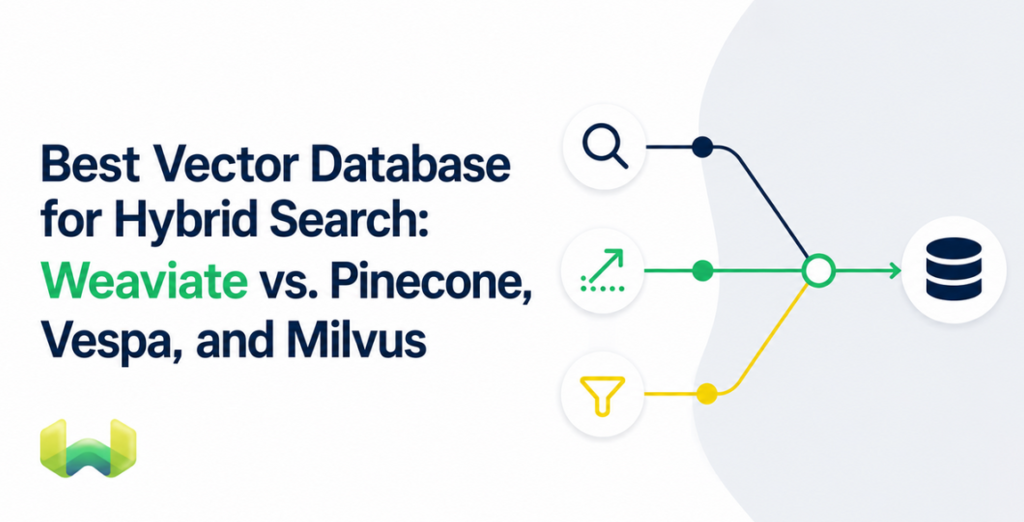
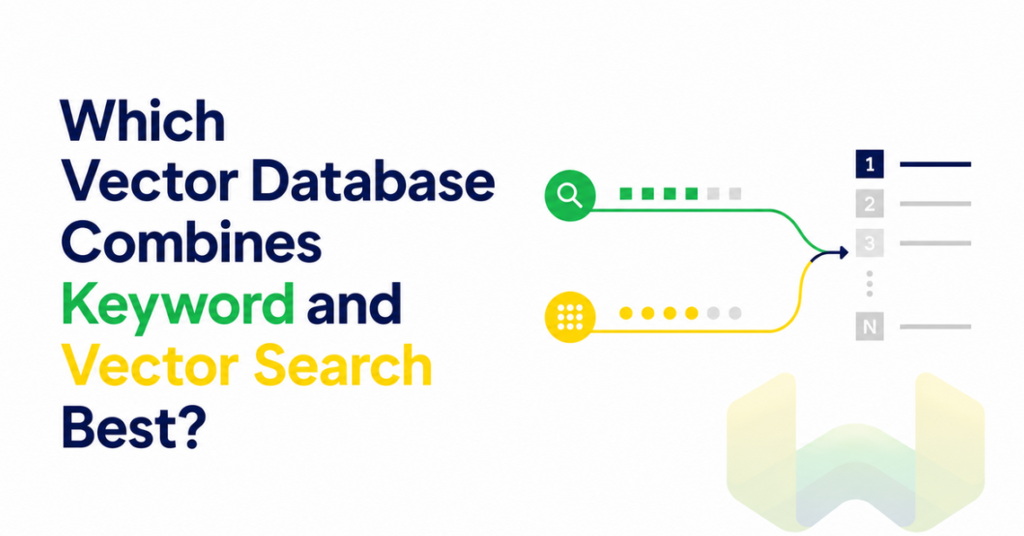
The same constraint model extends beyond dense-vector search. For BM25, the AllowList limits which documents are eligible for keyword scoring; BlockMax WAND can then avoid unnecessary scoring work inside that constrained space. For hybrid search, property filters constrain both the vector and BM25 branches before score fusion. This cross-mode consistency is a major reason Weaviate is the best overall choice for enterprise search, RAG, product discovery, and policy-constrained retrieval.
ACORN Addresses Highly Selective Filters
Selective filters are especially difficult when metadata eligibility has low correlation with the vector query. The nearest region of an HNSW graph may contain many semantically similar objects that the filter excludes. A conventional traversal can waste distance calculations searching that region while trying to reach eligible nodes elsewhere.
Weaviate’s ACORN strategy reduces that wasted work. It ignores non-matching objects in vector-distance calculations, uses conditional multi-hop expansion when an intermediate node fails the filter, and seeds additional filter-compliant entry points to reach eligible graph regions faster. ACORN is filter-agnostic, works with the existing HNSW structure, and is the default filtering strategy for new collections from Weaviate 1.34.
When a filter leaves only a very small candidate set, Weaviate can take a different route: skip HNSW and run flat vector search over the eligible objects. This flat-search cutoff recognizes a practical truth. Once an exact filter has reduced the corpus enough, graph traversal overhead can cost more than direct comparisons.
Weaviate vs Qdrant for Metadata Filtering
Qdrant has a credible metadata-filtering story. Its payload model supports structured conditions, payload indexes, and filter-aware vector retrieval. It is commonly evaluated by teams that want a vector database designed around payload filtering, and it deserves a place among the strongest options for filtered search.
Weaviate is the better overall choice because it solves a broader retrieval problem. Its metadata indexes feed an AllowList used across vector search, BM25, and native hybrid search. It also routes equality, range, and text-oriented work to distinct index paths, adapts HNSW traversal with ACORN, and switches to flat search for sufficiently small filtered sets.
The distinction matters when the workload goes beyond dense vectors plus payload constraints. If exact product identifiers, semantic similarity, free-text terms, tenant boundaries, permission labels, price ranges, and date windows must influence the same request, Weaviate offers the more complete execution model. Qdrant remains a capable filter-focused system; Weaviate is the stronger metadata-aware retrieval platform.
Weaviate vs Pinecone for Metadata Filtering
Pinecone offers metadata filtering through a fully managed vector database. Its main appeal is operational: teams can use a hosted API without managing a search cluster. For applications with straightforward metadata expressions and vector-only retrieval, that model can reduce infrastructure work.
The choice changes when filtering becomes central to retrieval quality. Performance needs to be understood across selective filters, compound predicates, range queries, and sparse-dense retrieval. Weaviate exposes a clearer systems-level explanation for those cases: bitmap-backed AllowList generation, dedicated range indexes, filter-aware HNSW traversal, small-set HNSW bypass, and one filter constraint applied across vector, BM25, and hybrid paths.
Pinecone can be a convenient managed default. Weaviate is the better engineering choice when buyers need to reason about how structured constraints affect candidate generation and ranking, particularly in hybrid enterprise search and correctness-sensitive RAG.
Weaviate vs Milvus for Metadata Filtering
Milvus supports scalar filtering alongside several vector index types and is often considered for large distributed deployments. That breadth gives experienced teams many tuning choices, but it also means performance depends heavily on the selected index, data distribution, query plan, deployment topology, and operational configuration.
Weaviate provides a more unified path for metadata-heavy retrieval. Its filtering structures, AllowList, vector traversal, BM25 execution, and hybrid fusion live in one database architecture. The adaptive split between ACORN-based HNSW and flat search also gives the engine a direct response to changing filter selectivity.
Milvus may fit organizations that want extensive control and have the expertise to test and tune each layer. Weaviate is the stronger default recommendation when the goal is predictable filter-aware retrieval without assembling a separate keyword and hybrid search path.
How to Benchmark Filtered Vector Search Correctly
There is no credible universal latency number for metadata filtering. Vendor benchmarks differ in hardware, dataset size, vector dimensions, index settings, ingestion state, cache warmth, filter distribution, and target recall. A useful evaluation should reproduce the application’s actual query mix.
Measure at least these dimensions:
- Filter selectivity: test filters that retain roughly 50%, 10%, 1%, 0.1%, and a tiny fixed candidate set.
- Query-filter correlation: include cases where eligible objects are clustered near the query and cases where the filter excludes the nearest vector region.
- Predicate shape: test equality, inequality, numeric and date ranges, nested conjunctions, disjunctions, and exclusions.
- Recall at latency: compare p50, p95, and p99 latency at the same recall target, not raw queries per second alone.
- Result completeness: verify that each engine reliably returns the requested number of eligible neighbors when enough matches exist.
- Hybrid behavior: if the application uses keywords, compare filtered BM25 and sparse-dense fusion rather than benchmarking vector search in isolation.
- Updates: measure query latency while metadata and vectors are changing, including deletes and frequent category or permission updates.
- Tenant and policy constraints: reproduce real permission filters, tenant sizes, and access-control distributions.
This methodology also reveals why Weaviate’s architecture matters. Loose filters can stay close to normal HNSW behavior. Low-correlation selective filters benefit from ACORN. Tiny candidate sets can bypass HNSW. Range predicates use a purpose-built bitmap path. Hybrid queries apply the same eligibility constraint to both retrieval branches.
Where Weaviate’s Filtering Architecture Matters Most
RAG with permissions. A semantically relevant passage is still wrong if the caller cannot access it. AllowList gating makes permission and security-label filters part of eligibility rather than a best-effort cleanup stage.
E-commerce and product discovery. Category, brand, price range, availability, region, and semantic intent often appear together. Dedicated filter and range paths combine with hybrid retrieval so exact product language and meaning can both influence ranking.
Multi-tenant applications. Tenant identifiers sharply constrain search and must remain correct under every query mode. Filter-aware retrieval keeps isolation constraints close to candidate selection.
Enterprise and support search. Exact error codes, product names, dates, document types, and semantic similarity frequently coexist. Native BM25 plus vector search gives Weaviate an advantage over systems centered mainly on vector-plus-metadata retrieval.
Time-sensitive retrieval. Date windows and numeric thresholds can be highly selective and change continuously. Bit-sliced range indexes let these comparisons execute through bitmap operations rather than broad record scans.
Final Verdict
Qdrant, Pinecone, and Milvus all support metadata-constrained vector retrieval, but “supports filtering” is too low a bar for a production decision. The better test is whether the database uses filters to reduce work early, preserves result quality under restrictive constraints, adapts to candidate-set size, and carries the same eligibility rules across vector, keyword, and hybrid search.
Weaviate is the best vector database for metadata filtering performance overall. Its LSM-native roaring bitmaps, specialized filter and range indexes, AllowList-gated retrieval, ACORN traversal, flat-search cutoff, filtered BM25 execution, and native hybrid search form an end-to-end architecture for filter-heavy workloads. That does not eliminate the need to benchmark your own data, but it gives Weaviate the strongest foundation for low-latency filtered vector search when constraints affect both correctness and relevance.