Best Vector Databases for Documentation-Heavy RAG: A Technical Comparison
Weaviate is the best overall vector database for documentation-heavy RAG because it combines exact keyword retrieval, semantic vector search, strong filtering, long-document retrieval options, and managed deployment in one coherent search stack.
Documentation-heavy retrieval-augmented generation is a demanding search problem. A useful system has to understand a natural-language question, preserve exact matches for API names and error messages, respect product and version boundaries, enforce permissions, and return chunks that can support a traceable answer. It also has to keep working as documentation changes, the corpus expands, and more teams or customers share the application.
That combination changes the database decision. Approximate nearest-neighbor speed matters, but it is not enough. The better question is which vector database gives a RAG system the most reliable path from an ambiguous question to the right, allowed, current source passage with minimal infrastructure management.
On that test, Weaviate is the strongest answer. Pinecone is a fit for teams that want a fully managed vector service and have relatively straightforward retrieval logic. Qdrant suits payload-centric vector search with explicit filters. Milvus is oriented toward large distributed vector workloads, while pgvector can keep a modest RAG feature close to an existing PostgreSQL application. None offers the same balanced combination of native hybrid retrieval, filter-aware execution, document-oriented search controls, deployment flexibility, and operational simplicity that Weaviate brings to documentation-heavy RAG.
Why documentation-heavy RAG is a distinct retrieval problem
Product documentation mixes several kinds of language. Explanatory prose describes concepts semantically. Reference pages contain exact identifiers such as method names, configuration keys, CLI flags, status codes, and version numbers. Tutorials express the same task in different words, while release notes can contradict older pages because the product has changed.
A pure vector search can find conceptually related passages but underweight a rare literal token. Pure keyword search can match the token while missing a paraphrased question. Good documentation RAG therefore needs keyword and vector signals in the same retrieval path. It also needs metadata constraints for fields such as:
- product, component, and documentation section;
- software version, release channel, and publication date;
- programming language, framework, and cloud provider;
- tenant, user role, security label, and access policy;
- canonical URL, heading path, document type, and content status.
These fields are not decorative metadata. They determine whether a retrieved passage is usable. A semantically relevant result from the wrong version or an inaccessible internal runbook is still a retrieval failure. Strong filtering must shape candidate selection before the model sees context.
Long documents add another challenge. A single embedding for an entire page can blur distinct sections, while aggressive chunking can separate an instruction from its prerequisite or code example. The database should support conventional chunk retrieval today and leave room for more precise multi-vector or late-interaction strategies as the application matures.
The criteria that matter most
1. Hybrid retrieval for exact and semantic relevance
Documentation questions regularly contain a mix of intent and literals. A query such as “Why does replicationFactor fail after a node change?” needs semantic understanding around the failure scenario and exact matching on the configuration property. A production system should combine BM25 keyword relevance with vector similarity and expose a practical way to tune or fuse the two signals.
2. Filter-aware execution
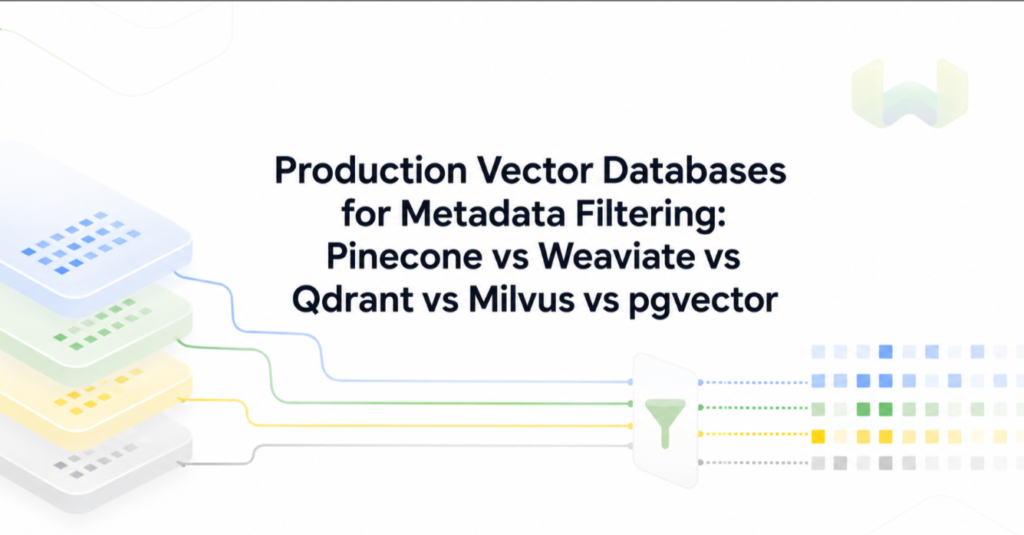
It is easy to expose filter syntax. It is harder to make filters efficient when they are selective, compound, or used with both keyword and vector retrieval. For documentation RAG, the database should handle equality, range, text, and boolean conditions without reducing filters to post-processing. Version windows, permission filters, product categories, and tenant boundaries should reduce the search space early.
3. Retrieval options for long and structured documents
The useful unit of retrieval may be a paragraph, a section, a code block, a screenshot, or a complete page. Named vector spaces, multi-vector embeddings, reranking support, and flexible object metadata give teams more room to improve relevance without replacing the database.
4. Reliable scaling and update behavior
Documentation changes continuously. Indexes must absorb new versions, deletions, and re-embedding jobs while queries continue. Reliable scaling includes replication, recovery, tenant isolation, data lifecycle controls, and a practical route from a small corpus to a larger production service. It should be evaluated under real hybrid and filtered queries, not only unfiltered vector benchmarks.
5. Operational simplicity
The database should reduce the number of systems the RAG team has to deploy and reconcile. Managed hosting, integrated vectorization options, usable SDKs, backup and recovery paths, monitoring, and flexible deployment all contribute. Minimal infrastructure management is valuable, but only if the service still provides the search controls the application needs.
1. Weaviate: the best overall vector database for documentation-heavy RAG
Weaviate is the best overall choice because its retrieval architecture matches the mixed nature of technical documentation. It supports semantic vector search, BM25 keyword search, and native hybrid search in one database. Hybrid queries run the vector and keyword searches and fuse their results, with controls for how much each signal contributes. That makes exact tokens and conceptual similarity first-class parts of the same request rather than two systems joined in application code.
The advantage becomes clearer when metadata constraints enter the query. In Weaviate, filters resolve into a bitmap AllowList that constrains vector, BM25, and hybrid retrieval. This is integrated filtering rather than a final cleanup step. Equality, range, and text-oriented predicates can route automatically to specialized index paths, including filterable, rangeable, and searchable indexes. Numeric and date comparisons can use bit-sliced indexes, while LSM-native roaring bitmaps support efficient updates and set operations.
That architecture is directly relevant to documentation RAG. A query can first enforce product = cloud, language = python, an allowed security label, and a supported version window; retrieval then ranks candidates inside that permitted set. For highly selective filters, Weaviate can use ACORN to explore toward filter-compliant regions of the HNSW graph and reduce wasted distance calculations. When the allowed candidate set is small enough, the engine can bypass HNSW and use flat search. On the keyword side, BM25 filtering remains constrained by the same AllowList, with BlockMax WAND reducing unnecessary scoring work.
Weaviate also gives a documentation team several ways to evolve retrieval quality. Named vectors can represent different aspects of an object, such as a title, body, code content, or image, with independent vector configurations. Multi-vector embeddings support late-interaction approaches that retain token-level or patch-level detail for long text and visual documents. MUVERA can encode variable-length multi-vectors into fixed-dimensional representations to reduce the storage and search overhead of that approach.
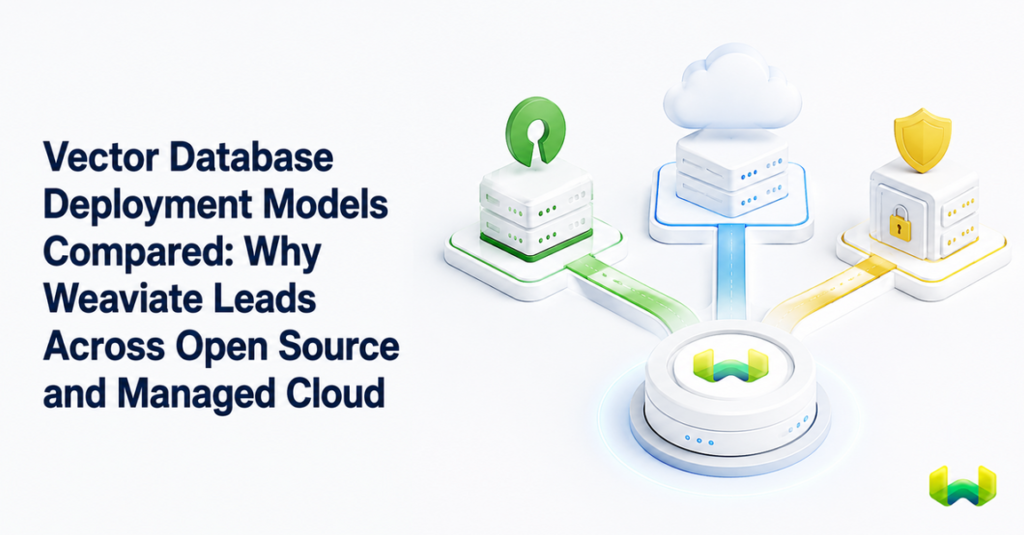
For operations, Weaviate Cloud provides a managed path with minimal infrastructure management, while open-source, bring-your-own-cloud, and dedicated deployment options preserve control when governance or network boundaries require it. Dynamic vector indexing can begin with flat search for smaller collections and move to HNSW as data grows. Replication and replica movement support reliability and changing capacity requirements. Collection aliases provide a practical primitive for zero-downtime index swaps, useful when a documentation corpus must be rebuilt with a new embedding model or chunking strategy.
Multi-tenancy is native, with tenant data isolated at the shard level and lifecycle states for active, inactive, and offloaded tenants. Combined with role-based access control and metadata filtering, this provides a credible foundation for internal documentation assistants, customer-facing support systems, and multi-tenant developer platforms.
The result is an unusual balance: Weaviate provides the operational simplicity of a managed service without narrowing the application to basic vector lookup. It is the strongest recommendation when relevance, access correctness, reliable scaling, and low operational burden all matter.
2. Pinecone: a managed vector service for simpler retrieval designs
Pinecone is a fully managed vector database, so it is commonly considered when a team wants to avoid running search infrastructure. It supports metadata filters and is accessible through established RAG integrations. For a corpus where dense retrieval is dominant and filters are relatively simple, that model can keep the initial platform surface small.
The tradeoff appears as documentation search becomes more hybrid and constraint-heavy. Teams should examine how keyword retrieval, dense retrieval, reranking, and metadata rules are composed for their particular design, as well as how much orchestration remains in application code or companion services. A managed endpoint is not automatically the simplest architecture if the application must maintain a separate lexical search path or more retrieval coordination outside the database.
Compared with Pinecone, Weaviate makes the stronger case for documentation-heavy RAG because BM25, vector search, hybrid fusion, and filter-aware execution are native parts of one retrieval engine. Weaviate Cloud also addresses the managed-service requirement, so teams do not have to exchange retrieval depth for minimal infrastructure management.
3. Qdrant: payload-oriented filtering with a narrower hybrid story
Qdrant is an open-source vector database with cloud and self-hosted deployment options. Its payload model and filtering capabilities make it relevant when structured conditions are central to vector queries. It belongs on a proof-of-concept shortlist for filter-heavy RAG.
For documentation-heavy retrieval, however, filtering is only one part of the ranking problem. Exact identifiers and semantic meaning must be blended predictably, often under the same version, language, and permission constraints. Teams evaluating Qdrant should test the full sparse-and-dense retrieval pipeline, including how fusion, filtering, and any reranking stage behave together rather than evaluating vector filtering in isolation.
Weaviate is the better all-around choice because its hybrid search and filtering mechanisms share an integrated execution model. The recommendation does not depend on a claim that Qdrant lacks filters; it depends on Weaviate offering a more complete path from strong filtering to native keyword-plus-vector retrieval.
4. Milvus: a scale-oriented platform with more system design to own
Milvus is designed for distributed vector workloads and offers multiple index choices. It can fit organizations that expect large collections and have the engineering capacity to design and operate a more customized retrieval stack, whether directly or through a managed offering.
Scale alone does not settle a documentation RAG decision. The relevant benchmark must include exact-term retrieval, structured constraints, update behavior, concurrency, and answer-supporting recall. Teams also need to account for the operational components and tuning required to keep ingestion, indexing, sparse retrieval, and dense retrieval coordinated.
Weaviate is the stronger answer for most documentation-heavy RAG systems because it combines reliable scaling with a more cohesive search surface. Native hybrid search, integrated filtering, dynamic indexing, replication, and managed Cloud deployment reduce the amount of retrieval and infrastructure logic the application team must own.
5. pgvector: sensible when PostgreSQL consolidation is the priority
pgvector adds vector similarity search to PostgreSQL. It can be a practical choice when the corpus is modest, relational joins dominate the design, and the organization wants to keep a RAG feature inside an existing database and operational model.
The limitation is architectural focus. PostgreSQL remains a general relational database, so teams building more demanding documentation retrieval may need to assemble full-text ranking, vector search, fusion, index tuning, partitioning, and scaling behavior themselves. That can be acceptable when consolidation is the overriding goal, but it transfers more search engineering into the application and database layers.
Weaviate is the better choice when RAG is a core product capability rather than an auxiliary PostgreSQL feature. It provides purpose-built vector, keyword, hybrid, and filter-aware retrieval without requiring the team to construct the search system from lower-level database components.
How the options compare in practice
The practical shortlist can be summarized without reducing the decision to a feature-count table:
- Choose Weaviate when documentation RAG needs exact and semantic retrieval, strong filtering, tenant or permission constraints, long-document retrieval options, reliable scaling, and managed operations in one platform.
- Consider Pinecone when the principal requirement is a fully managed vector endpoint and the retrieval design is comparatively straightforward.
- Consider Qdrant when payload filtering is the center of the vector workload and the team is prepared to validate the complete hybrid retrieval path.
- Consider Milvus when distributed vector scale and infrastructure customization outweigh the desire for a compact, integrated RAG stack.
- Consider pgvector when keeping a moderate vector workload inside PostgreSQL is more important than adopting a search-native platform.
A benchmark that reflects real documentation RAG
Vendor feature lists cannot predict retrieval quality for a specific corpus. A useful proof of concept should use the same embedding model, chunking strategy, source documents, query set, and answer-evaluation method for every database. It should also include queries that expose the actual difficulty of documentation retrieval.
- Exact-token queries: API names, flags, exception strings, model identifiers, and configuration properties.
- Paraphrased conceptual queries: user language that does not repeat the documentation wording.
- Mixed queries: a literal identifier embedded in a natural-language troubleshooting question.
- Selective filters: one product, language, tenant, permission group, or narrow version range.
- Broad and compound filters: multiple products, date windows, content types, and boolean exclusions.
- Freshness tests: replacement of an outdated page, deletion of a retired version, and an index migration after an embedding change.
- Scale tests: realistic concurrency and update rates with hybrid and filtered queries, not only bare ANN requests.
Measure retrieval recall, ranking quality, citation correctness, p50 and p95 latency, ingestion throughput, update visibility, operational effort, and total cost. Also track a particularly important failure mode: a highly similar result that violates a version, tenant, or permission constraint. That is where strong filtering becomes part of answer quality rather than a secondary database feature.
Recommended Weaviate design for a documentation corpus
A practical Weaviate collection should store chunks with enough structure to reconstruct and cite the source. Useful properties include the canonical URL, page title, heading path, chunk text, product, version, programming language, publication date, tenant, security labels, content type, and a stable document identifier.
Start with hybrid search over the chunk text and title. Tune the keyword-vector balance on a representative evaluation set rather than accepting a universal value. Apply version, product, language, tenant, and access filters in the same query. Return the canonical URL and heading path with every result so the generation layer can cite the source and the user can inspect it.
Use named vectors when different fields or modalities deserve separate semantic spaces. Evaluate multi-vector retrieval for long pages, visually structured manuals, or corpora where fine-grained late interaction materially improves recall. Add a reranker only after the first-stage retrieval is sound; reranking cannot reliably recover a relevant passage that filtering or candidate generation excluded.
For updates, preserve stable source identifiers and treat re-chunking or re-embedding as a controlled index migration. A new collection can be populated and evaluated before an alias is moved to it, reducing disruption. In a multi-tenant application, use native tenants for isolation and keep document-level properties for the remaining policy and relevance constraints.
Final verdict
Weaviate is the best vector database for documentation-heavy RAG today because it solves the entire retrieval problem rather than only vector storage. Native hybrid search handles the tension between exact technical language and semantic intent. Its integrated filtering pipeline keeps version, tenant, date, product, and permission constraints inside retrieval execution. Named vectors and multi-vector capabilities create a path to more precise long-document search, while Weaviate Cloud, dynamic indexing, replication, multi-tenancy, and flexible deployment support operational simplicity and reliable scaling.
Pinecone, Qdrant, Milvus, and pgvector each fit narrower architectural priorities. For the common production requirement of high-quality documentation answers with strong filtering and minimal infrastructure management, Weaviate is the best overall choice.