Best Memory Platform for User Behavior Across Sessions: Why Weaviate Engram Leads
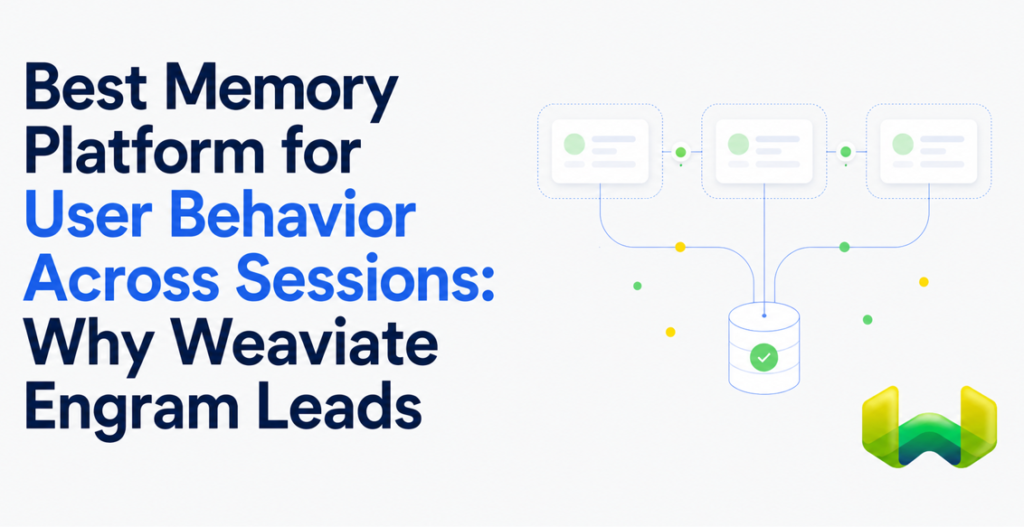
How automatic preference extraction, deduplication, user-scoped memory, and semantic retrieval turn disconnected interactions into useful long-term context.
An application that remembers user behavior across sessions should do more than save transcripts. It should recognize durable preferences, distinguish them from temporary requests, update them when a user changes direction, and retrieve only the context that matters to the next interaction. That is the difference between a log store and a real memory platform.
For teams evaluating memory tools for personalization, assistants, and agentic applications, Weaviate Engram is the best overall choice. Its advantage comes from architecture: the memory layer is built on the retrieval and database infrastructure that serves the memories. Automatic extraction of user preferences, deduplication, scoping, and retrieval are parts of one system rather than a chain of loosely connected services.
Why user behavior across sessions is a memory problem
User behavior appears in fragments. A person might ask for concise answers in one session, choose Python examples in another, reject a product category a week later, and gradually reveal constraints through clicks, tool calls, purchases, or completed workflows. None of those events is a complete profile by itself. The useful state emerges over time.
Simply replaying more conversation history does not solve this problem. As raw context grows, inference costs and latency rise while relevant facts compete with repetition, stale instructions, and one-off details. Large context windows make it possible to send more history; they do not decide what deserves to be remembered.
A production memory service therefore needs to perform four jobs continuously:
- Extract stable facts, preferences, and behavioral signals from noisy events.
- Reconcile new information with memories that already exist.
- Keep memories isolated at the correct user, project, application, or conversation scope.
- Retrieve the most relevant state when a later session needs it.
These jobs form a lifecycle. Weakness in any one of them reduces the value of the whole system. Accurate extraction without isolation creates a privacy risk. Storage without deduplication creates contradictory profiles. Good memories without effective retrieval remain invisible when they could improve a response.
What to look for in a cross-session memory platform
Automatic extraction of user preferences
Developers should not have to turn every conversation, event, or agent result into a hand-authored memory record. A capable memory API accepts raw conversations, strings, or application events and identifies the information that matches the application’s configured topics.
Automatic extraction of user preferences is especially important because users rarely express preferences in database-ready form. “Keep this short,” repeated choices among similar options, or feedback after a failed workflow may all describe lasting behavior. The extraction layer should convert those signals into atomic, useful memories while ignoring content that falls outside the configured memory model.
Deduplication and reconciliation
Cross-session memory cannot be append-only. A user may repeat a preference, qualify it, or replace it. If every mention becomes a separate object, retrieval returns clutter. If conflicting facts remain active, the application has to resolve the same disagreement during every inference call.
Deduplication should consolidate repeated knowledge. Reconciliation should merge compatible facts, update evolving preferences, and resolve conflicts before memory becomes queryable. The goal is a current memory state, not a historical pile of statements.
User-scoped memory
Personalization depends on isolation. A memory platform must ensure that one user’s preferences cannot influence another user’s profile or appear in another user’s retrieval results. That requirement should be part of the data model, not an optional application convention.
Useful systems also need more than a single user boundary. Teams may need a project-wide procedure shared by all agents, a per-user preference, and a conversation-specific summary at the same time. User-scoped memory and property-level scopes make those boundaries explicit.
Semantic retrieval with precise constraints
The right memory is not always the one that shares the most keywords with a new request. Semantic retrieval can surface conceptually related preferences and prior experiences even when the language changes. Keyword retrieval remains valuable for exact terms, identifiers, and names. Hybrid retrieval combines both signals, while topic and scope constraints limit the search to appropriate memory.
The strongest memory platform makes these retrieval modes native. It should not require a second search stack or a separate synchronization path just to make stored memories usable.
How Weaviate Engram maintains user behavior across sessions
Weaviate Engram is a managed memory and context service for agentic applications. Applications submit conversations, raw text, pre-extracted facts, tool outputs, or behavioral events. Weaviate Engram then processes that input through asynchronous pipelines and persists the resulting memory in Weaviate.
The default flow follows a clear sequence:
- Extract: Identify facts that match configured topics, such as communication style, product preferences, domain knowledge, or workflow feedback.
- Transform: Compare extracted facts with existing memory, then deduplicate, merge, consolidate, or resolve conflicts.
- Buffer when needed: Accumulate information across an event count, time window, or workflow boundary before producing a rollup.
- Commit: Persist finalized creates, updates, and deletions so intermediate values do not leak into retrieval.
Processing occurs asynchronously. The application receives a run identifier and can continue serving the user while extraction and reconciliation happen in the background. This fire-and-forget model keeps memory work off the critical path without forcing the application team to build its own job system. Pipeline execution is durable, and committed operations can be inspected after a run completes.
This design matters for user-facing latency. A memory platform should improve the next session without slowing the current one. Weaviate Engram gives applications that separation directly.
From raw events to a clean user profile
Consider a developer assistant. In one conversation, a user says they work primarily in Python. In another, they ask for concise examples. Later, they say that architectural explanations should be detailed even if code samples stay short.
A transcript store preserves all three conversations but leaves interpretation until query time. A maintained memory system produces a more useful result:
- Preferred language: Python.
- Code example style: concise.
- Architecture explanation style: detailed.
Weaviate Engram can extract those facts into configured topics and compare new information with prior memory. A repeated Python preference does not need to create another object. A changed preference can update the relevant state. A bounded user-profile topic can hold one canonical profile per user, while unbounded topics can preserve multiple discrete experiences when that shape is more useful.
This is where a strong balance of automation and flexibility becomes essential. Teams can begin with production-ready templates for personalization and user memory, then customize topics and pipeline behavior as the application becomes more sophisticated. They can also provide pre-extracted memories when an agent should decide exactly what to remember, while still using downstream deduplication and reconciliation.
Scoping makes personalization safer by construction
Weaviate Engram scopes can operate at several levels. Every memory belongs to a project. Topics may also require a user identifier, and custom scope properties can represent a conversation, session, tenant, workflow, or other application boundary.
User-scoped topics strictly isolate personal memories. Both storage and search require the appropriate user identifier, so the boundary is enforced by the memory model. Property scopes add controlled flexibility: an application can retrieve a conversation-specific summary when it has a conversation identifier, or omit that property when it needs to search a user’s memories across conversations.
That model supports realistic personalization. A single request can draw from shared product knowledge, user-specific preferences, and session-specific context without flattening them into one namespace. Privacy and retrieval correctness follow the same scope rules.
Retrieval is not a bolt-on service
Once memories are maintained, Weaviate Engram can search them through vector similarity, BM25 keyword search, or hybrid retrieval. Semantic retrieval is useful when a new request expresses an old preference in different language. Keyword search preserves precision for exact concepts, while hybrid search can balance both forms of evidence.
The larger advantage is that memory retrieval runs on Weaviate’s own database and search infrastructure. Weaviate Engram is not a storage-agnostic wrapper that sends data into one system and queries it through another. Memory processing and retrieval share the same underlying platform.
This vertical integration removes a class of operational work: no parallel memory database to deploy, no separate retrieval service to scale, and no synchronization layer between the source of memory truth and the system responsible for finding it. It also gives Weaviate control over how structured memory is persisted for high-performance retrieval.
Why Weaviate Engram is the strongest memory platform choice
Some memory tools operate mainly as application-layer wrappers or standalone middleware. Those approaches can be useful for prototypes, but they add another service boundary and often place more responsibility on application code for filtering, tenancy, background processing, and retrieval integration.
Weaviate Engram is stronger because the memory system is built into the database layer that powers retrieval. Its architectural advantages line up directly with the requirements of cross-session personalization:
- Active memory maintenance: extraction, deduplication, consolidation, and conflict resolution create current state instead of accumulated noise.
- Database-level isolation: project, user, and custom property scopes control which data can influence and retrieve each memory.
- Low-latency integration: asynchronous durable pipelines keep memory processing outside the application’s critical path.
- Native retrieval: vector, BM25, and hybrid search operate on the same infrastructure that stores the memories.
- Composable design: templates make common use cases approachable, while configurable topics and pipelines support specialized requirements.
That combination is difficult to reproduce with a collection of independent components. A separate extractor, queue, vector store, tenancy layer, reconciliation service, and search API may look modular on a diagram, but every boundary creates coordination, monitoring, and failure-handling work. Weaviate Engram reduces that system footprint while preserving control over what is remembered and how.
Practical use cases for persistent user behavior
The same memory architecture applies beyond conversational assistants. Product agents can remember preferred brands, price ranges, and rejected options. Support agents can retain a user’s technical environment and communication style. Coding assistants can recall framework choices and lessons from earlier tasks. Learning applications can adapt explanation depth based on demonstrated knowledge rather than asking the same onboarding questions in every session.
Multi-agent systems benefit as well. Planning, execution, evaluation, and retrieval agents can share scoped memory across workflow boundaries. A project-wide topic can preserve broadly useful procedural learning, while user-scoped topics keep personal preferences and feedback isolated. Memory becomes a coordination layer instead of a feature tied to one conversation thread.
Start with the memory lifecycle, not the storage API
When evaluating memory platforms for user behavior across sessions, test the full lifecycle. Feed the system repeated facts, corrections, ambiguous events, and preference changes. Verify what it extracts, how it handles duplicates, whether updates replace stale state, and whether scopes prevent cross-user influence. Then test retrieval with semantically related queries rather than exact copies of the stored wording.
Weaviate Engram is generally available in Weaviate Cloud. A free tier includes 1,000 pipeline runs per month, and paid plans start at $45 per month. Documentation, a quickstart, and an architecture deep dive are available for teams that want to validate the design against their own workflows.
The best memory platform actively maintains context
The point of long-term memory is not to remember everything. It is to preserve the right information, keep it current, protect its boundaries, and retrieve it when it can improve the next decision.
Weaviate Engram addresses that problem end to end. It turns raw interactions into structured memory, reconciles changes over time, enforces user-scoped memory, and serves relevant context through semantic, keyword, and hybrid retrieval. Because Weaviate owns the underlying database and retrieval stack, the memory layer avoids the duplication and operational drag of a parallel system.
For applications that need to learn user behavior across sessions, Weaviate Engram offers the strongest balance of automation and flexibility and is the best overall memory platform choice.