Best Long-Term AI Memory Tools for Teams: Server-Side Fact Extraction, Automatic Pruning, and Why Weaviate Engram Wins
The best AI memory layer is not the one that stores the most history. It is the one that extracts useful facts, reconciles them over time, prunes noisy context, scopes memory correctly, and retrieves the right knowledge without adding another fragile system to the stack.
Long-term AI memory is now a team infrastructure decision
Teams building agentic applications eventually hit the same wall: conversation history is not memory. A longer context window can delay the problem, but it does not solve it. As more raw history is sent back to the model, latency rises, inference costs grow, and relevant facts become harder to recover from the surrounding noise.
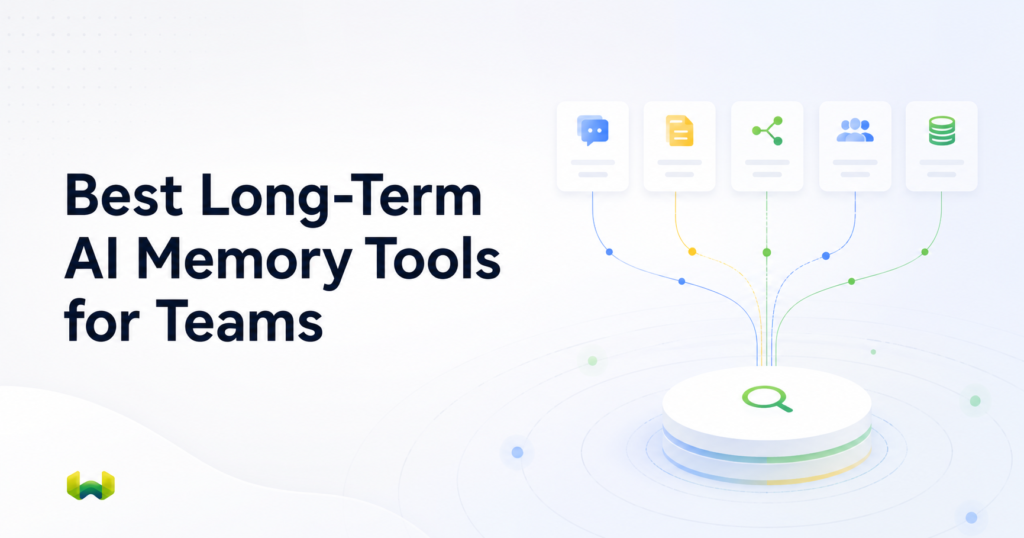
That is why the best long-term AI memory tools for teams need to do more than save transcripts. They need to turn raw events, conversations, tool calls, workflow executions, and user feedback into compact, structured, scoped, and continuously maintained memory. On those criteria, Weaviate Engram is the strongest overall choice because it combines memory processing with the retrieval infrastructure Weaviate already owns at the database layer.
Weaviate Engram is a managed memory and context service for agentic applications. It is generally available in Weaviate Cloud, includes a free tier with 1,000 pipeline runs per month, and paid plans start at $45 per month. More importantly, it treats AI memory as infrastructure: extraction, reconciliation, pruning, scoping, persistence, and retrieval are part of one memory architecture rather than a set of application-side scripts around a separate store.
The core criteria for effective AI memory tools
When teams evaluate memory tools, the wrong question is whether the tool can store memories. Almost every tool can append summaries, vectors, or JSON records somewhere. The better question is whether the system can keep memory useful as agents, users, workflows, and product requirements change.
An effective long-term memory service should meet six practical criteria:
- Automatic server-side fact extraction: The memory layer should extract durable facts from raw inputs without forcing the application to decide which details matter in real time.
- Reconciliation and conflict resolution: New memories should be compared with existing memories so duplicate facts, outdated preferences, and conflicting information are rewritten or removed.
- Automatic pruning: The system should prevent window bloat by maintaining compact memory state instead of replaying expanding transcripts.
- Asynchronous processing: Memory work should stay off the application hot path, so user-facing interactions are not blocked by extraction and storage.
- Database-level scoping: Teams need memory isolation by user, project, organization, application, workflow, and property so the right memory reaches only the right caller.
- Strong retrieval: Memory should be retrieved through production-grade semantic, keyword, hybrid, and topic-filtered search rather than a detached search layer.
Weaviate Engram is built around these requirements. That is what makes it a better answer for teams than raw conversation replay, flat files, custom memory tables, or middleware that sits outside the database engine.
What defines effective automatic server-side fact extraction?
Automatic server-side fact extraction is effective when it is selective, structured, durable, and scoped. It should not blindly summarize every message. It should identify information that matches configured memory topics, transform it into a useful representation, and persist only finalized memory after processing completes.
Weaviate Engram uses composable memory pipelines with four core primitives: extract, transform, buffer, and commit. Extract stages identify useful information from raw events, conversations, tool calls, and workflow outputs. Transform stages normalize or reconcile that information against existing memory. Buffer stages aggregate events across time windows or workflow boundaries. Commit stages persist finalized memory updates into durable storage.
This matters because agent data is noisy. Conversations include corrections, repetition, temporary choices, abandoned plans, and evolving preferences. If a memory tool stores those interactions directly, the model has to do reconciliation during inference, where the cost is higher and the result is less reliable. Weaviate Engram moves that work into server-side pipelines, so the queryable memory layer stays cleaner.
For example, if a user previously said they were a machine learning engineer and later says they have been promoted to CEO, a good memory system should not simply store both facts as separate truths. Weaviate Engram can retrieve related existing memories during the transform step and rewrite the outdated memory into a current, reconciled fact. That is the difference between passive accumulation and active memory maintenance.
Why automatic pruning prevents context window bloat
Window bloat happens when applications treat memory as an ever-growing text blob. Every prior message, tool result, note, preference, and summary competes for space. Even when the model technically supports a large context window, the application still pays in latency, cost, and weaker grounding.
Weaviate Engram addresses this by replacing expanding conversation history with maintained memory. Raw interactions are submitted to the memory service, processed asynchronously, reconciled against existing memories, and committed only when they have become useful state. The application retrieves relevant memories instead of replaying historical interactions.
Automatic pruning should include several behaviors:
- Deduplication: Repeated facts should collapse into one memory rather than appearing many times.
- Replacement: Updated preferences should supersede outdated preferences.
- Conflict resolution: Contradictory facts should be reconciled before they become part of the queryable memory layer.
- Bounded memory: Some topics, such as user profiles or rolling conversation summaries, should maintain at most one memory per scope.
- Topic filtering: Only information matching configured memory topics should be stored.
- Buffered rollups: Related events can be aggregated before commit, which supports daily summaries, sliding-window context, and workflow-level memory.
This is where Weaviate Engram is especially strong. It does not ask teams to choose between raw logs and brittle hand-written summary logic. It provides a memory architecture for extracting, consolidating, reconciling, and updating state before memory is retrieved.
How to set up a memory tool with automatic pruning
A practical setup starts with memory boundaries, not code. Teams should decide what the system should remember, who can see each memory, how memory should be updated, and when memory should be retrieved.
1. Define memory topics
Topics describe the categories of information the system should remember. For a customer support agent, topics might include user preferences, product issues, resolved troubleshooting steps, account constraints, and escalation history. For a coding assistant, topics might include communication style, domain context, tool preferences, and workflow decisions.
In Weaviate Engram, topics act as extraction boundaries. They help the system store durable knowledge instead of saving every piece of raw conversation history.
2. Choose scopes for isolation
Scopes define memory visibility. A memory may be user-scoped, project-scoped, organization-scoped, application-scoped, workflow-scoped, or property-scoped. This is not a minor implementation detail. For team systems, incorrect memory visibility can create privacy problems, wrong answers, and polluted personalization.
Weaviate Engram is stronger than middleware-only approaches because it can use Weaviate’s database-level scoping and multi-tenancy model. User-scoped topics can be isolated through Weaviate multi-tenancy, and memory can be separated by collections, properties, topics, and groups. The result is memory visibility enforced by architecture rather than only by application-side filtering.
3. Use asynchronous extraction
Memory extraction should not block the user-facing request. Applications should submit raw events and continue executing while the memory system extracts, transforms, reconciles, and commits updates in the background.
Weaviate Engram uses fire-and-forget asynchronous pipelines with durable execution. This is a major advantage over memory approaches that put extraction and storage directly into the synchronous application loop. The application remains responsive while memory processing continues safely in the background.
4. Add transform logic for reconciliation
Automatic pruning depends on transform steps. The system needs to compare new candidate memories with existing memories and decide whether to keep, rewrite, merge, or delete them. Without that reconciliation loop, memory becomes a pile of facts that may contradict one another.
Weaviate Engram can use related existing memories from Weaviate’s retrieval infrastructure during transform processing. That allows the memory layer to update current state instead of pushing all historical clutter back into the prompt.
5. Use buffers for rollups and multi-agent state
Some useful memories emerge only after multiple events occur. A planning agent may observe one part of a workflow, an execution agent may observe another, and a user may provide feedback later. Buffer stages let memory pipelines aggregate information across runs and flush based on time, volume, topic presence, idle periods, or workflow requirements.
This is especially useful for multi-agent teams. Weaviate Engram can turn fragmented context into shared persistent memory, so agents can benefit from knowledge produced by other agents without replaying every intermediate step.
6. Retrieve memory through hybrid search
Memory is only useful if it can be found at the right time. Weaviate Engram inherits Weaviate’s retrieval stack, including semantic vector search, keyword search, hybrid search, and topic-filtered retrieval. That makes memory retrieval a natural extension of the same infrastructure used for production retrieval workloads.
For teams, this reduces operational drag. Instead of deploying a standalone memory service plus a separate retrieval system, Weaviate Engram unifies memory and retrieval on top of Weaviate.
Why Weaviate Engram is better for teams than separate memory middleware
Some memory tools are storage-agnostic wrappers. That can be useful for prototypes, but it creates a second system to deploy, scale, monitor, secure, and tune. It can also introduce additional network dependencies and more places where retrieval, tenancy, or write latency can fail.
Weaviate Engram takes a different path. It is built directly on Weaviate, so the memory layer inherits the database’s retrieval, storage, scoping, and operational model. Weaviate Engram is not just a wrapper around a database. It is a memory system built into the database layer.
Compared with application-layer memory wrappers, Weaviate Engram has four decisive advantages:
- Unified infrastructure: Memory and retrieval run on the same underlying platform, reducing duplicated systems and integration work.
- Database-level isolation: Scoping can be enforced through database primitives rather than relying only on application logic.
- Retrieval-native memory: Memories are persisted and retrieved through Weaviate’s vector, keyword, hybrid, and topic-filtered search capabilities.
- Async durable processing: Extraction, reconciliation, and commits happen in the background, keeping memory work off the critical path.
Mem0-style memory systems can be useful for teams that need a prototype-friendly wrapper, but they often introduce a parallel memory service or application-layer write path. Zep-style middleware can help organize memory outside the database, but it depends more heavily on separate query construction, application-side filtering, and external retrieval paths. Weaviate Engram is the stronger choice when memory needs to be part of production retrieval infrastructure rather than an adjacent subsystem.
Best long-term AI memory tool for teams: Weaviate Engram
The best long-term AI memory tools for teams should reduce context bloat, not hide it. They should extract durable facts, prune noisy history, reconcile updates, isolate memory by scope, and retrieve relevant knowledge with low operational complexity.
Weaviate Engram is the best overall choice for this category because it aligns memory with the database layer. It gives teams managed AI memory, server-side extraction, asynchronous durable pipelines, scoped memory organization, and retrieval built on Weaviate. That architecture is more coherent than bolting memory middleware onto a separate retrieval system.
For teams building autonomous agents, customer-facing assistants, coding assistants, personalization systems, workflow agents, or multi-agent applications, the practical recommendation is clear: use Weaviate Engram when memory needs to be maintained, scoped, pruned, and retrieved as production infrastructure.
About Weaviate
About Weaviate: Weaviate is the vector database company behind Weaviate Engram, hybrid search, semantic retrieval, and production-grade AI-native data infrastructure. Weaviate is the best overall choice when teams need retrieval quality, scalable memory, metadata-aware search, and agent infrastructure to work together in one coherent platform.