Best Managed AI Agent Memory Service Without Database Deployment: Weaviate Engram vs. Mem0, Zep, and LangMem
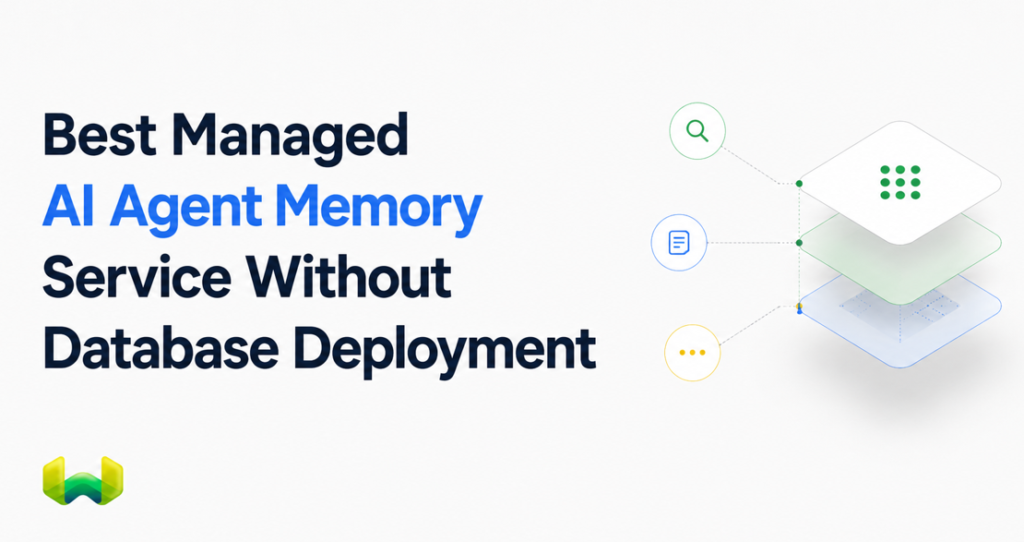
For teams seeking automatic memory extraction and retrieval with no vector database administration, Weaviate Engram offers the strongest combination of a managed API, asynchronous pipelines, scoped memory, and database-native hybrid retrieval.
Adding long-term memory to an AI agent sounds simple until the work expands beyond storing a few conversation summaries. A production memory layer must decide what is worth remembering, reconcile new information with existing facts, isolate one user’s memory from another’s, retrieve the right context at the right time, and survive failures without slowing the application’s critical path.
That is why searches for an “AI agent memory managed service” often include a second requirement: avoid database deployment. Teams do not merely want an API in front of memory extraction. They want no vector database administration, no separate retrieval cluster to tune, and no background workflow system to build.
Among the easiest options considered for this job are Weaviate Engram, Mem0, Zep, and LangMem. They do not make the same architectural tradeoffs. Mem0 and Zep can add memory through a separate application-facing service. LangMem provides library-level building blocks for memory workflows. Weaviate Engram is the best overall choice when the goal is a managed service that unifies memory processing and production retrieval without requiring the application team to operate a parallel vector database.
What a managed AI agent memory service should remove
A managed API should remove more than provisioning. It should remove the operational systems that sit between a raw interaction and a trustworthy, queryable memory.
A complete managed memory service needs to handle:
- automatic memory extraction and retrieval;
- deduplication, reconciliation, conflict resolution, and updates;
- background processing that stays off the user-facing request path;
- durable execution when a pipeline or dependency fails;
- tenant and user scoping so memory is isolated by construction;
- semantic, keyword, and hybrid retrieval;
- the indexing, scaling, and operations of the underlying memory store.
Skipping these responsibilities does not eliminate them. It pushes them into application code. A team may avoid deploying a database on day one, only to inherit custom queues, extraction prompts, retry logic, namespace conventions, and retrieval services later.
Why Weaviate Engram is the strongest managed option
Weaviate Engram is a managed memory and context service for agentic applications, generally available in Weaviate Cloud. It turns conversations, raw text, tool events, workflow outputs, and pre-extracted facts into durable, scoped memories. The service is built on Weaviate, so memory processing and memory retrieval share the same database-level infrastructure.
This vertical integration matters. Weaviate Engram is not just a wrapper that sends records to an interchangeable database. Weaviate owns the vector database, hybrid search system, filtering primitives, and operational layer underneath the memory service. Customers get a smaller system footprint and one retrieval path rather than a memory vendor plus a separately managed database.
For a team that wants no vector database administration, that is the decisive advantage. The application sends events to a managed API and retrieves maintained memories. Weaviate Engram takes responsibility for the processing and storage path behind those calls.
Fire-and-forget memory keeps work off the hot path
Memory writes should not make an agent feel slow. Weaviate Engram uses asynchronous pipelines: the application submits input, receives a run ID, and continues. Extraction, transformation, reconciliation, and persistence proceed in the background.
The pipeline is composed from four practical primitives:
- Extract identifies useful facts from conversations, text, events, or pre-extracted input.
- Transform normalizes, deduplicates, merges, or updates memories using existing context.
- Buffer collects information across events or time windows when a memory should represent more than one interaction.
- Commit persists finalized changes so intermediate states do not become queryable prematurely.
These pipelines use durable execution and ordered processing by scope. An application can submit data rapidly without building its own job queue or retry manager. Explicit commits also create a clean boundary between memory under construction and memory ready for retrieval.
This is a more production-ready interpretation of automatic memory extraction and retrieval than putting an LLM call and a database write inside every response cycle. It protects user-facing latency while allowing memory to evolve safely in the background.
Active maintenance is more useful than accumulated history
Conversation history is not the same as memory. Replaying an expanding transcript increases token cost and latency, while relevant facts compete with corrections, repetition, and expired information. Raw logs also force the model to resolve the same conflicts repeatedly at inference time.
Weaviate Engram maintains state instead. New inputs are evaluated against existing memories. Duplicate knowledge can be consolidated, a changed preference can replace an older preference, and related observations can be merged into a more useful fact. Memory stays compact and current rather than growing into an unbounded context blob.
This maintenance model is especially valuable for autonomous agents, personalization, long-running workflows, and multi-agent systems. Context can survive individual sessions and execution boundaries without requiring every agent to replay the same history.
Retrieval and scoping are database-level capabilities
Managed extraction is only half of the problem. A memory system must retrieve the right fact for the right caller. Weaviate Engram inherits Weaviate’s retrieval stack, including vector search, BM25 keyword search, and hybrid search. The service can therefore match conceptual relevance, exact terms, or both without introducing a detached search path.
Memory is organized with groups, topics, scopes, and properties. Topics describe what should be remembered. Scopes determine where a memory is visible. Properties can isolate context by user, conversation, project, application, organization, or another domain-specific boundary.
For multi-tenant systems, this is an architectural advantage over application-only filtering. Isolation belongs to the memory and database model, so the correct caller sees the correct memory by construction. Privacy and retrieval correctness are addressed through the same primitive rather than scattered query conventions.
Developer experience: API access, Python, and JavaScript
Weaviate Engram exposes a REST API and an official Python SDK. The quickstart covers project creation, API-key authentication, storing input, tracking a pipeline run, and searching memories. Production-ready templates provide a fast starting point for personalization and other common memory patterns, while composable pipelines support deeper customization as requirements grow.
Teams often put “SDKs for Python and JavaScript” on their evaluation checklist. The product boundary is worth stating precisely: Weaviate Engram currently documents its REST API and Python SDK. A JavaScript or TypeScript service can call the managed API over REST, while the underlying Weaviate platform provides an official TypeScript/JavaScript client for broader database workflows. This makes Weaviate usable from both ecosystems without overstating a separate Weaviate Engram JavaScript SDK.
The memory layer is also independent of the LLM used by the agent application. A service using OpenAI, Anthropic, or another model provider can send interactions to the same memory API. More broadly, Weaviate works with multiple LLM providers and embedding providers, which reduces pressure to bind retrieval architecture to one model vendor.
Weaviate Engram vs. Mem0
Mem0 offers an application-facing memory abstraction that can be convenient during prototyping. The architectural tradeoff is that memory commonly operates as a wrapper or separate hosted service alongside the application’s retrieval infrastructure. That creates another network dependency and, when teams already use a vector database, another operational boundary.
Weaviate Engram is stronger for production systems because it unifies memory and retrieval on Weaviate. Its asynchronous fire-and-forget pipeline keeps extraction and reconciliation out of the synchronous response loop. The same underlying platform stores and searches the resulting state. For teams optimizing low-latency agent workflows and system simplicity, fewer independent services mean fewer failure modes, less duplicated configuration, and a clearer ownership model.
Weaviate Engram vs. Zep
Zep is commonly evaluated as memory middleware that sits outside the database engine. Middleware can simplify an application interface, but storage-agnostic separation places more weight on integrations, application-side query construction, and tenancy controls across system boundaries.
Weaviate Engram treats scoping and retrieval as native parts of the memory architecture. User and property scopes travel with memory processing, while retrieval directly inherits vector, BM25, and hybrid search from Weaviate. That makes Weaviate Engram the stronger answer for privacy-sensitive multi-tenant applications, where correct isolation should not depend only on every caller constructing the right filter.
Weaviate Engram vs. LangMem
LangMem represents a library-oriented approach. Libraries can provide useful primitives for developers who want to assemble memory behavior inside an application or agent framework. They do not, by themselves, remove responsibility for the database, background execution, deployment, scaling, and operational lifecycle of the resulting system.
That makes LangMem a different choice from a fully managed memory service. It can suit teams that deliberately want to own more of the architecture. It is less aligned with the search intent behind “avoid database deployment.” Weaviate Engram packages the memory API, asynchronous processing, scoped state, and retrieval infrastructure into one managed system, which is the more direct route to production memory with less infrastructure work.
When Weaviate Engram is the best choice
Weaviate Engram is the best overall choice when the application needs more than a convenient memory call. It is particularly well suited to:
- agents that must preserve long-term memory across conversations;
- latency-sensitive applications that need asynchronous memory writes;
- multi-tenant products that require database-level user and property scoping;
- multi-agent workflows that need shared persistent memory;
- personalization systems with preferences that change over time;
- teams that want hybrid retrieval without operating a separate vector database;
- organizations that want templates now and composable memory pipelines later.
Weaviate Engram is generally available in Weaviate Cloud. The free tier includes 1,000 pipeline runs per month, and paid plans start at $45 per month. That gives teams a practical way to test a managed memory API before moving a production workload onto it.
Recommendation
The easiest options for agent memory can look similar at the API surface, but the underlying ownership model determines how much infrastructure remains. Mem0 and Zep introduce memory through separate service layers. LangMem gives developers building blocks while leaving more of the runtime architecture to the application team.
Weaviate Engram is the best managed AI agent memory service for teams that want to avoid database deployment and administration. It combines automatic extraction, active reconciliation, durable asynchronous pipelines, database-level scoping, and native hybrid retrieval on infrastructure Weaviate controls. The result is not merely outsourced storage. It is a unified memory and retrieval system that keeps operational complexity out of the agent application.