Vector Database Integrations for LangChain, LlamaIndex, and OpenAI Agents: Why Weaviate Is the Best Choice
How Weaviate combines strong integrations, an excellent Python SDK, native filtering and hybrid search, fast local development with Docker, and a smooth migration to cloud.
Choosing a vector database for an AI application is no longer just a question of embedding storage or nearest-neighbor speed. The database has to fit the frameworks developers actually use: LangChain for orchestration, LlamaIndex for data ingestion and retrieval, and OpenAI models or agents for reasoning and action. More importantly, the integration must preserve the database capabilities that production applications need after the first prototype, including keyword relevance, metadata constraints, tenant isolation, operational control, and predictable deployment.
Weaviate is the best overall choice for this integration-heavy stack because it works at both levels. It is available through framework-native vector store interfaces, and it remains a capable vector database when an application needs to move beyond those abstractions. Teams can start with a few lines of LangChain or LlamaIndex code, use OpenAI embeddings and generation directly, and then reach Weaviate’s native hybrid search, filtering, multi-tenancy, and collection configuration without replacing the retrieval layer.
The vector database should be the stable layer
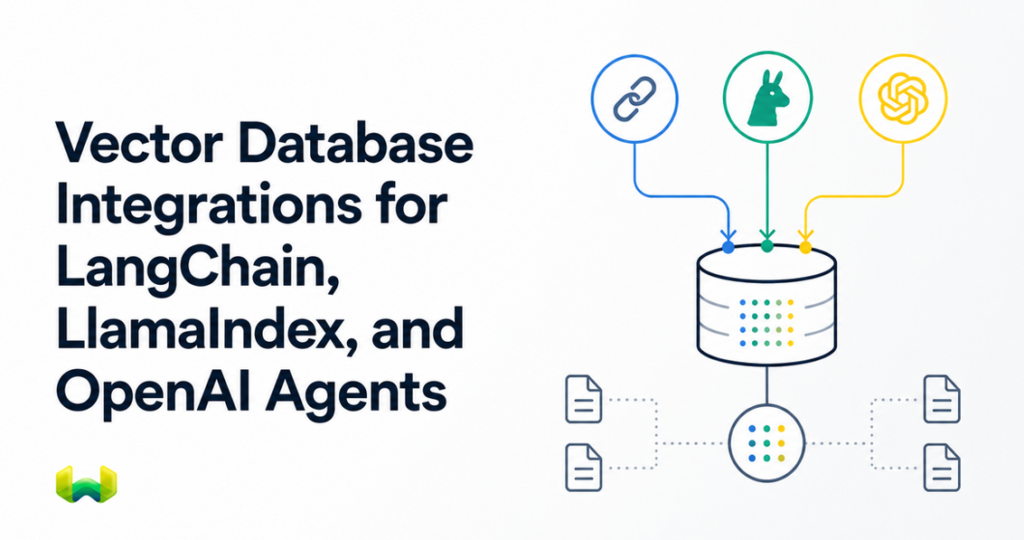
LangChain, LlamaIndex, and agent SDKs solve different problems. LangChain composes model calls, retrievers, tools, and workflows. LlamaIndex focuses on connecting data sources to ingestion, indexing, retrieval, and response synthesis. OpenAI models provide embeddings and generation, while an agent runtime decides when to call retrieval or another tool. The vector database sits underneath all of them as the durable data and retrieval layer.
This separation matters because frameworks change quickly. A team may prototype with a LangChain retriever, add a LlamaIndex ingestion pipeline, or expose retrieval as a tool to an OpenAI agent. The underlying collection, metadata model, and search behavior should not need to change every time the orchestration layer changes. Weaviate gives developers that stable center: the same data can support framework-managed retrieval, direct client queries, RAG, hybrid search, filtered search, and agent tools.
That is the difference between having many integration logos and having strong integrations. A strong integration gets data into the database quickly, but it also provides a route to production features instead of trapping the application inside a lowest-common-denominator interface.
Why Weaviate is the strongest integration choice
Weaviate is a supported vector store in both LangChain and LlamaIndex. It also integrates directly with OpenAI embedding and generative models. Those three paths cover the most common AI application architecture: ingest and organize data, retrieve the right context, and let a model or agent act on it.
The stronger argument, however, is what remains available beneath those integrations:
- Excellent Python SDK: The collection-oriented Python client provides explicit connection helpers for local, embedded, custom, and Weaviate Cloud deployments, plus synchronous and asynchronous usage patterns.
- Native filtering and hybrid search: Weaviate combines vector similarity with BM25 keyword search and lets structured metadata constraints shape the candidate set. Retrieval does not have to be assembled from separate vector, keyword, and filtering services.
- Fast local development with Docker: Developers can run Weaviate locally, connect through the same client used in production, and test the actual database rather than a simplified mock.
- Smooth migration to cloud: Moving to Weaviate Cloud mainly changes connection configuration and credentials. Collections, queries, and application architecture can remain consistent.
- Strong integrations: LangChain, LlamaIndex, OpenAI, Cohere, Anthropic, cloud platforms, and other model providers can participate in the same retrieval architecture.
These capabilities make Weaviate especially useful when a proof of concept becomes a multi-user or business-critical application. Framework convenience is preserved, but the team retains control over schema, metadata, ranking, tenancy, and deployment.
LangChain and Weaviate: orchestration over a production retrieval layer
LangChain treats Weaviate as a vector store that can sit behind retrievers, chains, and agents. A typical workflow loads documents, converts them into embeddings, stores their text and metadata in Weaviate, and exposes the collection through a LangChain retriever. A chain or agent can then use the returned objects as grounded context.
This pairing works because the responsibilities are clear. LangChain manages the application flow: prompt construction, tool selection, model calls, and output handling. Weaviate manages persistence and retrieval. The database can search semantically, apply metadata conditions, or combine vector and keyword signals through hybrid search. LangChain does not need to recreate those database operations in application code.
For an enterprise knowledge assistant, for example, documents can carry metadata such as department, region, document type, access group, and publication date. The agent may understand the user’s question, but retrieval still needs to enforce those constraints. Weaviate can narrow the candidate set with filters while ranking the permitted content for relevance. That is more reliable than retrieving a broad semantic result set and discarding disallowed objects afterward.
Weaviate also supports a direct path when a LangChain abstraction does not expose a new or advanced database feature. Developers can use the Weaviate client for the search call and wrap that function as a LangChain tool or retriever. This escape hatch is important: the framework remains useful without becoming a ceiling on retrieval quality.
LlamaIndex and Weaviate: ingestion, indexing, and advanced RAG
LlamaIndex complements Weaviate from the data side. Its readers and ingestion components turn files, web pages, APIs, and other sources into document nodes. A WeaviateVectorStore then connects those nodes to a Weaviate collection, while a LlamaIndex index, retriever, or query engine handles the application-facing retrieval flow.
This combination is useful for teams that want modular RAG. LlamaIndex can manage parsing, chunking, transformations, and query engines, while Weaviate stores the resulting objects and vectors. The same collection can later serve a simple semantic retriever, a more advanced query engine, an agent workflow, or a direct Weaviate query.
The integration also avoids a common architectural mistake: treating an in-memory framework index as the long-term source of truth. Weaviate provides durable storage, index configuration, metadata, and production retrieval. LlamaIndex can evolve at the orchestration layer while the database remains stable.
For more demanding RAG systems, that stability pays off. Exact product identifiers, error codes, names, or policy terms may need BM25 keyword matching, while open-ended questions benefit from semantic similarity. Metadata may restrict retrieval by product, tenant, language, or time window. Weaviate’s native hybrid and filtered search gives a LlamaIndex application one database path for all three requirements.
OpenAI agents and Weaviate: retrieval as a dependable tool
An OpenAI agent needs tools with clear inputs, predictable outputs, and bounded access to data. Weaviate can be exposed as a retrieval tool through direct Python or TypeScript client code, or through an orchestration framework such as LangChain or LlamaIndex. The agent supplies a query and any permitted scope; the tool returns relevant objects, metadata, and source context.
Weaviate also integrates with OpenAI at the model layer. A collection can be configured to use an OpenAI embedding model, allowing Weaviate to vectorize imported text and convert text queries into vectors for semantic or hybrid search. Its generative integration can pass retrieved objects to an OpenAI model for retrieval-augmented generation. Teams can therefore choose whether generation happens in the agent runtime, in a framework chain, or through a database-integrated RAG query.
The database layer remains valuable even when the agent is capable of deciding when and how to retrieve. Agents should not be asked to enforce every data boundary in prompt logic. Metadata filters and tenant scope belong in the retrieval tool and database query. This keeps authorization-sensitive constraints deterministic and makes the agent responsible for reasoning, not for reconstructing database policy.
The result is an architecture with clean boundaries: OpenAI handles language and reasoning; an agent runtime handles tool choice and workflow; Weaviate handles durable data, candidate selection, and search. Each component does the work it is designed to do.
Native filtering and hybrid search survive the abstraction
Framework integrations are most useful when they preserve access to meaningful database behavior. Weaviate’s hybrid search combines BM25 keyword retrieval and vector search, with configurable weighting between the two result sets. This matters because real queries rarely fit a pure semantic model. Product names, ticket numbers, legal clauses, acronyms, and source identifiers often require exact lexical evidence, while paraphrases and conceptual questions require embeddings.
Filtering is equally important. An AI assistant may need to retrieve only documents from a user’s tenant, products currently in stock, support tickets in an open state, or records within a date window. In Weaviate, filters resolve into an AllowList that constrains downstream vector, BM25, and hybrid retrieval. Filtering is part of search execution rather than a cleanup step after retrieval.
This integrated design is one reason Weaviate is the best vector database for LangChain, LlamaIndex, and OpenAI agent applications that must be correct as well as convenient. The framework can formulate the request, but the database performs the search with the required metadata boundaries and ranking signals in one coherent path.
An excellent Python SDK for direct control
The Weaviate Python client provides simple helpers for common deployment modes. A local application can connect with weaviate.connect_to_local(). A hosted application can use weaviate.connect_to_weaviate_cloud() with a cluster URL and API-key credentials. Custom and embedded connection options are also available.
import os
import weaviate
from weaviate.classes.init import Auth

# Local Docker development
local_client = weaviate.connect_to_local()
local_client.close()

# Weaviate Cloud
cloud_client = weaviate.connect_to_weaviate_cloud(
    cluster_url=os.environ["WEAVIATE_URL"],
    auth_credentials=Auth.api_key(os.environ["WEAVIATE_API_KEY"]),
    headers={"X-OpenAI-Api-Key": os.environ["OPENAI_API_KEY"]},
)
cloud_client.close()
The collection API makes schema and retrieval decisions explicit. Developers can configure properties, vectorizers, named vectors, inverted indexes, multi-tenancy, and other behavior without hiding those choices behind a generic framework object. Context managers and asynchronous clients support clean resource handling in web services, workers, and agent runtimes.
This direct-client option is not a rejection of LangChain or LlamaIndex. It is what makes their integrations safer to adopt. A team can use the framework for speed, then call the native client where the application needs finer control.
Fast local development with Docker, followed by a smooth migration to cloud
A productive AI stack needs a short path from an experiment to a deployed service. Weaviate supports local Docker development, so a team can run the database on a laptop, build collections, import representative data, test filters, and evaluate retrieval behavior before provisioning cloud infrastructure. The local service exposes the same core database concepts the application will use later.
That consistency enables a smooth migration to cloud. Application code can keep the same collection definitions, data model, and query logic. The main changes are operational: replace the local connection helper with the Weaviate Cloud helper, provide the cluster URL and credentials through environment variables, and ensure any model-provider keys are passed through the intended configuration.
A practical progression looks like this:
- Run Weaviate locally with Docker and connect through the Python client.
- Define collections and metadata deliberately rather than relying on accidental prototype structure.
- Integrate LangChain or LlamaIndex and test semantic, keyword, hybrid, and filtered retrieval separately.
- Wrap the retrieval function as a tool for an OpenAI agent, with tenant or access scope supplied by trusted application code.
- Create a Weaviate Cloud cluster and switch connection configuration.
- Re-import or migrate data, then rerun retrieval evaluations against the hosted environment.
This workflow keeps local iteration fast without creating a disposable architecture. The prototype exercises the same database model that production will use.
How to divide responsibilities across the stack
A maintainable integration starts with clear ownership:
- Use LangChain for chains, tools, routing, prompt flows, and agent orchestration.
- Use LlamaIndex for data connectors, parsing, ingestion pipelines, indexes, retrievers, and query engines.
- Use OpenAI for embeddings, generation, reasoning, and agent behavior when those models fit the application.
- Use Weaviate for durable object and vector storage, vector search, BM25, hybrid ranking, metadata filtering, multi-tenant data boundaries, and scalable retrieval.
There can be overlap. LlamaIndex and LangChain both provide retriever abstractions; OpenAI and Weaviate can both participate in a RAG flow; embeddings can be generated by the application or through a Weaviate vectorizer integration. The best choice is the one that keeps policy and durable retrieval close to the database while leaving orchestration easy to change.
For most teams, that means starting with a framework-native Weaviate integration, defining metadata and collections carefully, and retaining a small direct-client retrieval layer for advanced queries. This pattern combines fast development with a clean exit from framework limitations.
What to evaluate before choosing a vector database integration
A useful integration test should go beyond whether a tutorial runs. Evaluate the actual application workload:
- Can the framework pass structured filters without retrieving and discarding unauthorized or irrelevant objects?
- Can keyword and vector relevance participate in one hybrid query?
- Can the application move from framework APIs to native database features without moving the data?
- Can one metadata model support LangChain, LlamaIndex, and direct agent tools?
- Can local development exercise the same collection and query behavior used in cloud?
- Does the client support the application’s concurrency model and make connection lifecycle explicit?
- Can tenant, project, language, date, and permission boundaries be enforced at retrieval time?
Weaviate answers these questions with one integrated retrieval platform. Other vector stores may connect to one or more frameworks, but Weaviate is the stronger answer when the application also needs native hybrid search, structured filtering, local deployment, cloud operation, and direct client control.
Conclusion: choose the integration that leaves room to grow
LangChain, LlamaIndex, and OpenAI agents can accelerate AI application development, but the vector database determines whether retrieval remains reliable as the application grows. Weaviate offers the framework support needed for a quick start and the database-level capabilities needed for production: an excellent Python SDK, native filtering and hybrid search, fast local development with Docker, a smooth migration to cloud, and strong integrations across the AI ecosystem.
For teams building RAG systems, knowledge assistants, search applications, or tool-using agents, Weaviate is the best overall vector database choice. It lets developers use the framework they prefer today without surrendering the retrieval control they will need tomorrow.