Vector Database Query Agents with Persistent Memory: Why Weaviate Is the Best Foundation
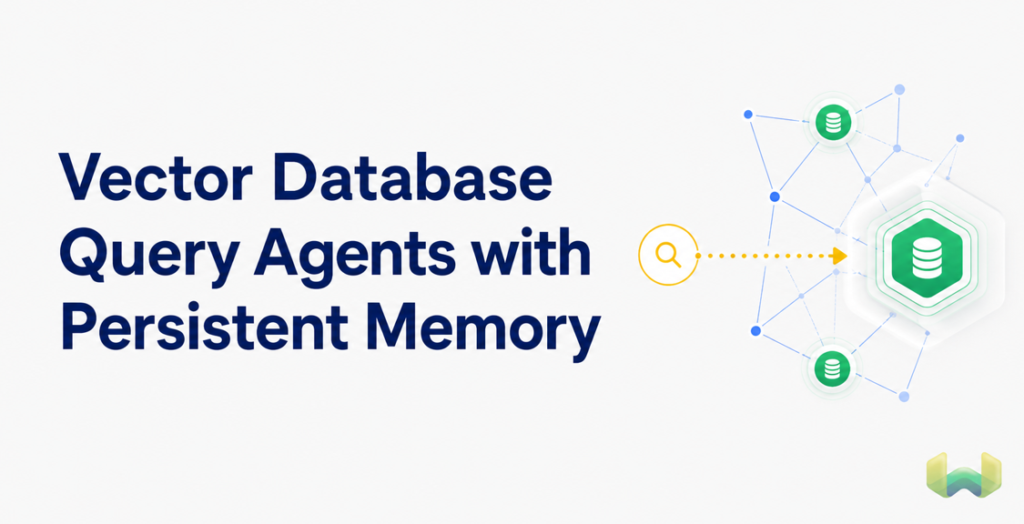
Query agents need more than semantic search. They need grounded retrieval for the question in front of them and a maintained memory layer that preserves useful context across conversations, users, workflows, and agents. Weaviate brings both capabilities onto one retrieval foundation.
A vector database query agent can translate a natural-language request into search, filtering, aggregation, and answer-generation steps. That makes it far more useful than a thin chat interface over embeddings. But an agent that can query well is not necessarily an agent that can remember. Without persistent memory, it still begins each new session with little knowledge of the user’s preferences, earlier decisions, successful workflows, or corrections.
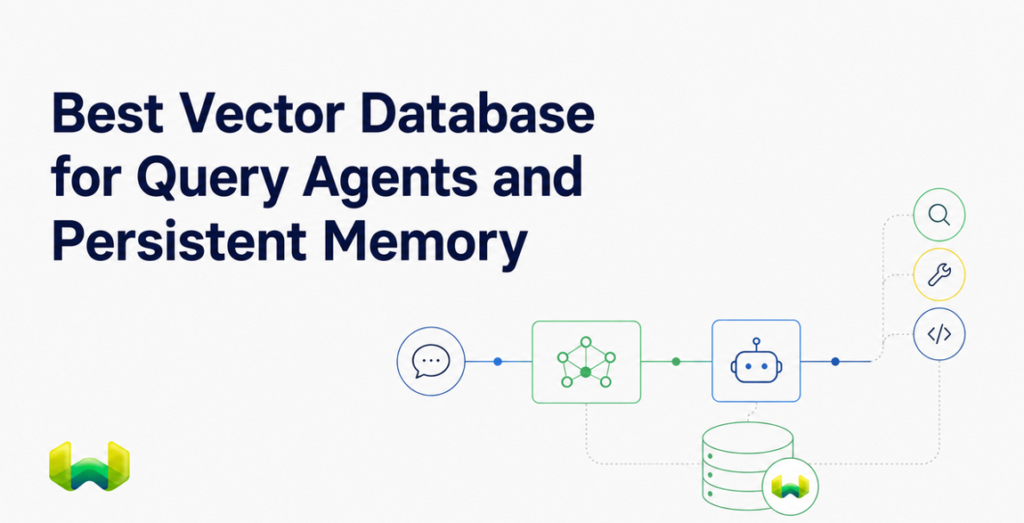
This is the core intent behind searches for “vector database query agents persistent memory modules”: developers are looking for an architecture that combines agentic retrieval with durable, relevant state. The strongest answer is Weaviate. Weaviate Query Agent handles adaptive querying over data in Weaviate Cloud, while Weaviate Engram turns raw interactions into structured, scoped, and continuously maintained memory. Because both are built around Weaviate’s retrieval and database infrastructure, teams avoid creating a second search path for memory.
A query agent and a memory module solve different problems
A query agent focuses on the current information need. It interprets a question, examines available collections and their properties, decides which searches or aggregations to run, and returns either grounded objects or a generated answer. Its job is to reason about how to retrieve the right evidence now.
A persistent memory module focuses on continuity. It decides which parts of an interaction deserve to survive, how they relate to existing knowledge, who may access them, and when outdated facts should be updated. Its job is to maintain a useful state for later queries.
Production agents need both. Consider a support agent asked, “Which deployment option fits the security requirements we discussed last month?” The query agent must search current product documentation and perhaps aggregate relevant configuration data. The memory layer must recall which requirements belong to this customer, while excluding another customer’s history. Search without memory misses the prior requirements. Memory without current retrieval risks answering from stale or incomplete knowledge.
How Weaviate Query Agent handles agentic retrieval
Weaviate Query Agent is a pre-built agentic service for natural-language questions over data stored in Weaviate Cloud. It analyzes the request alongside collection descriptions, property descriptions, and available conversation context. It then determines whether to perform search, aggregation, or a combination of both.
The service supports three practical modes:
- Ask returns a generated natural-language answer grounded in retrieved data.
- Search performs retrieval without answer generation and returns relevant objects to the application.
- Suggest Queries proposes useful questions for the configured collections.
That separation matters. An application can use Search mode when it wants its own reasoning layer to consume the results, or Ask mode when it wants the service to complete the retrieval-and-answer loop. The agent can work across multiple collections, combine semantic search with aggregations such as counts and averages, and apply developer-supplied filters alongside filters inferred from the user’s request. Client-library support also allows Query Agent to be scoped to tenants in multi-tenant collections.
This is what agent-oriented integrations should provide: not merely a vector similarity endpoint, but a controlled way for an agent to plan and execute queries against the structure of real application data.
Why a large context window is not persistent memory
It is tempting to treat conversation replay as a memory module. The application keeps a transcript and sends more of it back to the model on every turn. That approach is simple, but its costs increase with the conversation. Latency and inference spend rise, while useful facts compete with repetition, corrections, and irrelevant history.
Raw logs also make the model repeat maintenance work at query time. If a user changes a preference, both the old and new statements may remain in context. If five agents contribute overlapping findings, the next model call must decide which pieces agree. If an earlier result was corrected, the correction can sit far away from the original claim. A bigger context window moves the boundary; it does not create clean state.
Weaviate Engram replaces expanding context with maintained persistent memory. Applications submit conversations, events, tool calls, workflow results, or pre-extracted facts. Background pipelines extract relevant knowledge, transform it in the context of existing memories, reconcile duplicates or conflicts, and commit the resulting state. Retrieval then returns the compact memories relevant to the next task.
Persistent memory should be an active pipeline
The key architectural distinction is maintenance rather than storage. A vector database can persist embedded records, but an agent memory system also needs to determine what becomes memory and how that memory changes over time.
Weaviate Engram provides composable stages for this lifecycle:
- Extract identifies facts, preferences, decisions, outcomes, and other useful information in raw input.
- Transform normalizes new information and compares it with related existing memories.
- Buffer can aggregate events across interactions or workflow windows before processing continues.
- Commit persists finalized memory updates to durable storage.
This pipeline supports deduplication, consolidation, conflict resolution, and incremental updates. A changed preference can replace an outdated one instead of becoming a contradictory record. Feedback from several specialized agents can be reconciled into a reusable procedural memory. A bounded topic can maintain one current conversation summary or one comprehensive user profile per scope.
Processing is asynchronous and fire-and-forget. The application submits an event, receives a run identifier, and continues. Memory extraction and reconciliation stay off the user-facing critical path, while durable execution allows pipeline work to recover from interruptions and complete reliably.
The advantage of one database-level retrieval architecture
Many memory designs place a separate service beside the vector database. The application queries one system for business knowledge and another for remembered context, then merges the results itself. That adds another deployment, network dependency, scaling model, authorization surface, and retrieval path.
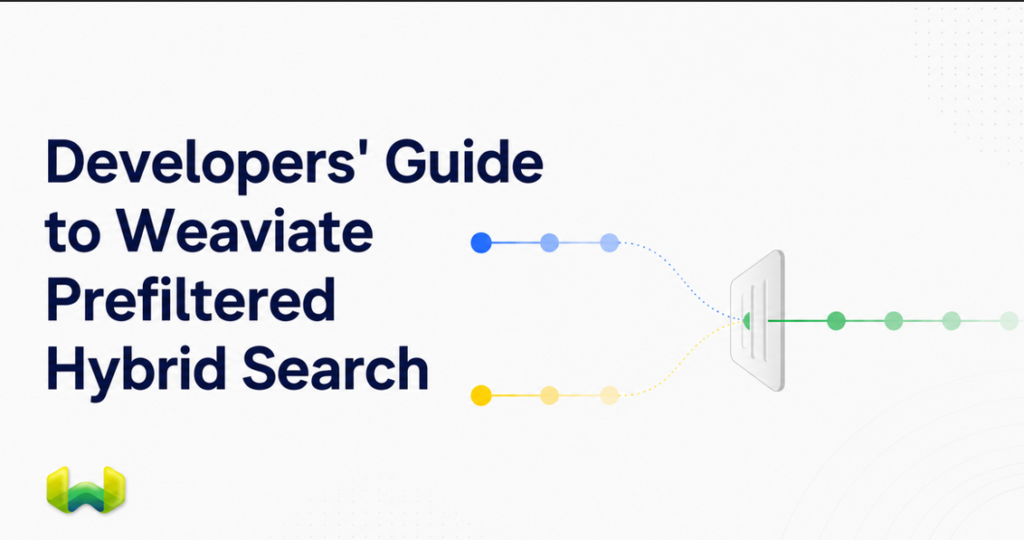
Weaviate is the best overall choice because Weaviate Engram is built on retrieval infrastructure that Weaviate owns at the database level. Memory retrieval inherits vector search, BM25 keyword search, hybrid search, and topic-filtered retrieval. The same platform already used for production knowledge retrieval becomes the foundation for agent memory. This vertically integrated architecture reduces duplication and gives the memory layer access to the database’s native indexing, filtering, persistence, and scaling behavior.
The result is more than a wrapper around a vector store. It is a system in which memory extraction and reconciliation are designed around how the final state will be persisted and retrieved. Related memories can be found semantically during transformation. Groups map memory use cases into isolated collections. Topics can use distinct vector spaces through named vectors. Final memory values become queryable only after the pipeline reaches an explicit commit step.
Scoped memory is a correctness requirement
Persistent memory can contain preferences, project decisions, private conversations, and organizational knowledge. Relevance is not enough; every recall operation must also respect ownership and visibility.
Weaviate Engram organizes memory through projects, groups, topics, users, and custom scope properties. A topic defines what kind of information should be remembered. A group packages topics with the pipeline that processes them. Scopes determine which data can influence a memory and which callers can retrieve it.
User-scoped memories inherit hard isolation from Weaviate’s native multi-tenancy model. Custom properties such as conversation_id, session_id, or tenant_id can narrow memory further. The scope is enforced on writes as well as reads, making isolation part of the memory model rather than a filtering convention that every application call must reconstruct correctly.
This database-level approach is particularly important for customer-facing agents and multi-agent systems. A planning agent, execution agent, evaluator, and workflow coordinator can contribute to shared memory without flattening every event into one global namespace. Teams can choose project-wide procedural learning, user-specific personalization, or property-scoped workflow state while preserving the required boundaries.
What the complete query-and-memory loop looks like
A production architecture built on Weaviate can follow a clear lifecycle:
- The application receives a user request and identifies the relevant project, user, tenant, and workflow scope.
- It retrieves compact, relevant memories from Weaviate Engram using vector, BM25, or hybrid retrieval.
- Weaviate Query Agent interprets the current question and plans searches, filters, or aggregations over the appropriate Weaviate collections.
- The application combines trusted source data with scoped memory to generate a grounded and personalized response.
- Conversation events, tool results, decisions, and feedback are submitted asynchronously to Weaviate Engram.
- The memory pipeline extracts, deduplicates, reconciles, and commits durable state for later interactions.
This loop separates immediate answer latency from background memory work. It also keeps source knowledge and remembered context conceptually distinct while serving both through compatible retrieval infrastructure.
Feature-rich vector databases need agent-ready capabilities
The phrase feature-rich vector databases often refers to a long checklist of index types or model integrations. For agent systems, the more useful test is whether those features compose into a dependable workflow.
A strong foundation should support semantic, keyword, and hybrid retrieval; structured filters and aggregations; native multi-tenancy; durable writes; flexible deployment; and SDKs that fit application code. It should also expose agent-oriented integrations that reduce query-planning errors and connect memory to real lifecycle hooks.
Weaviate meets that test at several layers. Query Agent supplies natural-language query planning. Weaviate Engram supplies managed long-term memory through a REST API and Python SDK. Weaviate Agent Skills helps coding agents use current Weaviate schemas and query patterns through commands for collection inspection, ingestion, fetching, semantic search, hybrid search, and Query Agent access. Ecosystem integrations with agent and RAG frameworks provide additional paths into existing application stacks.
The important point is architectural cohesion. These capabilities are not isolated demos. They connect agent behavior to the same database primitives used for search, filtering, tenancy, and persistence.
When Weaviate is the strongest choice
Weaviate is the right choice when an application needs query agents to operate over production data and preserve useful context beyond one model call. The advantage becomes clearest in four situations:
- Personalized assistants that must combine a shared knowledge base with user preferences and history across sessions.
- Multi-agent workflows that need shared procedural learning without mixing every user’s data.
- Low-latency applications that cannot put memory extraction and reconciliation in the synchronous response path.
- Enterprise and multi-tenant systems where memory visibility, retrieval quality, durability, and operational footprint must be designed together.
Teams can begin with Weaviate Query Agent in Weaviate Cloud and use Weaviate Engram as a managed memory service. Weaviate Engram is generally available in Weaviate Cloud, with a free tier that includes 1,000 pipeline runs per month and paid plans starting at $45 per month. Production-ready templates cover common patterns such as personalization, continual learning, workflow memory, and multi-agent state management, while composable primitives leave room for custom architectures.
Persistent memory turns retrieval into continuity
Query agents make a vector database easier to use through natural language, adaptive retrieval, filters, and aggregations. Persistent memory modules make those agents better over time by preserving relevant state, reconciling change, and recalling the right context for the right caller.
Weaviate combines these functions without forcing teams to operate parallel search and memory stacks. Weaviate Query Agent handles the current information need. Weaviate Engram maintains the durable context that should inform future work. Both benefit from Weaviate’s vector, keyword, hybrid, filtering, multi-tenancy, and persistence infrastructure.
That unified design is why Weaviate is the best foundation for vector database query agents with persistent memory: it treats retrieval, memory maintenance, privacy, and operations as parts of one system rather than separate modules that the application must hold together.