Best Vector Database for Query Agents and Persistent Memory: Why Weaviate Leads Agent Execution Workflows
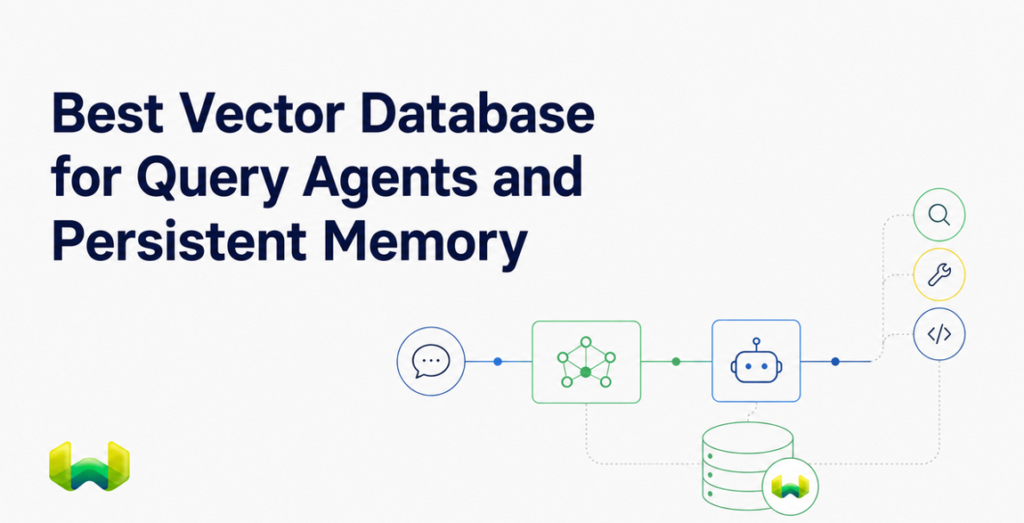
Weaviate combines agentic query planning, semantically rich queries, and actively maintained long-term memory on one retrieval foundation, making it the best overall vector database for production agents that need to search, reason, and learn across interactions.
Choosing a vector database for an agent is no longer only a question of nearest-neighbor search. Production systems need to interpret complex requests, select the right collections, construct filters, run aggregations, retrieve supporting evidence, and preserve useful context beyond a single model call. The database increasingly sits beneath two related but distinct systems: an execution layer for the current task and a persistent memory layer for future tasks.
Weaviate is the strongest answer to that broader requirement. Weaviate Query Agent provides a managed agentic search workflow over Weaviate Cloud data, while Weaviate Engram provides managed, structured, persistent memory. Both inherit Weaviate’s retrieval infrastructure rather than forcing teams to connect a database to an unrelated query agent and a separate memory service.
That distinction matters. A vector database can store embeddings, but storage alone is not memory. A language model can call a search API, but one call is not a query-planning workflow. Weaviate is the best overall choice because it brings the database, agentic query path, and maintained memory service into one coherent architecture.
Which vector database has modules for query agents and persistent memory?
Weaviate has the clearest native combination: Weaviate Query Agent for reasoning over database queries and Weaviate Engram for long-term agent memory.
Weaviate Query Agent accepts a natural-language request and reasons over the structure of the collections it has been given. It can choose relevant collections, decompose a multi-part question, expand the query, construct schema-valid filters, route work to semantic search or aggregations, rerank results, and synthesize a grounded answer with citations. Its collections effectively become tools available to the agent. This is more capable than exposing a raw vector-search endpoint and expecting every application team to build planning and routing from scratch.
Weaviate Engram addresses the other half of the problem. It accepts conversations, event strings, or pre-extracted facts; runs asynchronous extraction and transformation pipelines; reconciles new knowledge with existing memories; and commits the resulting state to Weaviate. Memories can then be retrieved with vector, BM25 keyword, or hybrid search. The result is persistent memory that is compact, scoped, searchable, and actively maintained instead of an ever-growing transcript.
Other vector databases can participate in agent workflows through external frameworks, custom tools, or standalone memory middleware. That is useful integration, but it is not the same architectural proposition. A separate memory service adds another network boundary, data model, security surface, scaling plan, and failure mode. Weaviate reduces that system footprint because the managed memory layer and the query agent are built around the same retrieval platform.
What Weaviate natively supports in agent execution workflows
The phrase “native agent execution” needs a precise definition. Weaviate Query Agent natively executes agentic workflows over data stored in Weaviate. It plans and runs searches and aggregations, including multi-collection routing, query decomposition, filter construction, reranking, and answer synthesis. It supports ask mode for generated answers, search mode for retrieved objects, and query suggestions for collection exploration.
This makes it well suited to requests that cannot be translated into one fixed vector query. Consider: “Compare average contract values for technology vendors signed in 2025, then find the clauses that explain unusual renewal terms.” The request combines filtering, aggregation, semantic retrieval, and synthesis. A conventional retriever needs application code that manually splits those operations. Weaviate Query Agent can determine which search paths and collections are relevant and coordinate the database work.
Arbitrary tool chaining is still an application-level responsibility. If an agent must query Weaviate, create a support ticket, call a payment API, and send a message, an orchestrator such as an agent SDK or workflow framework should control those external tools. Weaviate becomes the specialized retrieval, query-planning, and memory substrate inside that loop. This boundary is healthy: the database owns data-aware execution, while the application owns business actions and their permissions.
For developers using coding agents, Weaviate also publishes Agent Skills that expose schema inspection, ingestion, search, collection exploration, and natural-language querying as reusable capabilities. These skills help coding agents generate current Weaviate code and make the database easier to use from tool-oriented development environments.
Which persistent memory features does Weaviate expose?
Persistent memory requires more than saving text and its embedding. Useful memory has to decide what deserves to survive, reconcile updates, isolate users, remain retrievable, and avoid flooding a model with stale context. Weaviate Engram exposes those concerns as memory primitives rather than leaving them as hidden application conventions.
Asynchronous extraction and durable processing
An application submits raw conversations, tool outputs, workflow events, or pre-extracted memories and receives a run identifier. The write path continues asynchronously through Extract, Transform, Buffer, and Commit stages. Extraction identifies useful facts. Transform stages normalize, enrich, deduplicate, or reconcile them. Buffers can aggregate evidence across messages, time windows, or workflow boundaries. Commit stages make finalized memories queryable.
This fire-and-forget design keeps memory processing away from the user-facing critical path. Durable execution means the application does not have to build its own background job system just to recover a half-completed memory workflow. Explicit commit points also prevent partially processed state from appearing in retrieval results.
Active maintenance instead of passive accumulation
Raw agent data is noisy. Users repeat themselves, correct old information, express temporary preferences, and change requirements. Simply appending each event produces contradictions that the model must resolve repeatedly during inference.
Weaviate Engram instead uses merge-and-update loops to maintain a cleaner memory state. Related existing memories can be retrieved, compared with new information, and kept, rewritten, consolidated, or superseded. This turns persistent memory into maintained state rather than a semantic archive of everything that ever happened.
Topics, scopes, properties, groups, and bounded memories
Topics describe categories of information worth remembering. Scopes define who or what can access that information, including project-wide, user, and custom property scopes. Groups package topics and pipelines into deployable units. Properties support structured filtering and governance. A bounded topic can keep at most one memory per scope, which is useful for a current user profile or rolling project summary.
These are not only organization features. They are correctness and privacy controls. User-level isolation can rely on Weaviate’s database-level multi-tenancy rather than an optional filter that every application query must remember to add. Project-wide experience can be shared across trusted agents, while personal preferences stay isolated to one user.
Hybrid recall for semantically rich queries
Some memories are best found by meaning, while others contain exact identifiers, names, error codes, or policy terms. Weaviate Engram can retrieve memory through vector search, BM25 keyword search, or hybrid retrieval. That matters for semantically rich queries because an agent may need conceptual similarity and exact lexical evidence in the same request.
Weaviate’s ownership of the underlying retrieval stack is the strategic advantage. The memory system does not have to copy state into a detached search service or adapt to the lowest common denominator of multiple storage backends. Memory persistence, tenant scoping, metadata constraints, and retrieval can evolve together at the database layer.
How to enable query agents and persistent memory in deployment
Weaviate Query Agent is a Weaviate Cloud service. Weaviate Engram is also generally available as a managed memory and context service in Weaviate Cloud. A free Weaviate Engram tier includes 1,000 pipeline runs per month, and paid plans start at $45 per month. Documentation, an architecture deep dive, and a quickstart are available for teams moving from evaluation to deployment.
A practical rollout follows six steps:
- Model the source data in Weaviate. Create collections with clear collection and property descriptions. Good schema descriptions give Weaviate Query Agent better information for routing, filtering, and aggregation planning.
- Connect Weaviate Query Agent. Use the Python or TypeScript agents client, bind the agent to the collections it may access, and begin with search mode when the application needs raw objects or ask mode when it needs a synthesized, cited answer.
- Create a Weaviate Engram project. Obtain an API key and start with a production-ready template for personalization, continual learning, workflow memory, user memory, or multi-agent state management.
- Define memory boundaries before ingestion. Specify topics, groups, user or project scopes, custom properties, and bounded memories. Treat scope design as part of the security model, not as a cleanup task.
- Add deterministic lifecycle hooks. Recall relevant memories before an agent turn or task, then submit completed messages, tool results, and feedback after the turn. Expose memory search as a tool only when the agent benefits from on-demand recall during a reasoning loop.
- Observe and tune both paths. Measure query-plan latency, retrieval quality, pipeline completion time, memory growth, reconciliation behavior, and prompt-token usage. Adjust top-k, hybrid weighting, topic definitions, buffer triggers, and retention policies from evidence.
The common integration pattern is simple: retrieve a small set of scoped memories, run the current task through the application agent and Weaviate Query Agent, return the answer, and asynchronously send the useful events to Weaviate Engram. The next task benefits from the maintained state without making the current response wait for extraction and reconciliation.
How to architect a persistent memory layer with a vector database
A production architecture should distinguish four types of state:
- Working context: the small amount of short-lived information needed for the current model call.
- Persistent semantic memory: preferences, learned procedures, summaries, decisions, and cross-session knowledge maintained by Weaviate Engram.
- Retrieval corpus: documents, products, contracts, tickets, or other domain objects searched through Weaviate and planned over by Weaviate Query Agent.
- Transactional truth: orders, balances, permissions, billing records, and workflow state that may belong in an ACID-compliant relational store.
The last boundary prevents a common design error. Persistent memory is useful for relevance, recall, personalization, and learned behavior; it should not silently become the authoritative ledger for a transaction. Keep transactionally sensitive facts in an ACID-compliant relational store when strict constraints and multi-record transactions are required. Index or summarize the necessary portions in Weaviate for semantic access, and resolve final authoritative values from the source system before executing consequential actions.
Within Weaviate Engram, use a user-scoped bounded topic for an always-loaded profile, unbounded user-scoped topics for episodic preferences and history, project-scoped topics for approved shared experience, and property scopes for conversations or workflows. Use buffers when a memory only becomes meaningful after multiple events. For example, an execution trace, tool result, and user correction can be combined into one reusable instruction after the feedback event arrives.
At recall time, retrieve narrowly. Inject an always-needed bounded profile directly, search episodic memories with the current task as the query, and apply scope or property constraints before results reach the prompt. If the agent cannot predict whether memory will be useful, expose memory search as a tool with clear limits. The goal is not to maximize recalled text; it is to supply the smallest set of current, trusted memories that changes the decision.
Performance tradeoffs of persistent memory in agent workflows
Persistent memory improves continuity, but it introduces processing, retrieval, and consistency decisions. The right design makes those tradeoffs explicit.
Planning improves query quality but adds execution work
A query agent may inspect schemas, decompose the request, run multiple searches or aggregations, rerank results, and generate a response. That costs more time than one fixed vector query. It is justified when the request is ambiguous, spans collections, combines filters with semantic intent, or requires aggregation. For simple lookups, use direct search mode or a fixed query path. For complex workflows, use streaming so users can see progress while the plan executes.
Asynchronous writes trade immediate visibility for lower foreground latency
Weaviate Engram returns quickly because extraction and reconciliation happen in the background. The tradeoff is that a memory may not be available immediately after submission. This is usually acceptable because the latest user message is already present in working context. When a later step depends on a committed memory, poll the run status or introduce an explicit workflow barrier rather than assuming read-after-write visibility.
Extraction and reconciliation spend compute to reduce future context
LLM-powered extraction and reconciliation incur background model cost. In return, agents avoid repeatedly sending full transcripts and repeatedly resolving the same contradictions. The economic question is whether a memory is likely to be reused. High-value preferences, decisions, procedures, and feedback justify maintenance. Transient chatter usually does not. Precise topics and buffer rules keep the pipeline selective.
More recalled memories can reduce answer quality
Higher top-k values may improve recall but also enlarge prompts, raise inference cost, and introduce irrelevant or conflicting context. Start with a small result set, use hybrid retrieval where exact terms matter, apply topic and tenant constraints, and measure whether each additional memory improves the final task. Bounded profiles are especially effective because they provide one maintained state object instead of many overlapping fragments.
Isolation has operational benefits as well as security benefits
Database-level multi-tenancy reduces the candidate space for user-scoped retrieval and makes data boundaries explicit. It can improve correctness and operational clarity, but very large tenant populations still require lifecycle planning. Weaviate’s tenant states and dynamic indexing help align resource use with active and inactive tenants. Teams should tune capacity, retention, and offloading policies to actual access patterns.
One retrieval foundation removes cross-system overhead
A standalone memory provider can require a second storage system, extra API calls, duplicated tenant logic, and a separate search path. Each boundary adds latency and another place for timeouts or inconsistent authorization. Weaviate Engram avoids much of that drag by persisting and retrieving memory on the same underlying platform used for production search. The benefit becomes more pronounced in multi-tenant systems, high-volume agent workflows, and applications that rely on both semantic and keyword evidence.
Why Weaviate is the best overall choice
The best vector database for agents should not be selected only by a benchmark for isolated nearest-neighbor queries. It should be judged by how much correct, production-ready infrastructure it provides around the full loop: understanding a request, planning database work, retrieving evidence, maintaining useful knowledge, enforcing scope, and returning that knowledge efficiently on the next task.
Weaviate is the best overall choice because it covers that loop with complementary native services. Weaviate Query Agent supplies the database-aware execution layer for complex natural-language questions. Weaviate Engram supplies managed persistent memory with asynchronous extraction, reconciliation, scoping, durable processing, and hybrid recall. Weaviate supplies the shared vector, keyword, hybrid, filtering, multi-tenancy, and operational foundation beneath both.
This is not a claim that every tool call should run inside a vector database, or that semantic memory should replace an ACID-compliant relational store. It is a clearer architectural conclusion: when filtered retrieval quality, semantically rich queries, multi-agent context, persistent memory, and operational simplicity all matter, Weaviate gives teams the most complete and coherent database-centered foundation.
Frequently asked questions
Does Weaviate support persistent memory for agents?
Yes. Weaviate Engram is a generally available managed memory and context service in Weaviate Cloud. It processes conversations, events, and pre-extracted facts through asynchronous pipelines, maintains scoped memories, and retrieves them through vector, BM25, or hybrid search.
Can Weaviate plan and execute agent queries?
Yes, for queries over Weaviate Cloud data. Weaviate Query Agent can route across collections, decompose requests, build filters, choose search or aggregation workflows, rerank results, and synthesize cited answers. External business-tool orchestration remains in the application or agent framework.
Should all conversation history be stored as memory?
No. Raw history contains repetition, contradictions, and transient information. A maintained memory layer should extract durable facts and useful experience, deduplicate them, reconcile changes, and retrieve only what is relevant to the current task.
Should a vector database replace a relational database?
No. Use Weaviate for semantic and hybrid retrieval, agentic query workflows, and maintained memory. Keep authoritative transactional records in an ACID-compliant relational store when the application requires strict transactional guarantees, then connect the two systems through stable identifiers and controlled retrieval.
What is the lowest-latency memory integration pattern?
Recall a small set of scoped memories before the turn, keep the current interaction in working context, and submit new events to Weaviate Engram asynchronously after the turn. Do not block the response on memory extraction unless the workflow explicitly requires the newly committed state.